First Baptist Church . 3 Hedge Street . Simpsonville, SC 29681 . phone: (864) 967-8591 . Class Location: Main 210
Our Prayer
Our Prayer
Heavenly Father, I know that I have sinned against You and that my sins separate me from You. I am truly sorry. I now want to turn away from my sinful past and turn to You for forgiveness. Please forgive me, and help me avoid sinning again. I believe that Your Son, Jesus Christ, died for my sins, that He was raised from the dead, is alive, and hears my prayer. I invite Jesus to become my Savior and the Lord of my life, to rule and reign in my heart from this day forward. Please send Your Holy Spirit to help me obey You and to convict me when I sin. I pledge to grow in grace and knowledge of You. My greatest purpose in life is to follow Your example and do Your will for the rest of my life. In Jesus' name I pray, Amen.
Have you ever faced a
situation that seemed hopeless, but later you saw how God was working behind
the scenes?
The book of Ruth is more than a love story — it
is a story of redemption, providence, and faithfulness that foreshadows the
gospel of Jesus Christ.
Ruth, a Moabite widow, finds herself in a
desperate situation, yet through her faith, steadfastness, and divine guidance,
she becomes part of God’s redemptive plan.
This week's lesson will explore the major themes of
Ruth, including God’s sovereignty, Ruth’s faith, and Boaz’s role as a
kinsman-redeemer, a role that points ultimately to Christ, our true Redeemer.
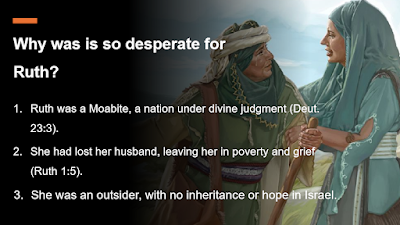
I would encourage you to read the full story of Ruth chapter's 1 - 4 as it's not a long read and it's important that you grasp the desperation and despair that is at stake here.
The book of Ruth is the story of tragic loss,
unimaginable grace, and God’s ability to redeem even the most broken of
circumstances. Ruth and her mother-in-law, Naomi, find themselves in a horribly
broken and hopeless situation as both of their husbands are dead, they are
separated from the people of God, and they have no prospects of financial
provision.
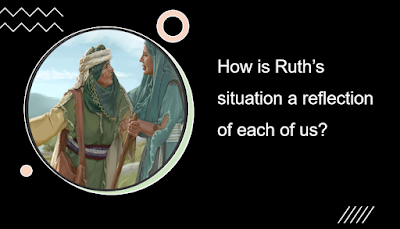
Have you been here? Are you here right now?
RUTH 1:1-5 and 4:13-22
Beginning & End
Naomi Widowed
1 In the days when the judges ruled there was
a famine in the land, and a man of Bethlehem in Judah went to sojourn in the
country of Moab, he and his wife and his two sons. 2 The name of the man was
Elimelech and the name of his wife Naomi, and the names of his two sons were
Mahlon and Chilion. They were Ephrathites from Bethlehem in Judah. They went
into the country of Moab and remained there. 3 But Elimelech, the husband of
Naomi, died, and she was left with her two sons. 4 These took Moabite wives; the
name of the one was Orpah and the name of the other Ruth. They lived there
about ten years, 5 and both Mahlon and Chilion died, so that the woman was left
without her two sons and her husband.
Ruth and Boaz Marry
13 So Boaz took Ruth, and she became his
wife. And he went in to her, and the Lord gave her conception, and she bore a
son. 14 Then the women said to Naomi, “Blessed be the Lord, who has not left
you this day without a redeemer, and may his name be renowned in Israel! 15 He
shall be to you a restorer of life and a nourisher of your old age, for your
daughter-in-law who loves you, who is more to you than seven sons, has given
birth to him.” 16 Then Naomi took the child and laid him on her lap and became his
nurse. 17 And the women of the neighborhood gave him a name, saying, “A son has
been born to Naomi.” They named him Obed. He was the father of Jesse, the
father of David.
The Genealogy of David
18 Now these are the generations of Perez:
Perez fathered Hezron, 19 Hezron fathered Ram, Ram fathered Amminadab, 20
Amminadab fathered Nahshon, Nahshon fathered Salmon, 21 Salmon fathered Boaz,
Boaz fathered Obed, 22 Obed fathered Jesse, and Jesse fathered David
The
Holy Bible: English Standard Version (Wheaton, IL: Crossway Bibles, 2016), Ruth
1:1-5, Ruth 4:13-22
Questions for Discussion:
How does Boaz’s role as a kinsman-redeemer
foreshadow Christ’s work of redemption?
How do we see God’s invisible hand at work in
the “coincidences” of Ruth’s story?
What does Ruth’s transformation from an
outsider to a covenant member teach us about the inclusion of Gentiles in God’s
redemptive plan?
Naomi’s suffering led to Ruth’s redemption — how
does this reflect the greater biblical theme of God using suffering for His
redemptive purposes?
How does Boaz’s willingness to redeem Ruth
contrast with the law’s inability to redeem, and how does this point us to
Christ?
Every parent knows the
painful repetition of this question being asked on a long road trip with
children. At this point, Joshua probably knows the same pain. Joshua came out
of Egypt with the people of Israel. Joshua had been a spy sent into Canaan to
scope out the land. Then, Joshua witnessed the people rebel against God, and he
had been subjected to wandering in the wilderness with the rebels for the past
forty years. All of that was changing, though. Now, the people of God had
finally arrived at the place that God had promised them. The people had crossed
over the Jordan River, and they were going to take what was theirs.
That was the plan anyway, until they came to
Jericho. Jericho was a great city in the Ancient Near East. It had the
reputation of being impenetrable and the capacity to survive any siege. In
short, Jericho was unconquerable to the army that had come to conquer it. It’s
safe to say that as the people of Israel approached Jericho, they had no idea
what they would do.
Repeatedly in the Bible, when the people of
God see no way forward, God shows up to reveal that His plan was never in
doubt.
What happens next is almost unbelievable.
The siege of Jericho involves
mighty warriors, mighty musicians, odd battle plans, and unexpected heroes who
point us in the direction of the true hero to come. The Battle of Jericho introduces
another “scarlet thread” that reminds us Jesus is here, even as the walls come
tumbling down.
Read Joshua 5:13-6:27 and make observations
about the this week's text.
The Commander of the Lord’s Army
13 When Joshua was by Jericho, he lifted up
his eyes and looked, and behold, a man was standing before him with his drawn
sword in his hand. And Joshua went to him and said to him, “Are you for us, or
for our adversaries?” 14 And he said, “No; but I am the commander of the army
of the Lord. Now I have come.” And Joshua fell on his face to the earth and
worshiped and said to him, “What does my lord say to his servant?” 15 And the
commander of the Lord’s army said to Joshua, “Take off your sandals from your feet,
for the place where you are standing is holy.” And Joshua did so.
The Fall of Jericho
6 Now Jericho was shut up inside and outside
because of the people of Israel. None went out, and none came in. 2 And the
Lord said to Joshua, “See, I have given Jericho into your hand, with its king
and mighty men of valor. 3 You shall march around the city, all the men of war
going around the city once. Thus shall you do for six days. 4 Seven priests
shall bear seven trumpets of rams’ horns before the ark. On the seventh day you
shall march around the city seven times, and the priests shall blow the trumpets.
5 And when they make a long blast with the ram’s horn, when you hear the sound
of the trumpet, then all the people shall shout with a great shout, and the
wall of the city will fall down flat, and the people shall go up, everyone
straight before him.” 6 So Joshua the son of Nun called the priests and said to
them, “Take up the ark of the covenant and let seven priests bear seven
trumpets of rams’ horns before the ark of the Lord.” 7 And he said to the
people, “Go forward. March around the city and let the armed men pass on before
the ark of the Lord.” 8 And just as Joshua had commanded the people, the seven
priests bearing the seven trumpets of rams’ horns before the Lord went forward,
blowing the trumpets, with the ark of the covenant of the Lord following them.
9 The armed men were walking before the priests who were blowing the trumpets,
and the rear guard was walking after the ark, while the trumpets blew
continually. 10 But Joshua commanded the people, “You shall not shout or make
your voice heard, neither shall any word go out of your mouth, until the day I
tell you to shout. Then you shall shout.” 11 So he caused the ark of the Lord
to circle the city, going about it once. And they came into the camp and spent
the night in the camp. 12 Then Joshua rose early in the morning, and the
priests took up the ark of the Lord. 13 And the seven priests bearing the seven
trumpets of rams’ horns before the ark of the Lord walked on, and they blew the
trumpets continually. And the armed men were walking before them, and the rear
guard was walking after the ark of the Lord, while the trumpets blew
continually. 14 And the second day they marched around the city once, and
returned into the camp. So they did for six days. 15 On the seventh day they
rose early, at the dawn of day, and marched around the city in the same manner
seven times. It was only on that day that they marched around the city seven
times. 16 And at the seventh time, when the priests had blown the trumpets,
Joshua said to the people, “Shout, for the Lord has given you the city. 17 And
the city and all that is within it shall be devoted to the Lord for
destruction. Only Rahab the prostitute and all who are with her in her house
shall live, because she hid the messengers whom we sent. 18 But you, keep
yourselves from the things devoted to destruction, lest when you have devoted
them you take any of the devoted things and make the camp of Israel a thing for
destruction and bring trouble upon it. 19 But all silver and gold, and every
vessel of bronze and iron, are holy to the Lord; they shall go into the
treasury of the Lord.” 20 So the people shouted, and the trumpets were blown.
As soon as the people heard the sound of the trumpet, the people shouted a
great shout, and the wall fell down flat, so that the people went up into the
city, every man straight before him, and they captured the city. 21 Then they
devoted all in the city to destruction, both men and women, young and old,
oxen, sheep, and donkeys, with the edge of the sword. 22 But to the two men who
had spied out the land, Joshua said, “Go into the prostitute’s house and bring
out from there the woman and all who belong to her, as you swore to her.” 23 So
the young men who had been spies went in and brought out Rahab and her father
and mother and brothers and all who belonged to her. And they brought all her
relatives and put them outside the camp of Israel. 24 And they burned the city
with fire, and everything in it. Only the silver and gold, and the vessels of
bronze and of iron, they put into the treasury of the house of the Lord. 25 But
Rahab the prostitute and her father’s household and all who belonged to her,
Joshua saved alive. And she has lived in Israel to this day, because she hid
the messengers whom Joshua sent to spy out Jericho. 26 Joshua laid an oath on
them at that time, saying, “Cursed before the Lord be the man who rises up and
rebuilds this city, Jericho. “At the cost of his firstborn shall he lay its
foundation, and at the cost of his youngest son shall he set up its gates.” 27 So
the Lord was with Joshua, and his fame was in all the land.
The
Holy Bible: English Standard Version (Wheaton, IL: Crossway Bibles, 2016),
Joshua 5:13 - 6:27.
Sermon Recap
Joshua and the Israelites have finally made
it into the Promised Land and through the first five chapters God is
intentionally preparing his people to conquer the land.
The Lord promised Joshua that the battle over
Jericho was already won.
Like the Israelites, God calls us to
surrender to His battle plan. He promises that through Jesus, we are already
victors!
As believers we are now called to participate
in battles with obedience, surrender, and worship
Just as God was faithful to give Israel the
victory over Jericho, He was gracious to save Rahab (along with her family)
because of her faith. Rahab the prostitute would be restored and used in God’s
redemptive plan.
Discussion Questions
How does Joshua’s encounter with the
Commander of the Lord’s army challenge our understanding of God’s authority and
our role in His plans?
What does the fall of Jericho teach us about
God's power and faithfulness, and how should this shape our trust in Him today?
In what ways does Rahab’s story reveal God’s
mercy and sovereignty, and how does it challenge our view of who can receive
God’s grace?
Why do you think God required Israel to
follow such an unusual battle plan, and what does this teach us about living in
obedience even when we don’t fully understand His ways?
How does this passage encourage us to
surrender control to God, and what specific areas of your life is He calling
you to trust Him with more fully?
The story of Jericho’s fall reminds us that
true victory comes not by human strength, but by trusting in God’s power and
obeying His commands. Joshua and the Israelites had to believe that God’s way —
marching, waiting, and shouting — was better than any military strategy they
could devise. Likewise, we are called to trust that God’s ways are higher than
ours, even when they seem unusual or difficult.
We live in a culture that tells many lies
about what faith should be. One prevailing lie about faith in our time is that
faith should be kept private. Culture tells us that faith should be kept to
yourself. It’s not something that should impact our lives.
God has a different idea of what faith should
look like. Our relationship with God should impact every single part of our
lives. Faith should be at the center of our lives, determining what the rest of
life looks like. In Deuteronomy 6, Moses instructs how faith should be dominant
in our lives.
Moses clarifies that what we believe is the
most important thing about us. Thus, he delivers the “Shema,” the cornerstone
of the Old Testament theology. “Hear O Israel, the Lord our God, the Lord is
one.” The declaration, though simple, is earth-shattering in its theological
implications. Moses clarifies that there is only one God, the Lord over all
things.
What is the response to such a serious
theological statement? As the people of God, we should love the Lord with all
our hearts, souls, minds, and strength. Later, a Jewish Rabbi will teach His
followers that this is the greatest commandment in the faith.
Believers should have a faith that is so
serious that they love the Lord more than they love anything else in the entire
world. That Rabbi’s name was Jesus. Listen today as we hear the
long-established words of our faith. Look at the Shema, and you will see that Jesus
is here, even in the Shema.
Bottom Line:
Your love for God determines your life for
God.
Sermon Recap:
Deuteronomy 6 is foundational to the
Israelite people and to us today. The “Shema” helped Israelites understand who
God was and understand their response.
One of the best ways to love God is by
remembering the Lord for who He is and what He has done for us.
Loving God requires us to love with
everything we have. This is a lifelong commitment.
Deuteronomy 6 teaches us that another way to
love God is by raising up the next generation to love the Lord.
Deuteronomy 6:1-15
“Now this is the commandment — the statutes
and the rules — that the Lord your God commanded me to teach you, that you may
do them in the land to which you are going over, to possess it, 2 that you may
fear the Lord your God, you and your son and your son’s son, by keeping all his
statutes and his commandments, which I command you, all the days of your life,
and that your days may be long. 3 Hear therefore, O Israel, and be careful to
do them, that it may go well with you, and that you may multiply greatly, as
the Lord, the God of your fathers, has promised you, in a land flowing with
milk and honey. 4 “Hear, O Israel: The Lord our God, the Lord is one. 5 You
shall love the Lord your God with all your heart and with all your soul and
with all your might. 6 And these words that I command you today shall be on
your heart. 7 You shall teach them diligently to your children, and shall talk
of them when you sit in your house, and when you walk by the way, and when you
lie down, and when you rise. 8 You shall bind them as a sign on your hand, and
they shall be as frontlets between your eyes. 9 You shall write them on the
doorposts of your house and on your gates. 10 “And when the Lord your God
brings you into the land that he swore to your fathers, to Abraham, to Isaac,
and to Jacob, to give you—with great and good cities that you did not build, 11
and houses full of all good things that you did not fill, and cisterns that you
did not dig, and vineyards and olive trees that you did not plant—and when you
eat and are full, 12 then take care lest you forget the Lord, who brought you
out of the land of Egypt, out of the house of slavery. 13 It is the Lord your
God you shall fear. Him you shall serve and by his name you shall swear. 14 You
shall not go after other gods, the gods of the peoples who are around you — 15 for
the Lord your God in your midst is a jealous God — lest the anger of the Lord
your God be kindled against you, and he destroy you from off the face of the
earth
The
Holy Bible: English Standard Version (Wheaton, IL: Crossway Bibles, 2016), Dt
6:1–15.
Discussion Questions:
Deuteronomy 6:4 says, ‘The Lord our God, the
Lord is one.’
How does recognizing God’s oneness shape the
way you prioritize Him in your daily life, especially when other ‘gods’ (like
work, hobbies, or relationships) compete for your attention?
In verse 5, we’re called to love God with all
our heart, soul, and might.
Which of these areas do you find easiest to
give to God, and which is hardest? What’s one step you could take to grow in
the harder area?
Verses 6-7 urge us to keep God’s words on our
hearts and teach them diligently to our children.
How have you seen faith passed down (or not)
in your own family or community? What’s one way you could be more intentional
about sharing God with the next generation?
Deuteronomy 6:10-12 warns against forgetting
God when life gets comfortable.
What’s a blessing in your life (like a home,
job, or family) that could tempt you to rely less on God? How can we keep
gratitude alive in those moments?
Jesus quotes the Shema in Mark 12:29-30 as
the greatest commandment.
How does His life and sacrifice deepen your
understanding of what it means to love God fully? How might that inspire you
this week?
Closing
Applying the Shema (Deuteronomy 6:4-9) to
daily life begins with anchoring our routines in the truth that “the Lord our
God, the Lord is one,” letting His singular authority shape our priorities.
Practically, we can love God with all our heart, soul, and might by starting
each day with prayer or Scripture, aligning our desires and energy toward Him —
perhaps reciting the Shema itself as a reminder. Throughout the day, we weave
His commands into ordinary moments: discussing a Bible verse over breakfast
with family, listening to worship music during a commute, or pausing to thank
Him before bed. For those influencing others, like children or friends, we
model this love by sharing what God’s teaching us — maybe explaining a faith
lesson during a walk or praying together at night. It’s not about perfection
but consistency, letting God’s Word dwell in us richly (Colossians 3:16) so
that our lives, from sunrise to sunset, reflect a wholehearted devotion to Him.
When many people think about the Bible, they
think about a book full of rules, a bunch of thou shall, and thou shall nots.
Most don’t realize that the Bible is much more than that. The Bible is the
story of how God is always working for the salvation and redemption of His
people. However, God, in His grace, doesn't leave us without any clue how to
live.
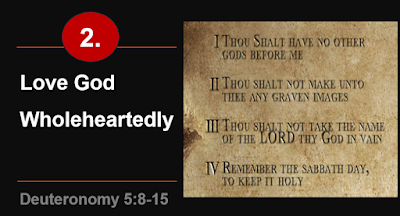
In the Ten Commandments, we have God’s rules
for how to live in a relationship with Him. Many people see these rules as
restrictive. God intends them to be anything but restrictive. God intends the
Ten Commandments to be freeing. When we walk in accordance with the Ten
Commandments, we experience the freedom of life in God's way. The Ten
Commandments function as boundaries that provide a safe space for us to run.
The Ten Commandments function as guard rails that keep us from catastrophe.
The problem with the Ten Commandments is that
we don’t have any power, in and of ourselves, to keep those rules. We know the
commandments, but so often, our hearts long for things outside of the
commandments, things the commandments forbid. The Christian does not just need
a list of rules, we need a Savior who can forgive us when we break the rules.
We need a Savior who can give us a new heart, a heart that wants to follow the
rules. Jesus does both things. Jesus forgives our sins when we break His law.
Then, Jesus gives us a heart that obeys the law because it loves the law. Jesus
is here, even in the Ten Commandments.
Bottom Line:
Our relationship with God leads
to our obedience
to His commands.
Deuteronomy 5:1-21
The Ten Commandments
Revisited
5 And Moses summoned all Israel and said to
them, “Hear, O Israel, the statutes and the rules that I speak in your hearing
today, and you shall learn them and be careful to do them. 2 The Lord our God
made a covenant with us in Horeb. 3 Not with our fathers did the Lord make this
covenant, but with us, who are all of us here alive today. 4 The Lord spoke
with you face to face at the mountain, out of the midst of the fire, 5 while I
stood between the Lord and you at that time, to declare to you the word of the
Lord. For you were afraid because of the fire, and you did not go up into the
mountain. He said: 6 “‘I am the Lord your God, who brought you out of the land
of Egypt, out of the house of slavery. 7 “‘You shall have no other gods before
me. 8 “‘You shall not make for yourself a carved image, or any likeness of
anything that is in heaven above, or that is on the earth beneath, or that is
in the water under the earth. 9 You shall not bow down to them or serve them;
for I the Lord your God am a jealous God, visiting the iniquity of the fathers
on the children to the third and fourth generation of those who hate me, 10 but
showing steadfast love to thousands of those who love me and keep my
commandments. 11 “‘You shall not take the name of the Lord your God in vain,
for the Lord will not hold him guiltless who takes his name in vain. 12 “‘Observe
the Sabbath day, to keep it holy, as the Lord your God commanded you. 13 Six
days you shall labor and do all your work, 14 but the seventh day is a Sabbath
to the Lord your God. On it you shall not do any work, you or your son or your daughter
or your male servant or your female servant, or your ox or your donkey or any
of your livestock, or the sojourner who is within your gates, that your male
servant and your female servant may rest as well as you. 15 You shall remember
that you were a slave in the land of Egypt, and the Lord your God brought you
out from there with a mighty hand and an outstretched arm. Therefore, the Lord
your God commanded you to keep the Sabbath day. 16 “‘Honor your father and your
mother, as the Lord your God commanded you, that your days may be long, and
that it may go well with you in the land that the Lord your God is giving you. 17
“‘You shall not murder. 18 “‘And you shall not commit adultery. 19 “‘And you
shall not steal. 20 “‘And you shall not bear false witness against your
neighbor. 21 “‘And you shall not covet your neighbor’s wife. And you shall not
desire your neighbor’s house, his field, or his male servant, or his female
servant, his ox, or his donkey, or anything that is your neighbor’s.’
The
Holy Bible: English Standard Version (Wheaton, IL: Crossway Bibles, 2016), Dt
5:1–21.
Sermon Recap:
God gives rules to follow only after he has
delivered His people. This makes clear that the 10 Commandments do not function
as our path to earn God’s approval. Rather, these are how we maintain our
relationship with the God who rescued us.
The 10 Commandments express how to best
relate to God and to others. Commandments 1-4 show how to best love God.
Commandments 5-10 show how to best love others.
The 10 Commandments allow humans to walk in
freedom. When we do life as God intended, life goes better.
The 10 Commandments leave us in despair.
Though we know we should obey these commands, we fail in obedience repeatedly.
The 10 Commandments reveal one great truth: we need a savior to forgive our sin
and empower our obedience.
Discussion Questions:
God’s Identity and Our Response (vv. 1-6):
"Verse 6 reminds us that God introduces
Himself as the One who brought Israel out of Egypt before giving the
commandments. How does knowing God as our rescuer — not just our rule-giver — change
the way we approach His commands in our lives today?"
Exclusive Devotion (vv. 7-11):
"The first three commandments call us to
worship God alone, avoid idols, and honor His name. In our modern world, what
are some ‘other gods’ or ‘idols’ that compete for our attention, and how can we
refocus on God instead?"
Sabbath as Gift (vv. 12-15):
"The Sabbath command ties rest to God’s
deliverance, setting it apart from just a day off.
How do you currently practice rest, and what
might it look like to make it a time to celebrate God’s freedom in your
life?"
Relationships and God’s Heart (vv. 16-21):
"The last six commandments protect our
relationships with others — family, neighbors, even enemies. Which of these
feels most challenging to you right now (e.g., honoring parents, avoiding
envy), and what’s one step you could take to align with God’s heart in that
area?"
Law and Grace Together (Whole Passage):
"Jesus said He came to fulfill the law,
not abolish it (Matthew 5:17). How do you see these commandments pointing us to
Jesus, and how does His grace help us live them out in a way the Israelites
couldn’t on their own?"
END
Teacher Notes:
Click Play to Watch
Mom - remember how it started, I was 5 years old,
and I stole my brother’s sweets? You didn’t correct me, and I remember when I
was 7 - the day I stole my neighbor’s toy and hid it at home, you said nothing.
And remember when I was 12 and I hid my cousin’s ball in the garage, when he came
to play with us at home and you said you didn’t see it, but you did.
Do you remember the day I was expelled from
school at 15? Dad wanted to punish me, but you said no and that very day you
had a big argument with dad because you were defending me. You said I was still
young, you said the teachers were wrong to say that I was not attending class. You
defended me, you said I was right, yet you knew I was wrong. Mom, do you remember
when you saw me steal our neighbor’s bicycle when I was 17, you didn’t tell
anyone I stole it, no – mom you were silent? You loved me so much, yes, you
loved me, but you didn’t correct me, instead you spoiled me. That is how it started,
and it graduated slowly until today when I will be executed for bank robbery
and murder.
Mom, I was just a kid and I needed guidance.
By the time you read this I will be gone. Yours truly, your loving son.