Our Prayer

Our Prayer

Heavenly Father, I know that I have sinned against You and that my sins separate me from You. I am truly sorry. I now want to turn away from my sinful past and turn to You for forgiveness. Please forgive me, and help me avoid sinning again. I believe that Your Son, Jesus Christ, died for my sins, that He was raised from the dead, is alive, and hears my prayer. I invite Jesus to become my Savior and the Lord of my life, to rule and reign in my heart from this day forward. Please send Your Holy Spirit to help me obey You and to convict me when I sin. I pledge to grow in grace and knowledge of You. My greatest purpose in life is to follow Your example and do Your will for the rest of my life. In Jesus' name I pray, Amen.

Thursday, June 21, 2018

Class Lesson June 24, 2018


THE BIBLE MEETS LIFE 

I bought a new car several years ago, and it drove perfectly. Now it’s fully paid for, and I’d like to keep driving it. Recently, it kept losing power and I thought I had major transmission problems. I attempted to diagnose the problem and even fix it myself, but that didn’t work out so well. After narrowly avoiding two accidents on the freeway, I took it to my mechanic. He found the problem: two small computer modules had gone bad (and cost $900 to fix!). Although I wanted to fix the problem myself, there was no way I could restore the car to its original operating standards by myself. 

I have an owner’s manual that tells me what “standard operation” looks like; in other words, how my car is supposed to perform. God also has a standard by which we are to operate: perfect obedience to Him. Adam and Eve lived perfectly for a short time, but then sin entered the picture; now we just can’t live up to God’s standard. 


We can’t fix our sin problem. We’re broken and we need help.


WHAT DOES THE BIBLE SAY? 

Deuteronomy 5:32-33 

32 “Be careful to do as the Lord your God has commanded you; you are not to turn aside to the right or the left. 33 Follow the whole instruction the Lord your God has commanded you, so that you may live, prosper, and have a long life in the land you will possess. 

Years ago when I was a student pastor, I took a group of students to summer camp along the Brazos River in central Texas. I gave the students specific instructions about hiking and established a clear standard of behavior for the week: stay on the trails! To venture off the trail could expose them to poison ivy and— worse!—several varieties of snakes. I instructed them to stay on the trails clearly marked for hiking. To do so would ensure them a safe and enjoyable time. 

God clearly wanted the Hebrews to enjoy His blessings, so He established a standard for how they should live in relationship to Him. He did not play hide-and-seek with His will; He gave them the law and made it very clear how He wanted them to live. “Be careful to do as the LORD your God has commanded you.” 

I am thankful God has given us the complete revelation of His Word so that we can clearly know His will. The Bible shows us how we can live and operate according to His standards. “You are not to turn aside to the right or the left” applies just as much to us today as it did to the Israelites. He wants us to stay on the narrow path that leads to blessing and salvation. 

So many of us know the Lord’s instructions. We have Bibles. We have pastors who teach God’s Word to us. We have Bible study leaders who help us explore God’s Word. Yet, even with all our knowledge, we don’t seem to be able to stay on the path. We turn to the right and left, ignore boundaries set by God, and wind up hurting others and ourselves in the process. We’re unable to live up to God’s holy standard.


Earlier in Deuteronomy 5, the Israelites had experienced a great encounter with God. God spoke the Ten Commandments to them. Out of fear, they asked Moses to go before God on their behalf, but they promised to do whatever God told him. “For who out of all mankind has heard the voice of the living God speaking from the fire, as we have, and lived? Go near and listen to everything the LORD our God says. Then you can tell us everything the LORD our God tells you; we will listen and obey” (vv. 26-27). 

Verbal commitments are commendable, but do they impress the Lord? The Israelites promised to listen and obey, but the proof of their love, reverence, and awe of the living God would be in how they lived.


Galatians 3:10-12 

10 For all who rely on the works of the law are under a curse, because it is written, Everyone who does not do everything written in the book of the law is cursed. 11 Now it is clear that no one is justified before God by the law, because the righteous will live by faith. 12 But the law is not based on faith; instead, the one who does these things will live by them. 

We’ve probably all been “fair weather fans” at one time or another. Born and raised in Texas, I am a fan of several Texas sports teams, including one professional football team that is known by the lone star on the players’ helmets. We have really high hopes for our team at the beginning of a season. We post images or comments in social media to show our support. We engage in playful banter with friends who cheer for other teams. But as the season goes by and losses accumulate, we realize our team isn’t invincible. When we realize they’ve been eliminated from post-season play, we lose heart. Disappointment sets in. We aren’t raving fans like we were at the beginning of the season. 


Something similar can happen in a spiritual sense. Remember the Israelites’ excitement at Mt. Sinai? Moses had received the law and God had carved the Ten Commandments onto stone tablets. The standard of the law was perfection, but the people thought they were ready. “We will listen and obey” (Deut. 5:27). Everyone was hopeful and the people promised God they would do right. 

It didn’t take long to realize it wasn’t going to be “a winning season.” As much as the people wanted to obey God, they couldn’t live up to the law’s standard, which was perfection. The law not only tells us how to live, but it tells us we are sinners. 

Sinner. That’s a hard label for some people to accept. At best, people often try to mask their sinful behavior by pointing out the things in their lives they consider good. But according to this passage, we are only good if we “do everything written in the book of the law” (Gal. 3:10). 

The law was designed to do more than tell us how to live. God intended it to show us the futility of thinking we are good enough to earn His favor. The law points us to the fact that we cannot live the kind of life we were intended to live—a life of perfect obedience. So if we can’t attain to the standard, what hope do we have? We live by faith in Jesus Christ, the One who lived the perfect standard for us. We will look further into this wonderful solution in the next session, but for the moment, let’s consider how the law points out our sinful imperfection while pointing us to seek the One who is perfect.


Galatians 3:19a, 24-25 

19a Why then was the law given? It was added for the sake of transgressions until the Seed to whom the promise was made would come. ............................. 24 The law, then, was our guardian until Christ, so that we could be justified by faith. 25 But since that faith has come, we are no longer under a guardian,


Earlier in Galatians 3, Paul pointed out that the law can’t give us the Holy Spirit, it can’t bring us into a right relationship with God, and it can’t save us; it can only pronounce our condemnation. (See vv. 10- 12.) Paul then proposed: If the law can’t do these things, “why then was the law given?” 

Paul gave one single reason: the law “was added for the sake of transgressions until the Seed to whom the promise was made could come.” The law convicted people of sin from the time it was given through the coming of Christ. For centuries after God gave the law at Mt. Sinai, the law instructed people they were unable to live up to God’s standard. The law faithfully taught that message to generations until Christ came. At that time a message of justification by faith in Jesus Christ, was proclaimed. 

Few of us have been in prison, but we have all been imprisoned. Trying to live by the law imprisoned us. “We were confined under the law, imprisoned until the coming faith was revealed” (v. 23). Paul described the law as “our guardian.” In Paul’s culture, a guardian was more than a nanny; he was more like a drill sergeant who kept those under his charge under control. 

Then came Christ, who lived the only perfect life and kept every part of the law. He fulfilled the law perfectly. (See Matt. 5:17.) The law ruled over us “until Christ” (Gal. 3:24). He kept the law we couldn’t, and by faith His perfect righteousness becomes ours! A life of failure can be replaced with a life of faith.


LIVE IT OUT


The story doesn’t stop with the truth that we are unable to live up to God’s holy standard. But what will you do with this truth? 

  • Seek forgiveness. Admit to God your sin and failures. At your absolute best, you’re still a sinner, so confess any and all sins. Thank Him for His grace and forgiveness in Christ. 
  • Stop trying. Evaluate your life for any actions you might think make you right before God. Self-righteousness might feel good, but it’s an illusion. You can only stand strong when you stand in Christ. Choose to rest in Christ and trust Him. 
  • Start encouraging. Encourage others to trust Christ instead of following a lot of rules or rituals to gain God’s favor. Help them see Christ has fulfilled the law for them, and they need only to trust Him. 

My car needed repair, but I could not do anything except trust my car in the hands of someone who could actually fix it. That’s our story. We’re broken and we need to trust our lives in the hands of Christ, the only one who can “fix” us.


Hope to see you on Sunday!

In His Love,

David & Susan


Teacher's Notes


WHY ARE WE HERE?


  1. God’s creation was orderly, with purpose, and according to His plan. We happen to be God’s treasured creation - created in His own image and likeness. And we are here to fulfill God’s purpose for our lives and to live in fellowship with Him through repentance and faith.
  2. But in last week’s lesson, we ruined a perfect relationship with God through our sin. And that’s why we’re in the mess we are in now. By prideful rebellion Adam and Eve broke God’s one law that He gave them in paradise. Was it because Adam/Eve ate an apple? Was it because Adam listened to his wife? Was it because of a snake? Was it a God Complex? Was it their Free Will? Was it because of Prideful Rebellion?
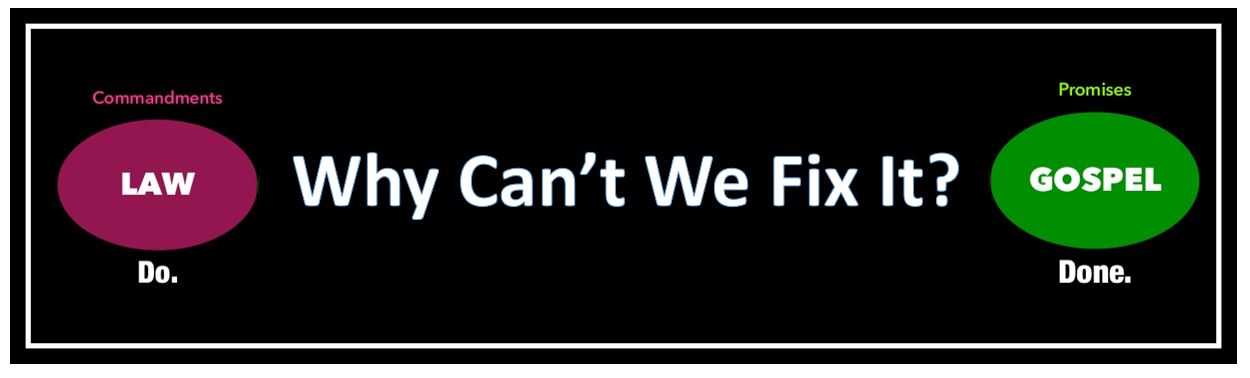
  3. Why Can't We Fix It?


It's Like It Never Happened

Adam and Eve probably wished they could have called ServePro after their SIN.


God also has a standard by which we are to operate: perfect obedience to Him. Adam and Eve lived perfectly for a short time, but then sin entered the picture; now we just can’t live up to God’s standard. We can’t fix our sin problem. We’re broken and we need help. Many of us seek to improve our lives and hope to make the world a better place. We think a certain way of living – an ideal standard – will get us there. But try as we may, we usually fail to live up to the ideal. We discover some things are easier said than done. Paul said in Romans 7:18 I know that nothing good lives in me, that is, in my flesh; for I have the desire to do what is good, but I cannot carry it out. 19For I do not do the good I want to do. Instead, I keep on doing the evil I do not want to do. 20And if I do what I do not want, it is no longer I who do it, but it is sin living in me that does it.…


Are we saved by what we do or by what Christ has done for us? It’s a question of faith versus works; grace versus the Law of Moses. The very heart of the gospel is at stake in the answer. 


I. God Established a Standard for Us to Live in Relationship to Him Deuteronomy 5:32-33 

32 “Be careful to do as the Lord your God has commanded you; you are not to turn aside to the right or the left. 33 Follow the whole instruction the Lord your God has commanded you, so that you may live, prosper, and have a long life in the land you will possess. 


a) God’s standard is clear. (Deut. 5:32-33) God loved His people so He provided a series of laws that would protect and guide them in their daily affairs, personal relationships, and reverence for God. These laws that we know as the Ten Commandments have become the basis for all civilizations. Keeping them enables people to live rightly with God and with one another. Once given, God instructed His people to be careful to live in accordance with each law and to focus intently on each one as the standard and guide for life. The people were to obey them completely. In return, God would give them an abundant, fruitful, and long life. God's best interest for His people was revealed in these laws. His love shows through each law. God is not vindictive, nor the ultimate joy stealer, by giving these laws. Their restrictions are for our relationships, health, and personal and corporate well-being. These laws reflect God’s compassion for all humanity. The proper response to these laws is reverence for God and obedience to His standard.


What are some things that cause us to turn to the right or left of where we know we should go?


God sets the standard by which He expects His people to live. We are to be determined to keep God’s Word by acting on it to the exact degree He expects. God blesses those who are faithfully obedient to His Word.


Why did God give the law?

1. The Law was given to separate God’s people from the evil nations around them and to define sin.

2. While the Law itself was good, it was weak in that it lacked the power to change a sinful heart (Romans 8:3).


II. We Sin and Are Incapable of Meeting God’s Standard                   Galatians 3:10-12 

10 For all who rely on the works of the law are under a curse, because it is written, everyone who does not do everything written in the book of the law is cursed. 11 Now it is clear that no one is justified before God by the law, because the righteous will live by faith. 12 But the law is not based on faith; instead, the one who does these things will live by them. 


b) Our character is flawed. (Gal. 3:10-12) The law demands 100% compliance all the time for all of life. The law demands that we do what the law commands. We must do all that the law commands. We must continue to do all the law commands. Living by the law isn’t a buffet where we pick and choose the rules we want to obey. Either we keep all the law all the time, or we'll never get to heaven by following the law. God doesn't grade on the curve. It's a simple Pass/Fail. Keep the law correctly 100% of the time, and we go to heaven. Mess up once, and we go to hell. That doesn't leave a significant margin for error. Unfortunately, no person can keep God's law entirely. As much as we would want to fulfill each one, we can't. No one can. The regulations not only provide a basis for a society that indicates the measurement of righteousness to be right with God and to gain entrance into heaven. Due to their exacting standard, all humanity is condemned by them. We fall short of the perfect standard. Our attempt at righteousness, though admirable, comes up short. And, as righteous as one may be, even one failure brings God’s judgment. As a result, all of humanity is cursed. “Cursed” is the divine sentence of death. We are rejected, judged, condemned, and sentenced to eternal death. It applies to everyone without exception. The whole human race is under a curse because of our failure to keep the law correctly. Apart from divine grace, we are all by nature spiritually dead, lost, separated from God, rejected and condemned. We are in a genuinely hopeless condition. The result is attempting to go to heaven on our merit. The law is like a chain; every link must be forged securely, or it will not support the person who clings to it for salvation. And, since our flaws and failures create chinks in the chain, it cannot assist us in our climb toward redemption. We cannot earn God’s blessing by being good or righteous. Instead, living by faith is the only hope, the only support by which salvation is granted. Works of the law do not justify us. Keeping the law does not save us. Faith in God saves us. Taking God at His Word and relying on it as trustworthy is what saving faith involves.


What is meant by the idea of being under a curse?


No one is able to live by the entirety of the law. Failure to live by the entirety of the law makes one subject to God’s wrath. Justification by keeping the law is impossible. Conforming to the law for eternal life is not a matter of trust but an inadequate attempt to accomplish what is beyond sinful, human ability. Faith is the way of justification; faithfulness is the practice of the justified. 


It was into this legalistic climate that Jesus came, and conflict with the hypocritical arbiters of the Law was inevitable. But Jesus, the Lawgiver, said, “Do not think that I have come to abolish the Law or the Prophets; I have not come to abolish them but to fulfill them” (Matthew 5:17). 


1. The Law served as a mirror to reveal the condition of a person’s heart (Romans 7:7). John 1:17 says, “For the law was given through Moses; grace and truth came through Jesus Christ.” Jesus embodied the perfect balance between grace and the Law (John 1:14).


III. The Law Gave a Temporary Provision Until Christ Came           Galatians 3:19a, 24-25 

19a Why then was the law given? It was added for the sake of transgressions until the Seed to whom the promise was made would come. ... 24 The law, then, was our guardian until Christ, so that we could be justified by faith. 25 But since that faith has come, we are no longer under a guardian,


3. The Law has value. (Gal. 3:19a, 24-25) Why did God give His law? What is its purpose? Paul answered the question with a simple, but perhaps, confusing phrase, “the sake of transgressions.” This phrase has three possible meanings: • To restrain from transgressions since all law has a restraining effect. Laws keep us from doing as we please or doing what feels good. Laws provide boundaries for our lives. They restrain us from hurting ourselves and others. Without laws, anarchy would prevail. • To reveal transgression, since the law shows where humans fail and fall short. Like an x-ray that reveals the cancer of sin, laws are the measuring sticks, the standard, that show where we miss the mark or get off the path or fail to live up to the stated rule. No matter how hard we try, we can never entirely keep the law. • To provoke transgression since humans tend to do what they’re instructed not to do. For example, when we see a sign that reads, "Don't walk on the grass!" We walk on the grass. Sometimes the law provokes us to break it, just because it is stated. Paul, furthermore, reminded his readers that the law was a temporary measure. The law as an instrument of righteousness, leading to salvation, and was designed to function until Jesus came. The law set the standard. Now, Jesus is the standard of and the way to salvation. In a sense, the law led to Christ. People could never keep the standard. They needed another way to God. Faith in God has always provided that way. The law had a regulatory purpose and a revelatory purpose, but never a redemptive mission. The law could never save. It led people to Christ. It prepared for the coming of Christ by showing that human righteousness was inadequate. All humanity needed righteousness only God could supply. 


What steps can we take to move beyond the law as we follow Christ?


The law reveals our sinfulness and our need for a savior. Christ came to free us from the demands of the law, none of which we are capable of meeting. This truth cannot be overstated: we are justified by faith in Christ alone.


The conflict between Jesus and the self-righteous arose immediately. Many who had lived for so long under the Pharisees’ oppressive system eagerly embraced the mercy of Christ and the freedom He offered (Mark 2:15). Some, however, saw this new demonstration of grace as dangerous: what would keep a person from casting off all moral restraint? Paul dealt with this issue in Romans 6: “What shall we say, then? Shall we go on sinning so that grace may increase? By no means! We are those who have died to sin; how can we live in it any longer?” (verses 1—2). Paul clarified what Jesus had taught: the Law shows us what God wants (holiness), and grace gives us the desire and power to be holy. Rather than trust in the Law to save us, we trust in Christ. We are freed from the Law’s bondage by His once-for-all sacrifice (Romans 7:6; 1 Peter 3:18).


Conclusion: The law condemns us because it arouses within us a desire to do the very thing we know is wrong. According to verse 24, that vicious cycle is broken when we are justified. At the moment we come to Christ for salvation, God declares us righteous and wipes away the record of our guilty disobedience. And that means the law can't keep us in the prison house of sin anymore. The law that condemned us now has no power over us. We are set free from the trap of trying to please God by our outward behavior. Salvation is true freedom. And it comes only to those who trust in Christ.


Question: "Law vs. grace—why is there so much conflict among Christians on the issue?"


Answer: One side says, “Salvation is by grace and grace alone.” The other side counters, “That idea leads to lawlessness. God’s righteous standard in the Law must be upheld.” And someone else chimes in with, “Salvation is by grace, but grace only comes to those who obey God’s Law.” At the root of the debate are differing views on the basis of salvation. The importance of the issue helps fuel the intensity of the discussion.


When the Bible speaks of “the law,” it refers to the detailed standard God gave to Moses, beginning in Exodus 20 with the Ten Commandments. God’s Law explained His requirements for a holy people and included three categories: civil, ceremonial, and moral laws. The Law was given to separate God’s people from the evil nations around them and to define sin (Ezra 10:11; Romans 5:13; 7:7). The Law also clearly demonstrated that no human being could purify himself enough to please God—i.e., the Law revealed our need for a Savior.

By New Testament times, the religious leaders had hijacked the Law and added to it their own rules and traditions (Mark 7:7–9). While the Law itself was good, it was weak in that it lacked the power to change a sinful heart (Romans 8:3). Keeping the Law, as interpreted by the Pharisees, had become an oppressive and overwhelming burden (Luke 11:46).

It was into this legalistic climate that Jesus came, and conflict with the hypocritical arbiters of the Law was inevitable. But Jesus, the Lawgiver, said, “Do not think that I have come to abolish the Law or the Prophets; I have not come to abolish them but to fulfill them” (Matthew 5:17). The Law was not evil. It served as a mirror to reveal the condition of a person’s heart (Romans 7:7). John 1:17 says, “For the law was given through Moses; grace and truth came through Jesus Christ.” Jesus embodied the perfect balance between grace and the Law (John 1:14).

God has always been full of grace (Psalm 116:5; Joel 2:13), and people have always been saved by faith in God (Genesis 15:6). God did not change between the Old and New Testaments (Numbers 23:19; Psalm 55:19). The same God who gave the Law also gave Jesus (John 3:16). His grace was demonstrated through the Law by providing the sacrificial system to cover sin. Jesus was born “under the law” (Galatians 4:4) and became the final sacrifice to bring the Law to fulfillment and establish the New Covenant (Luke 22:20). Now, everyone who comes to God through Christ is declared righteous (2 Corinthians 5:21; 1 Peter 3:18; Hebrews 9:15).

The conflict between Jesus and the self-righteous arose immediately. Many who had lived for so long under the Pharisees’ oppressive system eagerly embraced the mercy of Christ and the freedom He offered (Mark 2:15). Some, however, saw this new demonstration of grace as dangerous: what would keep a person from casting off all moral restraint? Paul dealt with this issue in Romans 6: “What shall we say, then? Shall we go on sinning so that grace may increase? By no means! We are those who have died to sin; how can we live in it any longer?” (verses 1—2). Paul clarified what Jesus had taught: the Law shows us what God wants (holiness), and grace gives us the desire and power to be holy. Rather than trust in the Law to save us, we trust in Christ. We are freed from the Law’s bondage by His once-for-all sacrifice (Romans 7:6; 1 Peter 3:18).

There is no conflict between grace and the Law, properly understood. Christ fulfilled the Law on our behalf and offers the power of the Holy Spirit, who motivates a regenerated heart to live in obedience to Him (Matthew 3:8; Acts 1:8; 1 Thessalonians 1:5; 2 Timothy 1:14). James 2:26 says, “As the body without the spirit is dead, so faith without deeds is dead.” A grace that has the power to save also has the power to motivate a sinful heart toward godliness. Where there is no impulse to be godly, there is no saving faith.

We are saved by grace, through faith (Ephesians 2:8–9). The keeping of the Law cannot save anyone (Romans 3:20; Titus 3:5). In fact, those who claim righteousness on the basis of their keeping of the Law only think they’re keeping the Law; this was one of Jesus’ main points in the Sermon on the Mount (Matthew 5:20–48; see also Luke 18:18–23).

The purpose of the Law was, basically, to bring us to Christ (Galatians 3:24). Once we are saved, God desires to glorify Himself through our good works (Matthew 5:16; Ephesians 2:10). Therefore, good works follow salvation; they do not precede it.

Conflict between “grace” and the “Law” can arise when someone 1) misunderstands the purpose of the Law; 2) redefines grace as something other than “God’s benevolence on the undeserving” (see Romans 11:6); 3) tries to earn his own salvation or “supplement” Christ’s sacrifice; 4) follows the error of the Pharisees in tacking man made rituals and traditions onto his doctrine; or 5) fails to focus on the “whole counsel of God” (Acts 20:27).

When the Holy Spirit guides our search of Scripture, we can “study to show ourselves approved unto God” (2 Timothy 2:15) and discover the beauty of a grace that produces good works.


Thursday, June 14, 2018

Class Lesson June 17, 2018


THE BIBLE MEETS LIFE
Do you have a favorite game you like to play? Mine is Monopoly. My wife objects to my strategy. I tuck away a few of the larger bills I’ve earned when she isn’t looking. She sells properties to me thinking I have no money to spend on houses or hotels. But as soon as she sells me her properties, I pull out my hidden money and it’s “game over.” She blames me for cheating. I blame her for not catching my stealth like moves. We teasingly point fingers at each other.

You may have noticed the world we live in isn’t a perfect place. But it was in the beginning. God created a sinless, spectacular world for us to enjoy. Adam and Eve chose to ignore His instructions for living, and sin entered the world. Adam blamed Eve. Eve blamed the serpent. Adam even tried to blame God! Adam and Eve played the “blame game.”

Our world is in a mess because we sinned against God. Sin always devastates. Our condition is nobody’s fault but our own. We should point fingers at ourselves.


WHAT DOES THE BIBLE SAY?

Genesis 3:1-7
1 Now the serpent was the most cunning of all the wild animals that the Lord God had made. He said to the woman, “Did God really say, ‘You can’t eat from any tree in the garden’? ” 2 The woman said to the serpent, “We may eat the fruit from the trees in the garden. 3 But about the fruit of the tree in the middle of the garden, God said, ‘You must not eat it or touch it, or you will die.’” 4 “No! You will not die,” the serpent said to the woman. 5 “In fact, God knows that when you eat it your eyes will be opened and you will be like God, knowing good and evil.” 6 The woman saw that the tree was good for food and delightful to look at, and that it was desirable for obtaining wisdom. So she took some of its fruit and ate it; she also gave some to her husband, who was with her, and he ate it. 7 Then the eyes of both of them were opened, and they knew they were naked; so they sewed fig leaves together and made coverings for themselves.

Things went great—perfectly!—in Genesis 1–2, but someone new showed up in chapter 3. The serpent appeared and was characterized as “cunning”. The Hebrew word is not necessarily positive or negative, so we might wonder initially if this was a good character or a bad one. Snakes were categorized as unclean animals because they crawled on the ground on their bellies. (See Lev. 11:42.) In the early moments of Raiders of the Lost Ark, Indiana Jones declared “I hate snakes, Jock, I hate ‘em!” to his pilot friend. The Hebrews would have felt similarly about snakes. Snakes were a source of uncleanness.

I love a good movie, and musical scores let us know when something bad is about to happen. When we watch Jaws, every time we hear that low, rhythmic bass sound start to crescendo, we know the shark is about to attack. But in the garden in Genesis 3, Eve was neither in a movie, nor did she hear music to warn her what was about to happen. Eve heard nothing, and she had nothing to fear. Or so she thought.


The sly serpent cut right to the chase. No time for small talk. His very first words fit his description of “cunning.” The serpent knew very well Adam and Eve could eat from any tree except one. (See Gen. 2:16-17.) Feigning naiveté, however, the serpent asked what seemed to be an innocent question, but he had sinister intent. “Did God really say, ‘You can’t eat from any tree in the garden’?” (Cue the shark music.) The serpent wanted to introduce a thought into Eve’s mind. He wanted her to believe God was withholding important information from the first couple.

The first couple sinned by failing to keep God’s command concerning “the tree of the knowledge of good and evil” (2:17). God’s command—His will for us—is always right. His will for us is grounded in His love for us, so anything we choose that is outside His loving will for us is sin. We experience life at its fullest when we obey God, but when we step outside of obedience and trust, we sin. We face consequences. “The wages of sin is death” (Rom. 6:23). As we will see, Adam, Eve, and the serpent will all face consequences for their roles in disobeying God.

Genesis 3:14-15
14 So the Lord God said to the serpent: Because you have done this, you are cursed more than any livestock and more than any wild animal. You will move on your belly and eat dust all the days of your life. 15 I will put hostility between you and the woman, and between your offspring and her offspring. He will strike your head, and you will strike his heel.

Talk about a mess! Fingers were pointing. Accusations were flying. Adam blamed Eve for their sin. Adam blamed God for giving him Eve in the first place. (See Gen. 3:12.) Eve blamed the serpent for deceiving her. (See v. 13.)


Sin had entered God’s perfect world. God’s relationship with mankind had changed. Adam’s relationship with his wife had changed. Eve’s relationship with her husband had changed. Everything had changed. And all the while, Satan knew he’d accomplished his goal.

God responded by pronouncing a curse against the serpent. We find nothing redemptive in God’s address to Satan. Only judgment awaited the cunning one who tempted humanity into sin. Many consider verse 15 to be the first prophetic verse in the Bible. A descendant of Eve would ultimately deliver a fatal blow against the serpent. Jesus would deliver Satan’s ultimate doom.


Genesis 3:16-19
16 He said to the woman: I will intensify your labor pains; you will bear children with painful effort. Your desire will be for your husband, yet he will rule over you. 17 And he said to the man, “Because you listened to your wife and ate from the tree about which I commanded you, ‘Do not eat from it’: The ground is cursed because of you. You will eat from it by means of painful labor all the days of your life. 18 It will produce thorns and thistles for you, and you will eat the plants of the field. 19 You will eat bread by the sweat of your brow until you return to the ground, since you were taken from it. For you are dust, and you will return to dust.”

While God cursed Satan and the ground, He issued no curse against the woman or the man. Yes, He did punish them, but He did not curse them. Thus, we are left with the hope of redemption and blessing. The punishment God declared over Eve was two-fold.


  • The pain of childbearing would increase greatly. I was present when my wife delivered both of our sons. Labor is difficult, even with the help of medications to reduce the pain.

  • Eve’s desire would be for her husband, and “he will rule over you.” Although this could mean that her sexual desires would overpower her in spite of the pain of childbearing, it more likely means her inability to rule over or somehow control her husband would be a constant source of frustration. Adam would be God’s appointed leader in the home, exercising leadership over her. Husbands and wives were thus locked in an ongoing struggle for control.

Adam was not immune from judgment. God declared that man would be in conflict, not cooperation, with the ground. No longer would man easily tend the garden with its fruit-producing trees. Instead, the land would require constant vigilance. It would “produce thorns and thistles” requiring hard, painful labor. Man would eat, but he would not eat easily.


We experience the consequences of our sin—even when God forgives the sin itself.

Why are we in the mess we’re in? We’re in it because of sin. When Adam and Eve sinned, we—the descendants of this first couple— were forever changed. We’re now born with a sin nature. That sin nature leads us to naturally choose sin; it’s who we are.

We’re sinners who need a new nature. We are people who need new hearts—hearts that choose God’s Word and God’s ways. Thankfully, there is a solution to our sin problem. God loves us and He would not leave us in this helpless state. Although Satan slithered his way into the garden and led Adam and Eve astray, God was not caught off guard. God knew this would happen, so He planned a response to our sin.


LIVE IT OUT
We’re in a mess because we chose to sin instead of following God’s way. We can point fingers, or we can point to solutions.

  • Memorize 1 John 1:9. Our sins can be forgiven if we confess them to God. Memorize 1 John 1:9 as a promise and source of encouragement as you confess your sins to God: ”If we confess our sins, he is faithful and righteous to forgive us our sins and to cleanse us from all unrighteousness.”                                                                                                                                           
  • Seek forgiveness. If your sin involves someone else, ask their forgiveness. Seek to make amends for your part in hurting another person or harming your relationship.                                                                                                
  • Avoid sin. If certain sins are a constant struggle for you, determine what makes it easy for you to give in to the temptation. Make a plan for removing those things from your life. If specific individuals encourage or enable your sin, stop associating with them.


God created a paradise for us to enjoy, but we messed it up. Rejoice that God is gracious and had a plan to redeem us!


Hope to see you on Sunday!

In His Love,

David & Susan

Teacher Notes:


Last week, we opened this series with the question: Why Are We Here?

The story is told of a rich man who was determined to give his mother an epic birthday present. He read of a bird that had a vocabulary of 4000 words, could speak in numerous languages and sing 3 operatic arias. He immediately bought the bird for $50,000 and had it delivered to his mother. The next day he phoned to see if she had received the bird. "What did you think of the bird?" he asked. She replied, “It was delicious.” 

Not knowing the purpose of something can be costly. And I suppose in the case of the bird, it was deadly. Many people are overwhelmed by the vastness of our universe and the beauty of the stars. Yet somehow, we still conclude that everything is about us.

We talked last week about our distractions to this truth? What do you need to put into the pouch?

· The biggest distraction being ourselves.

1. God’s creation was orderly, with purpose, and according to His plan.

2. We happen to be God’s treasured creation - created in His own image and likeness. 

3. But we are here to fulfill God’s purpose for our lives and to live in fellowship with Him through repentance and faith.

This week, we turn to the mess our world is in today and how it all began. We are surrounded by adversity and tragedy. However, that was not God’s design from the beginning of creation. So, what went wrong?

WHY ARE WE IN THIS MESS?

We ruined a perfect relationship with God through our sin.


I. We sin when we fail to keep God’s commands                                           Genesis 3:1-7 

1 Now the serpent was the most cunning of all the wild animals that the Lord God had made. He said to the woman, “Did God really say, ‘You can’t eat from any tree in the garden’?” 2 The woman said to the serpent, “We may eat the fruit from the trees in the garden. 3 But about the fruit of the tree in the middle of the garden, God said, ‘You must not eat it or touch it, or you will die.’” 4 “No! You will not die,” the serpent said to the woman. 5 “In fact, God knows that when you eat it your eyes will be opened and you will be like God, knowing good and evil.” 6 The woman saw that the tree was good for food and delightful to look at, and that it was desirable for obtaining wisdom. So she took some of its fruit and ate it; she also gave some to her husband, who was with her, and he ate it. 7 Then the eyes of both of them were opened, and they knew they were naked; so they sewed fig leaves together and made coverings for themselves. 


Why didn't Adam and Eve find it strange that a serpent was talking to them?


A God Complex


Vince Lombardi coached the Green Bay Packers during their glory years of the 1960s. He had a monstrous ego, unlimited confidence, and an arrogant pride that was not always healthy. All sorts of stories exist about him—some true, some fiction. One story tells when he was in a championship playoff. His wife was not able to attend the game for some reason, and that disappointed Vince. No one thought the Packers were going to win, but against all the odds, they won the game. You can imagine the coach's exhilaration. When he came home, his wife was already asleep. He tried to slip into bed without awakening her. But when his cold feet touched her legs, she said, "God, your feet are cold." Instantly, Lombardi replied, "When we are in bed, just call me Vince." 

How do we try to be like God?

As a joke, I often say that someone suffers from the god complex when he wakes up and says, “OK God, you can go back and rest, I am awake now.” A god complex is an unshakable belief characterized by consistently inflated feelings of personal ability, privilege, or infallibility.


1. Humans are not God. (vv. 1-5) Let’s be clear: God is God; we are not. When we proudly step into God’s shoes, we discover that it’s a bad fit. Just as when a three-year-old girl tromps around the house in her Daddy's shoes, it doesn't work so well. We might think it's cute, but to let the child live her life in shoes too big would be disastrous. Mohammed Ali in his hey-day was always proclaiming, "I am the greatest." Once he boarded an airplane, refusing to buckle his seat belt. The flight attendant came by and said, "Mr. Ali, you will have to put on your seatbelt before we can take off." "Superman doesn't need no seat belt," Ali replied. The flight attendant, weighing no more than a hundred pounds dripping wet, said in her soft voice, "Superman don't need no airplane either." We are not God. The sooner we come to that realization and stop trying the better off we will be. 

I suppose, if we are honest with ourselves, there are times when we all think we are God. Or, at least, we want to be God. We want to exhibit our power, flaunt our egos, seize center stage, and commandeer the throne to control our little world. The sin of our first parents, Adam and Eve, was the desire to be like God. Satan’s hook, “You will be like God,” (v. 5) had scored its mark. Adam and Eve did eat the fruit, and the rest is, shall we say sinful history. When we desire to be like God, we discover why we are in this mess.


2. Disobedience leads to sin. (v. 6) Adam and Eve disobeyed God. They went against His will and His command. They ate from the tree they had been instructed to avoid. Sin first and foremost is disobedience against the will, commands, and nature of God. Sin is more like the act of a traitor than that of a criminal. A criminal violates the law; a traitor violates his citizenship. Sin is far worse than breaking the law. It is breaking the relationship with God. Someone once said, “Sin is a raised hand, a clenched fist, a blow in the face of God.” Sin is the only thing that can defile our fellowship with God. That disobedience has fatal consequences. 


3. Innocence is lost. (v. 7) Up until this moment, nothing but innocence was flowing through the bloodstream of humankind. Adam and Eve enjoyed perfect communion. They were the recipients of God’s blessing. They were a delight to each other and God. In the moment of sin, innocence was lost. At that awful moment, Adam and Eve yielded to temptation, and wickedness entered the human heart. Deception contaminated the human bloodstream. Depravity intercepted innocence. It was a sad day for them and for all of humanity that followed.

We experience life at its fullest when we obey God, but when we step outside of obedience and trust, we sin. We face consequences. “The wages of sin is death” (Rom. 6:23). As we will see, Adam, Eve, and the serpent will all face consequences for their roles in disobeying God. 

Temptation may come in a variety of forms. It is not a sin to be tempted; the sin is in giving in to it. Sin is any violation of God’s Word. God’s prohibitions are given to us with our best interests in mind. Sin leads to guilt and shame. Human beings attempt to cover their sin, guilt, and shame through their own efforts.


II. The serpent will ultimately be defeated                                                Genesis 3:14-15 

14 So the Lord God said to the serpent: Because you have done this, you are cursed more than any livestock and more than any wild animal. You will move on your belly and eat dust all the days of your life. 15 I will put hostility between you and the woman, and between your offspring and her offspring. He will strike your head, and you will strike his heel. 

How did God provide hope in the middle of Eden’s mess?

Satan and sin are subject to the authority of God and will ultimately be defeated. God has always had a plan to deal with our sin, for we cannot cover it ourselves. Ultimately, the promise of Genesis 3:15 found fulfillment in the sending of Jesus as Savior and the destruction of the great deceiver (Rev 20:10). 


4. Sin will be defeated. (vv. 14-15) Dr. John Phillips wrote, "Sin did not begin on earth; it began in heaven. The mystery of iniquity did not originate in the heart of a human being. It had its source in the breast of an angelic being of the highest order. It entered the Garden of Eden full grown, introduced there by Satan disguised as a serpent. Three chapters in from the beginning of the Bible the serpent appears for the first time; three chapters from the end of the Bible he is seen for the last time. The results of his work are seen on every page between." While Satan and his dastardly deeds run rampant, sin will not have the last word. 


III. We experience the consequences of our sin                                        Genesis 3:16-19 

16 He said to the woman: I will intensify your labor pains; you will bear children with painful effort. Your desire will be for your husband, yet he will rule over you. 17 And he said to the man, “Because you listened to your wife and ate from the tree about which I commanded you, ‘Do not eat from it’: The ground is cursed because of you. You will eat from it by means of painful labor all the days of your life. 18 It will produce thorns and thistles for you, and you will eat the plants of the field. 19 You will eat bread by the sweat of your brow until you return to the ground, since you were taken from it. For you are dust, and you will return to dust.” 


Why is it good for sin to have consequences?


5. Pain entered the world because of sin. (vv. 16-19) Due to Adam and Eve’s actions, sin entered the world and along with it came the consequences of their disobedience. As a result, humans experience pain, toil, hardship, suffering, and punishment. Sin, while momentarily enjoyed, has a destructive and dark side. It contaminates our relationship with God, those we love, and our inner harmony and peace. Tony Campolo stated, “Each of us comes into the world with a predisposition to live in such a way as to inflict pain on those who love us most, and to offend the God who cares for us infinitely.” Sin defeats us, brings on discouragement, causes doubt, dishonors God and those we love, disgraces us, and ultimately leads to death. Sin is a fatal disease. It sentences us to a slow and painful death. Sin does to a life what shears do to a flower. A cut of the stem separates a flower from the source of life. The flower may look attractive, colorful and robust. But watch the blossom over a period, the leaves will wilt, and the petals will drop. No matter what you do, the flower will never live again. Just as a dead flower has no life, a dead body has no life. We humans with sin defects have no life. Cut off from God, the soul withers and dies. The consequence of sin is not a bad day or a bad mood but a dead soul. Try as we might to look alive, we are dead in our sins. Conclusion: Though these realities appear to communicate bad news, there’s hope. An answer exists for our sin condition. The stage is being set for the grace and redemption needed to deal with our sin.


Sinful actions have their consequences. sin alienates our relationships with others and with the Lord. Sin brings God’s judgment and leads to death. The Lord provides for our redemption from sin and gives us hope of eternal life.


Why are we in the mess we’re in? 

· We’re in it because of sin. When Adam and Eve sinned, we—the descendants of this first couple— were forever changed. We’re now born with a sin nature. That sin nature leads us to naturally choose sin; it’s who we are. 

· We’re sinners who need a new nature. We are people who need new hearts—hearts that choose God’s Word and God’s ways. Thankfully, there is a solution to our sin problem. God loves us and He would not leave us in this helpless state. Although Satan slithered his way into the garden and led Adam and Eve astray, God was not caught off guard. God knew this would happen, so He planned a response to our sin.


LIVE IT OUT

Many people still are searching for ways to make themselves more than they are. In doing so, they take matters into their own hands rather than trust what God has to offer. Ambition and having aspirations are not wrong in themselves, but when they contradict or ignore God’s Word, they become sin against God. When we sin against God, we will find ourselves in a mess, for we have to deal with the consequences that accompany it.

We’re in a mess because we chose to sin instead of following God’s way. God created a paradise for us to enjoy, but we messed it up. Rejoice that God is gracious and had a plan to redeem us!

Based on this study, how would you define sin?

How is an attitude of rebellion against God essentially an expression of an individual’s personal, selfish pride?


The First Sin

Often when Christians think of the first sin, they think of Adam and Eve and the Fall in the Garden of Eden. While this is indeed the first human sin, it is not the first recorded sin in Scripture. As Christians, we know that the serpent tempted Eve, but we often forget that the devil’s fall from grace was what set the stage for humankind’s fall, both as antecedent and type.

We catch a glimpse of Satan’s fall in the following passage, prophetically directed at the king of Tyre, but in this portion, apparently meant to include someone apart from humanity (specifically referred to as a cherub) who had been in the Garden of Eden, the prophecy turns into a description of an angel, namely Lucifer:

Ezekiel 28:14–15 You were the anointed cherub who covers; I established you; You were on the holy mountain of God; You walked back and forth in the midst of fiery stones. You were perfect in your ways from the day you were created, till iniquity was found in you.


What was the first sin? 

We learn about it and Satan’s fall from Isaiah 14:12–15: How you are fallen from heaven, O Lucifer, son of the morning! How you are cut down to the ground, You who weakened the nations! For you have said in your heart: ‘I will ascend into heaven, I will exalt my throne above the stars of God; I will also sit on the mount of the congregation On the farthest sides of the north; I will ascend above the heights of the clouds, I will be like the Most High.’ Yet you shall be brought down to Sheol, To the lowest depths of the Pit.


It is obvious from the text that Satan’s sin was pride. He was so beautiful, so wise, and so powerful as an angel that he began to covet God’s position and authority. He chafed at having to serve God and grew angry and rebellious. He did not want to serve, he wanted to be served; he, as a creature, wanted to be worshiped. How starkly contrasted to our savior Jesus Christ, who came not to be ministered unto, but to minister and to give his life a ransom for many (Mark 10:45).


How did Satan’s prideful rebellion and subsequent fall impact humankind’s first sin? Look at some passages in Proverbs that talk about the sin of pride and what effect it produces.


· Proverbs 16:18 Pride goes before destruction, and a haughty spirit before a fall.

· Proverbs 11:2 When pride comes, then comes shame; But with the humble is wisdom.

· Proverbs 18:12 Before destruction the heart of a man is haughty, And before honor is humility.

Here it is evident that pride literally went before the fall, both the fall of Satan and the fall of man. Pride causes shame, loss of wisdom, destruction, and ruin. If one were to summarize what actually happened as Adam and Eve were kicked out of the Garden of Eden, would not these passages describe their mental and physical condition exactly? The shame of committing sin against God, physical disease, pain and death looming on the horizon, loss of fellowship with God, and the fight to eke out a living from the cursed ground—all these are the outworking of the sin of pride.

So, what was Adam and Eve’s sin? Wasn’t it just disobedience by eating the forbidden fruit? Well, yes, that was the physical act that solidified what had already occurred in their minds and hearts. But let’s take a closer look at the passages in Genesis to see what the real sin was and where it started.

Genesis 3:1–7 Now the serpent was more cunning than any beast of the field which the Lord God had made. And he said to the woman, “Has God indeed said, ‘You shall not eat of every tree of the garden’?” And the woman said to the serpent, “We may eat the fruit of the trees of the garden; but of the fruit of the tree which is in the midst of the garden, God has said, ‘You shall not eat it, nor shall you touch it, lest you die.’” Then the serpent said to the woman, “You will not surely die. For God knows that in the day you eat of it your eyes will be opened, and you will be like God, knowing good and evil.”  So, when the woman saw that the tree was good for food, that it was pleasant to the eyes, and a tree desirable to make one wise, she took of its fruit and ate. She also gave to her husband with her, and he ate. Then the eyes of both of them were opened, and they knew that they were naked; and they sewed fig leaves together and made themselves coverings.

Genesis 3:12–13 Then the man said, “The woman whom You gave to be with me, she gave me of the tree, and I ate.” And the Lord God said to the woman, “What is this you have done?” The woman said, “The serpent deceived me, and I ate.”

Let’s analyze what really happened in verses 1–7. First Satan questioned God’s word, then he openly lied to Eve, contradicting what God had said. Then he used the tantalizing bait that humanity could be more like God by having their eyes opened, knowing things they currently didn’t know. The real heart of the situation is the statement that Eve thought the tree was good for food and desirable to make one wise. Why would she think this? God himself had told Adam (and either God himself or Adam had told Eve) that eating from the tree would only lead to death. Why would she (and subsequently Adam) accept the word of a talking serpent over the word of God? Only doubt of God’s word and subsequently God’s motives could have led to this tragedy.


THEY DIDN’T JUST IGNORANTLY DECIDE TO EAT THE FRUIT, NOR DID THEY EAT IT BECAUSE “THE DEVIL MADE THEM DO IT.”


They didn’t just ignorantly decide to eat the fruit, nor did they eat it because “the devil made them do it.” Satan’s outright lies and cunning half-truths brought something to the surface of Eve’s mind that fateful day. She realized that to “be like gods” meant not having to serve God, it meant being equal to God. It meant that she felt as if God had deliberately kept her and Adam in the dark regarding their “divine potential.” Why should they tend God’s garden in Eden when they could be as gods themselves? Why should they have to obey God if they were also gods? The quickness with which Adam acquiesced to Eve’s offer of the fruit may possibly show that he too harbored these same feelings, or it may mean that Adam, though knowing Eve had sinned willfully decided to throw his lot in with her by deliberately eating from the fruit. Eve had been deceived, Adam had not. In any event, we know that it was Adam’s sin that was responsible for the fall and the curse (Romans 5:12). The sin of pride that led to Satan’s fall had now infected the hearts and minds of Adam and Eve, and the result was the same: shame, loss of wisdom, ruin, and death.

In verses 12 and 13, we see Adam and Eve’s response to God’s question. We see the sin of pride showing through in their replies. This isn’t just a pass-the-buck response on their part; look at whom they really blamed for their actions: “The serpent deceived me,” said Eve; “The woman you gave to be with me enticed me,” said Adam. They almost seem to say that if they had been God things would have been different; therefore, it’s all God’s fault. These are not the responses of broken and contrite hearts, they are the responses of a proud and willful people caught in the act of rebellion against God.

What is still man’s most prevalent sin? Little has changed since the fall. Man is still a creature consumed with pride. We read in Romans 1:18–21 the current condition of mankind:

For the wrath of God is revealed from heaven against all ungodliness and unrighteousness of men, who suppress the truth in unrighteousness, because what may be known of God is manifest in them, for God has shown it to them. For since the creation of the world His invisible attributes are clearly seen, being understood by the things that are made, even His eternal power and Godhead, so that they are without excuse, because, although they knew God, they did not glorify Him as God, nor were thankful, but became futile in their thoughts, and their foolish hearts were darkened.

Why does mankind suppress the truth? Why does he not glorify God? Why is he so unthankful? Why is his imagination vain and his heart darkened? Because he does not glorify God as God. Mankind wants to glorify himself as God. We want to be the sole decision maker and sole authority in our life. We want nothing to do with a creator God to whom we should owe allegiance. If only we could come up with some natural explanation for everything we see around us, if only we could ignore our conscience, if only we could forget past history that clearly shows divine intervention, then we could rationalize away God and make gods of ourselves. Isn’t this exactly what we see today? Now we have evolution, moral relativism, humanism, revisionist history, and all other attempts to willfully hold God’s revealed truth at arm’s length. Truly our sinful human pride knows no bounds!

The Lord knows where his creatures are most prone to err, and pride is a many-headed hydra that infects all of humanity. In fact, we could make a case for pride being the fountainhead of all other sins. Anger, hate, jealousy, and ingratitude all stem from pride; something we wanted to happen did not happen and we feel offended, our pride is wounded, and our emotions are stirred to cause us to act sinfully. One could even make the case that “the love of money is the root of all [kinds of] evil” passage in 1 Timothy 6:10 really deals with the sin of pride as well. We know that covetousness is the same as idolatry (Ephesians 5:5), and idolatry is the sin of creating our own god by being too proud and stubborn to worship the True God. Consider the following verses in Proverbs that reflect God’s attitude toward pride.


Proverbs 6:16–19 These six things the Lord hates, Yes, seven are an abomination to Him: A proud look, A lying tongue, Hands that shed innocent blood, A heart that devises wicked plans, Feet that are swift in running to evil, A false witness who speaks lies, And one who sows discord among brethren.


Proverbs 8:13 The fear of the Lord is to hate evil; Pride and arrogance and the evil way and the perverse mouth I hate.

On God’s list of the top seven most heinous sins, pride comes in at number one! In verse 13 we see that the fear of the Lord is equated with hating pride and arrogance. If we allow pride to control us, we do not really fear God as we ought. C. S. Lewis said, “The essential vice, the utmost evil, is Pride. Unchastity, greed, drunkenness, and all that, are mere flea-bites in comparison: it was through Pride that the devil became the devil: Pride leads to every other vice: it is the complete anti-God state of mind.”


What should we as Christians do to guard against this sin? There are no instant cures for this sin. Pride is a sin we struggle with on a daily basis. (Read Romans 7:13–25 to see how the Apostle Paul agonizes over his struggles against sin, and also think of the “thorn in the flesh” in 2 Corinthians 12:7 that was given to Paul to keep him from becoming exalted above measure.) However, God doesn’t leave us or forsake us. He gives us grace and power to overcome even this most insidious sin. A couple of passages in James and 1 Peter deal with this very subject.


James 4:5–8 Or do you think that the Scripture says in vain, “The Spirit who dwells in us yearns jealously”? But He gives more grace. Therefore, He says: “God resists the proud, but gives grace to the humble.” Therefore, submit to God. Resist the devil and he will flee from you. Draw near to God and He will draw near to you. Cleanse your hands, you sinners; and purify your hearts, you double-minded.

1 Peter 5:5–10 Likewise you younger people, submit yourselves to your elders. Yes, all of you be submissive to one another, and be clothed with humility, for “God resists the proud, but gives grace to the humble.” Therefore, humble yourselves under the mighty hand of God, that He may exalt you in due time, casting all your care upon Him, for He cares for you. Be sober, be vigilant; because your adversary the devil walks about like a roaring lion, seeking whom he may devour. Resist him, steadfast in the faith, knowing that the same sufferings are experienced by your brotherhood in the world. But may the God of all grace, who called us to His eternal glory by Christ Jesus, after you have suffered a while, perfect, establish, strengthen, and settle you.


It is only through God’s grace and provision that we can daily overcome our innate pride. We need to pray (cast all our cares upon God), study the Bible (be sober and vigilant), be submissive to God by obeying Him and revering Him, and recognize that it is Jesus Christ who strengthens, establishes, settles, and perfects us. Without Him we can do nothing!

It is interesting that in both of the above passages we are warned to forsake pride and humbly submit ourselves before God in order to resist the devil. Why this twofold warning? We give Satan a foothold when we walk more like him than like Christ (who came to do not His own will but the will of the Father). Secondly, playing to human pride is the oldest trick in Satan’s arsenal. Just ask Adam and Eve.