Our Prayer

Our Prayer

Heavenly Father, I know that I have sinned against You and that my sins separate me from You. I am truly sorry. I now want to turn away from my sinful past and turn to You for forgiveness. Please forgive me, and help me avoid sinning again. I believe that Your Son, Jesus Christ, died for my sins, that He was raised from the dead, is alive, and hears my prayer. I invite Jesus to become my Savior and the Lord of my life, to rule and reign in my heart from this day forward. Please send Your Holy Spirit to help me obey You and to convict me when I sin. I pledge to grow in grace and knowledge of You. My greatest purpose in life is to follow Your example and do Your will for the rest of my life. In Jesus' name I pray, Amen.

Wednesday, June 27, 2012

Class Lesson July 1, 2012


Hey Gang,


This week we will begin a new series on the understanding that when we come to Christ, we are not left alone. This 5-week study focuses on God's presence in our lives through His Holy Spirit. The Holy Spirit plays an active role in our salvation, and He continues to work in us and through us in order to help us live out that salvation. 

You want to know why this study is so important? It's because many adults seem to know that they can't gain salvation in their own power, but then so many believing adults attempt to live the Christian life in their own power. Many Christians are not knowledgeable about the work of the Holy Spirit. We can start to live beyond ourselves and our own ability as we discover the difference the Holy Spirit can make in our lives. 


I. GOD SENT THE COUNSELOR – JOHN 16:5-7

The Counselor’s Ministry

5 “But now I am going away to Him who sent Me, and not one of you asks Me, ‘Where are You going?’ 6 Yet, because I have spoken these things to you, sorrow has filled your heart. 7 Nevertheless, I am telling you the truth. It is for your benefit that I go away, because if I don’t go away the Counselor will not come to you. If I go, I will send Him to you.

The Greek idea of counselor (“paraclete”) is one called alongside another for support and encouragement. How does the Spirit do this?


II. THE COUNSELOR REVEALS – JOHN 16:8-11


8 When He comes, He will convict the world about sin, righteousness, and judgment: 9 About sin, because they do not believe in Me; 10 about righteousness, because I am going to the Father and you will no longer see Me; 11 and about judgment, because the ruler of this world has been judged.


What three things did Jesus say the Spirit would do? Why are these important?


What’s the connection between the Spirit’s conviction and freedom? When has His conviction helped you experience freedom?


III. THE COUNSELOR TEACHES – JOHN 16:12-15


12 “I still have many things to tell you, but you can’t bear them now. 13 When the Spirit of truth comes, He will guide you into all the truth. For He will not speak on His own, but He will speak whatever He hears. He will also declare to you what is to come. 14 He will glorify Me, because He will take from what is Mine and declare it to you. 15 Everything the Father has is Mine. This is why I told you that He takes from what is Mine and will declare it to you.


How do you know when someone isn’t telling you the truth?


How do you know the Spirit tells the truth? What is the result of living by truth? How about denying truth? How about sharing the truth?


Conclusion

Whom do you consider a mentor in your life? What important things have you learned from that person? What characteristics make that person reliable and trustworthy? How does the Holy Spirit reflect those qualities as your Guide?


On the celebration of the Fourth of July, we turn our attention to the Declaration of Independence that was signed on July 4, 1776. This is a key document that provides political freedom. The Constitution became our document that preserves the liberties stated in the Declaration. 


Click Here

While we celebrate our freedom, let us celebrate our even more important freedom from sin and death through faith in Jesus Christ. In our free land we are free to exercise and share our faith. Let’s make sure we do it!


Prayer of Commitment


Lord, free me from anything that hinders the exercise of the freedom You gave. Amen


We will miss all of you this Sunday and we hope that each one of you have a safe and enjoyable 4th of July. 


See you next Sunday as we continue in our series on the Holy Spirit. 


In His Love, 

David & Susan 


Wednesday, June 20, 2012

Class Lesson June 24, 2012


Hey Gang,

This week we will close out this 4 week series on spiritual apathy with, What is your decision going to be? My hope is that we all will confess and repent of any apathy we have toward God and commit to serve Him, honor Him, and live according to His Word.

The people to whom Malachi spoke were skeptics about the justice of God. They asked the Lord why He blessed evil people and assumed that this meant that He was unjust. The Lord denied being unjust and defended His just actions. God emphasized that people who deny His justice are striking at one of God's leading attributes. He made clear distinctions between the righteous and evildoers. He stated that a day is coming in which the righteous will be rewarded and the ungodly will be judged. God will send a blessing like a sun of righteousness with healing in its rays.


Name a way to make each of these decisions in a way that honors God. What instructions from God apply? 


1 Corinthians 10:31; Matthew 24:14-30; Galatians 5:6; Joshua 1:5-9; James 1:12; Romans 5:3-4; John 5:30; 2 Timothy 1:13


We have lived long enough to have developed a few regrets. Most of us would have done some things differently if we could go back in time. Hopefully, we also made some decisions we’re thankful for. This lesson presents the options at the crossroad of honoring God or ignoring Him. We still face these choices each and every day. 

Are you going to honor God or ignore Him in the choices you make each day?


Click Here


I. SERVE GOD – MALACHI 3:13-15


The Righteous and the Wicked

13 “Your words against Me are harsh,” says the Lord. Yet you ask: “What have we spoken against You?” 14 You have said: “It is useless to serve God. What have we gained by keeping His requirements and walking mournfully before the Lord of Hosts? 15 So now we consider the arrogant to be fortunate. Not only do those who commit wickedness prosper, they even test God and escape.”


What were God’s people saying about the benefits of serving Him? Why would they say this?


  • It is the privilege and responsibility of God’s people to proclaim His goodness and make known the benefits of serving Him. Instead, the people of Judah spoke against Him, declaring they found no value in serving God.
  • God’s people saw the wicked prosper and sin without punishment. They may have focused there to keep from seeing their own sin; or maybe they concluded, “it pays to be arrogant and reject God’s authority.”


If the wicked do often prosper and escape punishment, what reasons are there for faithfully serving God? 


  • Beyond God’s promises to supply our needs are His blessing of peace, joy, healthy relationships, fellowship with Him, purpose, and ability to sleep without guilt. See Titus 3:8.
  • If no blessings or rewards were promised for serving God, it would still be the right thing to do simply because He is God who created us.
  • God knows what is right. Even depending on logic alone, it makes sense to follow Him. Those who reject God will not escape punishment forever. A day of judgment and complete justice is coming.


What could bring a person to the point of saying it's USELESS to serve God?


Why do people often think that they know better than God?


  • No one would come out and say that. But by doing what they want, or by picking and choosing the Bible verses they’ll heed, they demonstrate what they believe. Some say they believe the Bible but it doesn’t apply to their specific circumstances. Others base their decisions on feelings. Then when things don’t go as they want, they blame God. They ask why He abandoned them, or why He won’t fix their problems. Their attitudes towards God become harsh.

  • Judah served the Lord, but they were expecting to gain something in return. Their motives were impure and God knew it. We should not serve God with improper expectations. God is not like a job where you work a certain number of hours then receive payment. Serving God is the response to being loved. We do the right thing because it’s the right thing. Period.


II. HONOR GOD – MALACHI 3:16-4:3


16 At that time those who feared the Lord spoke to one another. The Lord took notice and listened. So a book of remembrance was written before Him for those who feared Yahweh and had high regard for His name. 17 “They will be Mine,” says the Lord of Hosts, “a special possession on the day I am preparing. I will have compassion on them as a man has compassion on his son who serves him. 18 So you will again see the difference between the righteous and the wicked, between one who serves God and one who does not serve Him.


The Day of the Lord

4 “For indeed, the day is coming, burning like a furnace, when all the arrogant and everyone who commits wickedness will become stubble. The coming day will consume them,” says the Lord of Hosts, “not leaving them root or branches. 2 But for you who fear My name, the sun of righteousness will rise with healing in its wings, and you will go out and playfully jump like calves from the stall. 3 You will trample the wicked, for they will be ashes under the soles of your feet on the day I am preparing,” says the Lord of Hosts.


What’s the point of God’s book of remembrance now? How about for the future? How about for the past? 


  • God doesn’t forget as we do. Malachi spoke symbolically, assuring the faithful that God would not forget them and how they had honored Him. Similarly, see Isaiah 49:13-16.
  • The concept of God keeping records appears throughout Scripture (Ex. 32:32; Ps. 69:28; Isa. 4:3; Dan. 12:1; Luke 10:20; Phil. 4:3; Heb. 12:23; Rev. 3:5; 13:8; 17:8; 20:12, 15; 21:27).
  • We can rest assured that God notices and remembers our faithfulness to Him and will ultimately reward it.


Are these verses meant to frighten or reassure; challenge or comfort?


  • Malachi reassured the faithful remnant that God would ultimately reward obedience and punish sin; they could trust Him to bring justice. That faithful remnant needed also to keep obeying and not assume they have a pass.
  • Throughout the book, Malachi sought to warn the people of Judah as a whole of the coming judgment and call them to repent and turn back to the God who loved them.


God reassured His people that despite appearances, He knew and claimed His own. A day will come when God will recognize the righteous and judge the wicked. At that point, the value of fearing God and serving Him will be obvious. What do we do until then? We hold hands and encourage each other along the path.


III. LIVE BY GOD’S INSTRUCTION – MALACHI 4:4-6


A Final Warning

4 “Remember the instruction of Moses My servant, the statutes and ordinances I commanded him at Horeb for all Israel. 5 Look, I am going to send you Elijah the prophet before the great and awesome Day of the Lord comes. 6 And he will turn the hearts of fathers to their children and the hearts of children to their fathers. Otherwise, I will come and strike the land with a curse.”


What two options are presented here? Why is there no third option? How do we choose?


  • The choice to submit to God and live His way or go our own way is timeless. Although they claim to believe in God, many people live as practical atheists, going about life as if God did not exist.
  • Our decision whether to live for God or live for ourselves has very real consequences both now and on the Day of the Lord that is to come.


What’s involved in remembering? How is the Law of Moses applicable to Christians today?  


  • Remembering the instruction of Moses was like saying to our kids remember your homework” (or your chores). It meant to DO them.
  • Christians today are no longer bound by the ceremonial or ritual laws of Moses, like offering sacrifices or performing ritual washing. We are however quite bound by the moral laws, which include the Ten Commandments (Matt. 5:17-20).


Prayer of Commitment

Lord, help me identify areas where my life needs to change, and help me look to and depend on You for those changes. Amen


As you think back over this entire study, focus on the questions and answers between Malachi and the people. Do you fully appreciate how wonderful it is to be loved by God? Are you bored with your worship experiences? Are you generous in sharing God's gifts with those in need? Are you working to have a Christian marriage? Do you rob God by withholding your tithes? 

In your opinion, what is the most important verse in Malachi? 


Well, we come to another end to a great series on spiritual apathy. Next week we will begin a new 5-week series entitled "Living Beyond Yourself" with a focus on God's presence in our lives through His Holy Spirit. 


See you on Sunday! 

In His Love, 

David & Susan 


Tuesday, June 12, 2012

Class Lesson June 17, 2012


Click Here


Hey Gang,

This lesson examines some of the ways spiritually apathetic people mistreat God with their sinful attitudes and actions. If we want to respond to God with the honor and obedience He rightfully deserves, then we need to evaluate how we treat Him. Can you imagine what it might be like to weary your Father in heaven? Have you turned away from Him lately? Could you possibly, just possibly be actually stealing from your Father in heaven? Wow, is this really how you treat … your Father in heaven? Maybe it's time you made Him a cup of coffee!


When is it alright for your children to question or challenge you in their circumstances in their life? Can they cross a line in their questioning?


I. DO YOU WEARY GOD? – MALACHI 2:17-3:5


Judgment at the Lord’s Coming

17 You have wearied the Lord with your words. Yet you ask, “How have we wearied Him?” When you say, “Everyone who does what is evil is good in the Lord’s sight, and He is pleased with them,” or “Where is the God of justice?”

3 “See, I am going to send My messenger, and he will clear the way before Me. Then the Lord you seek will suddenly come to His temple, the Messenger of the covenant you desire—see, He is coming,” says the Lord of Hosts. 2 But who can endure the day of His coming? And who will be able to stand when He appears? For He will be like a refiner’s fire and like cleansing lye. 3 He will be like a refiner and purifier of silver; He will purify the sons of Levi and refine them like gold and silver. Then they will present offerings to the Lord in righteousness. 4 And the offerings of Judah and Jerusalem will please the Lord as in days of old and years gone by. 5 “I will come to you in judgment, and I will be ready to witness against sorcerers and adulterers; against those who swear falsely; against those who oppress the widow and the fatherless, and cheat the wage earner; and against those who deny justice to the foreigner. They do not fear Me,” says the Lord of Hosts.


What would weary you, as a father, about your kids?


How were the people of Judah wearying God with their words? What was wrong with the things they were saying/asking?


  • Reference verse 17 – “evil is good” to explain what the people insinuated about God.
  • People had crossed the line from respectful questioning of God’s ways into cynicism, arrogantly accusing God of being unjust. Such pride is foolish (Prov. 3:34; Jas. 4:6; 1 Pet. 5:5).
  • The prophet Malachi accused the people of wearying God with their cynical responses. They responded to Him by accusing God of being unjust by treating wicked people as if they were good. The Lord vigorously denied being unjust.
  • God is wearied by those who profess to be pious but are not.
  • Some people believe that God does not reward righteous people but prospers sinners.
  • Cynical people accuse God of being unjust.
  • Unbelievers treat God with cynicism.


When you hear judgment is coming: We will all get what we deserve. Does this comfort you or give you concern?

 
Do you think God’s response of the coming of the Lord surprised any of the people? Is this what they expected? 


  • He promised to send His messenger to administer justice. He would refine the people as gold is refined by fire. He would bring judgment to all kinds of sins, including failing to meet the needs of the poor.
  • People longed for deliverance by the Messiah, but when the Messiah came, he would bring judgment on them instead.
  • Malachi included references to both Christ’s initial coming to earth for His ministry and cross and to His second coming to judge.
  • All people will face a day of judgment. Believers will be judged, not to determine our eternal destiny, but to determine our reward (2 Cor. 5:9-10). Every word and action counts.


Who gets refined and by whom?


  • Refining increases the quality and value of the item.
  • God comes in justice to purge and refine His people.
  • There will be an evident distinction between the obedient and disobedient.


II. DO YOU TURN FROM GOD? – MALACHI 3:6-7


6 “Because I, Yahweh, have not changed, you descendants of Jacob have not been destroyed. 7 “Since the days of your fathers, you have turned from My statutes; you have not kept them. Return to Me, and I will return to you,” says the Lord of Hosts. But you ask: “How can we return?”

Why do you as a father give your children "second chances?"


What had changed since the time God first gave the Law (Ex. 24:3, 7)? Why would the people think it was God who had changed? Why would God continue to give us second chances? 


  • God had promised Abraham, Isaac, and Jacob their descendants would become a great nation through whom He would bless the entire world (Gen. 12:1-3). God remained faithful despite the cycle of disobedience perpetuated by the patriarchs’ descendants.
  • The reason they had survived was the unchanging character of God, which showed them mercy. Their entire history had been one of sinful rebellion against God. The Lord continued to call them to return to Him and He promised to return to them.
  • God is All-Powerful, but He does not force Himself on anyone.
  • The fact that God does not change is encouraging to those upon whom He has shown His mercy.
  • Our relation with God is based on His unchanging nature.


What did God want from His people? What is involved in returning to God? What is repentance? What is restoration? 


  • God loves people and goes out of His way to seek and restore those who turn away from Him. We are happiest when we serve Him.
  • Returning is about repenting of our sin. It involves confessing our sin and asking God to forgive us. It includes choosing to submit to God and follow His way. It expresses love.
  • “How can we return?” could be interpreted, “What need do we have to return?” They were asking how they could come back when they’d never left. They believed they had no reason to repent.


III. DO YOU ROB GOD? – MALACHI 3:8-12


8 “Will a man rob God? Yet you are robbing Me!” You ask: “How do we rob You?” “By not making the payments of the tenth and the contributions. 9 You are suffering under a curse, yet you—the whole nation—are still robbing Me. 10 Bring the full tenth into the storehouse so that there may be food in My house. Test Me in this way,” says the Lord of Hosts. “See if I will not open the floodgates of heaven and pour out a blessing for you without measure. 11 I will rebuke the devourer for you, so that it will not ruin the produce of your land and your vine in your field will not fail to produce fruit,” says the Lord of Hosts. 12 “Then all the nations will consider you fortunate, for you will be a delightful land,” says the Lord of Hosts.

What would be a way that our children might rob us?


How can we rob God? Why is it self-defeating?  


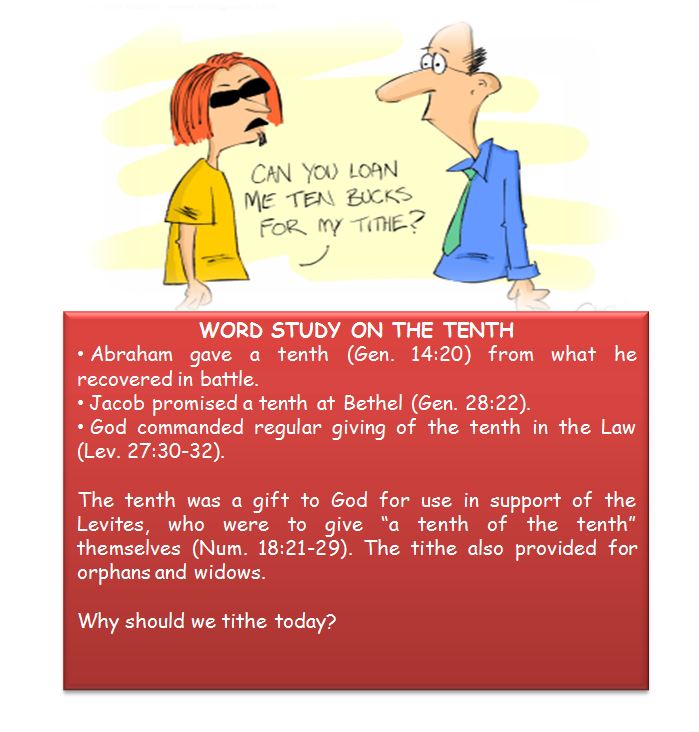
  • The people of Judah stole from God by withholding the tithe He had commanded.
  • Tithing acknowledges that God owns everything, and we are returning to Him a portion of what He has allowed us to use as His stewards.
  • The people of Judah were “suffering under a curse” (v. 9) because of their disobedience, yet they persisted in it. They thought they would be more prosperous by keeping back for themselves God’s tithe, but their plan backfired.
  • Among their sins was another serious sin of omission – failing to give their tithes. By this sin they robbed God. The Lord called them to bring all the tithes into the storehouse, and He promised blessings to those who obeyed.
  • People rob God by withholding their tithes. Failing to tithe was a basic indicator the people were not thinking of God first.
  • The rewards of tithing are sometimes physical but always real.
  • The secrets of tithing are setting aside the tenth at the beginning and trusting God to meet one’s needs.
  • Think of ways God has helped your money and resources stretch to meet your needs.


What other things might we withhold from God besides money? What is the relationship of giving to other parts of life?


  • Consider why God loves a cheerful giver (2 Cor. 9:7).
  • Name other characteristics of good giving.


Prayer of Commitment

Lord, help me to be faithful in how I live and in how I give. You have given so much for me and to me. Amen 


Be in prayer this week with how we respond to God with the honor and obedience He rightfully deserves. This lesson is not to condemn, but it is to convict. Apathy is a dangerous sin and one of the main reasons is that it can be so contagious. 


Hope everyone has a blessed rest of the week and we'll see you on Sunday! 


In His Love, 


David & Susan 


Thursday, June 7, 2012

Class Lesson June 10, 2012


Hey Gang,


Last week we began a new series entitled Apathy - Who Cares? There are 4 lessons from this series, all from the book of Malachi: Are You Just Going Through The Motions?, Do You Honor Your Commitments, How Do You Treat God?, and What Is Your Decision?


This series of lessons challenges the spiritual apathy of God's people. It calls for us to repent of any complacency we might have and to experience a genuine revival. Many believers have become apathetic and complacent in their walk with God. Revival is needed in the church today, and it must begin in the hearts of God's people. It's one thing to identify a problem, but it's another thing entirely to find a solution. This series not only looks at the problem but also presents the biblical solution.


Malachi Background

516 BC - Spurred on by the prophetic activity of Haggai and Zechariah, the returned exiles under the leadership of their governor Zerubbabel finished the temple.

458 BC - the community was strengthened by the coming of the priest Ezra and several thousand more Jews. Artaxerxes king of Persia encouraged Ezra to reconstitute the temple worship and to make sure the Law of Moses was being obeyed.

444 BC - Fourteen years later the same Persian king permitted his cupbearer Nehemiah to return to Jerusalem and rebuild its walls. As newly appointed governor, Nehemiah also spearheaded reforms to help the poor, and he convinced the people to shun mixed marriages, to keep the Sabbath and to bring their tithes and offerings faithfully.

433 BC - Nehemiah returned to the service of the Persian king, and during his absence the Jews fell into sin once more. Later, however, Nehemiah came back to Jerusalem to discover that the tithes were ignored, the Sabbath was broken, the people had intermarried with foreigners, and the priests had become corrupt. Several of these same sins are condemned by Malachi (see 1:6-14; 2:14-16; 3:8-11).

This was the condition of the Christians of Malachi’s day. The city of Jerusalem and the temple had been rebuilt for almost a century, but the people had become complacent in their worship of God. Their relationship with God was broken because of their sin, and they would soon be punished. But the few who repented would receive God’s blessing, highlighted in His promise to send a Messiah. Hypocrisy, neglecting God and careless living have devastating consequences. Serving and worshiping God must be the primary focus of our lives, both now and in eternity.

Last week opened with the question: Are You Just Going through the Motions?
  • This was exactly the attitude of the Christians in Malachi’s day. Apathy had taken over their lives and it can happen to us as well.
  • If we give God only our leftover time, money, and energy, then we repeat the same sin as the people in Malachi - they didn’t want to bring anything valuable to God.
  • What we give God reflects our true attitude toward Him.

This week’s question has to do with our commitments.

Do people take commitments as seriously as they use to? What kinds of commitments do people take the most seriously?

  • Marriage and work
  • God places a heavy importance on the commitments we make to Him and to each other.
  • Today, we look at making and keeping commitments in the way God does!

Is there a responsibility in each relationship that you have? What might that responsibility be?
  •  Fulfilling and honoring our commitments

Malachi rebuked the people and the priests for neglecting the worship of God and failing to live according to God’s will.


I. YOUR COMMITMENT TO GOD-GIVEN RESPONSIBILITIES – MALACHI 2:1-9


Warning to the Priests

2 “Therefore, this decree is for you priests: 2 If you don’t listen, and if you don’t take it to heart to honor My name,” says Yahweh of Hosts, “I will send a curse among you, and I will curse your blessings. In fact, I have already begun to curse them because you are not taking it to heart. 3 “Look, I am going to rebuke your descendants, and I will spread animal waste over your faces, the waste from your festival sacrifices, and you will be taken away with it. 4 Then you will know that I sent you this decree so My covenant with Levi may continue,” says the Lord of Hosts. 5 “My covenant with him was one of life and peace, and I gave these to him; it called for reverence, and he revered Me and stood in awe of My name. 6 True instruction was in his mouth, and nothing wrong was found on his lips. He walked with Me in peace and fairness and turned many from sin. 7 For the lips of a priest should guard knowledge, and people should seek instruction from his mouth, because he is the messenger of the Lord of Hosts. 8 “You, on the other hand, have turned from the way. You have caused many to stumble by your instruction. You have violated the covenant of Levi,” says the Lord of Hosts. 9 “So I in turn have made you despised and humiliated before all the people because you are not keeping My ways but are showing partiality in your instruction.”


Malachi’s concern was that if the priests are unfaithful, how could they lead the people? They were now stumbling blocks instead of spiritual leaders.


How had the priests failed to honor commitments to God?
  • Malachi had just delivered a blistering message that focused on the sins of priests in offering unworthy sacrifices. They were offering animals that were blind, sick, or stolen.
  • The priests didn’t take seriously God’s priority. How do you do what is most important to God? Begin by loving Him with all your heart, soul, and strength (Deuteronomy 6:5). This means listening to what God says in His Word and then setting your heart, mind, and will on doing what He says.
 

What was the warning to the priests?
  • God threatened to turn their blessings into curses because they had not taken to heart the need to honor His name. Priests were supposed to maintain the rules about ceremonial cleanliness. When offering sacrifices, they were to carefully treat each part of a sacrificial animal. For example, the animal waste was to be taken outside the camp and burned. (Lev. 4:11-12)
  • The sinning priests had only two options: they could “listen” and “take it to heart to honor My name.” (repent and obey)
  • Or they could disregard the word of the Lord and suffer His curse.

How would the curse appear?
  • Pestilence and lack of rain ruined harvests and left vines barren.
  • God may discipline disobedience through tangible difficulty and loss. King David suffered through revolt and civil war, in part, as a result of his sin. (2 Sam. 12:11; 15-18)
  • Some Corinthians were sick as a result of abusing the Lord’s Supper. (1 Cor. 11:29-30)
  • Suffering is not necessarily the result of one’s own sin (John 9:1-3), but if we disobey God, we should expect discipline.

Who was Levi?
  • Jacob’s son Levi.
  • When the Israelites worshiped the golden calf, the Levites showed themselves to be on the Lord’s side (Ex. 32:26).


Describe the covenant they were expected to keep.
  • To give true instruction and turn away from sin.
  • Instead they were disobedience to God’s instructions and they caused many to stumble.
 

Should we expect more from our Christian leaders?
  • But to accept any position of leadership or service in the church is to covenant with God.
  • Leaders have a special calling to do this.


How is the expectation of Christian leaders the same for each believer?
  • The responsibility to be faithful in God-given tasks applies to all believers, not just clergy. "Priesthood of all Believers."
  • All people are called to honor the Lord.
  • Each believer is a priest and thus should live like one.


II. YOUR COMMITMENT TO OTHERS AND TO GOD – MALACHI 2:10-12
Judah’s Marital Unfaithfulness

10 Don’t all of us have one Father? Didn’t one God create us? Why then do we act treacherously against one another, profaning the covenant of our fathers? 11 Judah has acted treacherously, and a detestable thing has been done in Israel and in Jerusalem. For Judah has profaned the Lord’s sanctuary, which He loves, and has married the daughter of a foreign god. 12 To the man who does this, may the Lord cut off any descendants from the tents of Jacob, even if they present an offering to the Lord of Hosts.


Malachi is saying that if the people are divorcing their wives and marrying pagan women, how could they lead their children? Their relationship with God must be inconsequential.


What do my commitments at home and work have to do with my commitment to God?
  • Commitment to others is inseparable from commitment to God.
  • We’ve all heard and read stories of people who profess deep and fervent faith in God but treat their families and fellow believers with disrespect.
  • If we treat fellow believers wrongly, we treat God wrongly.
 
What detestable thing had men of Judah done and why was it so bad? Why should believers marry those who show love for God still today?
  • The problem was not marrying cross-culturally but marrying idol worshipers (Ex. 34:15-16)
  • See 2 Corinthians 6:14
  • A healthy marriage requires common values and purpose in life.
  • We are to live out the best of our spiritual heritage.
  • We are to avoid profaning the Lord’s name by irresponsible actions.
  • Relationships bring responsibility.
 

After the temple had been rebuilt and the walls completed, the people were excited to see past prophecies coming true. But as time passed, the prophecies about the destruction of God’s enemies and a coming Messiah were not immediately fulfilled. The people became discouraged, and they grew complacent about obeying all of God’s laws. This complacency gradually led to blatant sin, such as marriage to those who worshiped idols.


III. YOUR COMMITMENT TO FAMILY – MALACHI 2:13-16
13 And this is another thing you do: you cover the Lord’s altar with tears, with weeping and groaning, because He no longer respects your offerings or receives them gladly from your hands. 14 Yet you ask, “For what reason?” Because the Lord has been a witness between you and the wife of your youth. You have acted treacherously against her, though she was your marriage partner and your wife by covenant. 15 Didn’t the one God make us with a remnant of His life-breath? And what does the One seek? A godly offspring. So watch yourselves carefully, and do not act treacherously against the wife of your youth. 16 “If he hates and divorces his wife, ” says the Lord God of Israel, “he covers his garment with injustice,” says the Lord of Hosts. Therefore, watch yourselves carefully, and do not act treacherously.


So the people were now complaining about their adverse circumstances when they had only themselves to blame.

Why does God put such an emphasis on how well we honor our marriage commitment?
  • The men of Judah were divorcing their wives for frivolous reasons (v. 16), apparently to pursue younger women. God would not accept the worship offerings of those who dishonored Him by violating their marriage covenants (1 Pet. 3:7).
  • Uphold God’s ideal for marriage as a permanent commitment (Matt. 5:31-32).
  • Shedding tears during times of worship does not always reveal genuine concern.
  • Marriage is the most important and most challenging human relationship.
  • God’s purpose is for a marriage to be a lifelong commitment of husband and wife.


What does Malachi mean when he says to, “watch yourselves carefully, and do not act treacherously?”
  • He means to have the same commitment to marriage that God has to His promises to His people.
  • We need passion in the marriage relationship to keep the commitment and intimacy satisfying, but this passion should be focused exclusively on our spouse.


When our relationship with God becomes less important than it should be, we can strengthen it by setting aside our sinful habits, thinking often of our Lord, and giving God our best each day.


Relationships and responsibilities go together. The most important relation is our relationship with God. Think about the various groups of people you have some relationship with and to whom you also have some responsibility. Begin with your spouse. This most intimate relation, marriage, calls for the greatest expression of responsibility. Our parents and our children also are close relationships that exact high levels of responsibilities. Relationships with members of your larger family, friends, fellow workers, and brothers and sisters in Christ also have some level of responsibility. The question asked in this lesson focus on the relationships of one’s life. What responsibilities does each bring? How well are you fulfilling these responsibilities?


Prayer of Commitment

Lord, help me fulfill my covenant responsibilities as appropriate for each one. Amen 


A big thanks to Paul Mahrle for stepping in and teaching for me last week! We missed everyone and look forward to seeing everyone this Sunday as we continue in this lesson series on spiritual apathy.  


See you on Sunday! 

In His Love, 

David & Susan