Our Prayer

Our Prayer

Heavenly Father, I know that I have sinned against You and that my sins separate me from You. I am truly sorry. I now want to turn away from my sinful past and turn to You for forgiveness. Please forgive me, and help me avoid sinning again. I believe that Your Son, Jesus Christ, died for my sins, that He was raised from the dead, is alive, and hears my prayer. I invite Jesus to become my Savior and the Lord of my life, to rule and reign in my heart from this day forward. Please send Your Holy Spirit to help me obey You and to convict me when I sin. I pledge to grow in grace and knowledge of You. My greatest purpose in life is to follow Your example and do Your will for the rest of my life. In Jesus' name I pray, Amen.

Thursday, May 8, 2025

Class Lesson May 11, 2025

The Whole Story

2 Chronicles 36

2 Chronicles brings us to a sobering conclusion to the era of the Davidic kings. Chapter 36 shows Judah’s final slide into rebellion as one king after another turns away from the Lord’s covenant. Despite generations of warnings through the prophets, the people harden their hearts and refuse to repent. The result is catastrophic: the armies of Babylon tear down Jerusalem’s walls, destroy the Temple, and carry the people into exile. All the promises and hopes that were once bound-up in the Davidic throne now appear lost, scattered in the dust of a ruined city.


These dark pages may tempt us to believe that God has abandoned his people. Yet, the Lord’s steadfast commitment to His covenant people shines through. After seventy years of exile, He moves the heart of a foreign king — Cyrus of Persia — to issue a decree allowing the exiles to return home and rebuild God’s house.

We see God’s plan unfolding through unexpected means within these bleak events. The sin of Judah’s kings and the brokenness of God’s people only heighten our longing for the true and perfect King, who will never fail. 


2 Chronicles 36:14-21

14 All the officers of the priests and the people likewise were exceedingly unfaithful, following all the abominations of the nations. And they polluted the house of the Lord that He had made holy in Jerusalem. 15 The Lord, the God of their fathers, sent persistently to them by His messengers, because He had compassion on His people and on His dwelling place. 16 But they kept mocking the messengers of God, despising His words and scoffing at His prophets, until the wrath of the Lord rose against His people, until there was no remedy. 17 Therefore, He brought up against them the king of the Chaldeans, who killed their young men with the sword in the house of their sanctuary and had no compassion on young man or virgin, old man or aged. He gave them all into his hand. 18 And all the vessels of the house of God, great and small, and the treasures of the house of the Lord, and the treasures of the king and of his princes, all these he brought to Babylon. 19 And they burned the house of God and broke down the wall of Jerusalem and burned all its palaces with fire and destroyed all its precious vessels. 20 He took into exile in Babylon those who had escaped from the sword, and they became servants to him and to his sons until the establishment of the kingdom of Persia, 21 to fulfill the word of the Lord by the mouth of Jeremiah, until the land had enjoyed its Sabbaths. All the days that it lay desolate it kept Sabbath, to fulfill seventy years.

The Holy Bible, English Standard Version. ESV® Text Edition: 2016. Copyright © 2001 by Crossway Bibles, a publishing ministry of Good News Publishers. 2 Chronicles’ 36:14-21


Here, we are reminded that earthly kings and kingdoms, even those begun by God’s hand, can never fully achieve what only the divine Son of David can accomplish. The tragedy of 2 Chronicles 36 points to the day God Himself would come in the flesh. The covenant is upheld and fulfilled in Jesus Christ, the perfect King of kings. Where the sons of David fell short, Christ remains faithful. Where human power crumbles into captivity, Christ rises in glorious freedom through His death and resurrection. In the gloom of exile and judgment, God sets the stage for a future far greater than any earthly throne could offer. In Christ alone, the true Temple is raised, a kingdom without end is established, and the hope of a restored creation finds its final answer. Jesus is here, even as the people are led away into captivity.


Discussion Questions

Why do you think Zedekiah refused to humble himself before Jeremiah, even after multiple warnings? 

How have you seen the danger of hearing God's Word without responding to it in your own life or in others? 

What does it mean to “pollute the house of the Lord” today? How does our sin impact the church community? 

What stood out to you about the phrase, “there was no remedy”? How does this shape how we think about grace and repentance?

Where in your life is God showing patience right now — and how can you respond to His Word before correction becomes necessary?


END

Teacher Notes:


Click Play to Watch


2 Chronicles 36:11-13

Zedekiah was twenty-one years old when he began to reign, and he reigned eleven years in Jerusalem. He did what was evil in the sight of the Lord his God. He did not humble himself before Jeremiah the prophet, who spoke from the mouth of the Lord. He also rebelled against King Nebuchadnezzar, who had made him swear by God. He stiffened his neck and hardened his heart against turning to the Lord, the God of Israel.


2 Chronicles 36:14-16

All the officers of the priests and the people likewise were exceedingly unfaithful, following all the abominations of the nations. And they polluted the house of the Lord that He had made holy in Jerusalem.  The Lord, the God of their fathers, sent persistently to them by His messengers, because He had compassion on His people and on His dwelling place. But they kept mocking the messengers of God, despising His words and scoffing at His prophets, until the wrath of the Lord rose against His people, until there was no remedy. 


2 Chronicles 36:14

…they polluted the house of the Lord that He had made holy in Jerusalem. 


2 Chronicles 36:17-20

Therefore, He brought up against them the king of the Chaldeans, who killed their young men with the sword in the house of their sanctuary and had no compassion on young man or virgin, old man or aged. He gave them all into his hand. And all the vessels of the house of God, great and small, and the treasures of the house of the Lord, and the treasures of the king and of his princes, all these he brought to Babylon. And they burned the house of God and broke down the wall of Jerusalem and burned all its palaces with fire and destroyed all its precious vessels. He took into exile in Babylon those who had escaped from the sword, and they became servants to him and to his sons until the establishment of the kingdom of Persia,


Friday, May 2, 2025

Class Lesson May 4, 2025

 The Whole Story


 1 Kings 18

On our journey through the Scriptures, 1 Kings 18 brings us to a dramatic and decisive confrontation on Mount Carmel. 

Here, the prophet Elijah stands alone against the assembled prophets of Baal. Israel’s hearts have drifted away from the Lord, lured by the empty promises of a false god. Desperate to restore true worship, Elijah issues a bold challenge: let him and the prophets of Baal prepare sacrifices but let the true God answer by fire. Baal’s prophets cry to their powerless deity, cutting themselves and dancing in vain. At last, Elijah steps forward and prays a simple prayer and the Lord’s fire falls from heaven, consuming not only the sacrifice but the stones, the dust, and even the water poured around the altar. In that fiery moment, the Lord reveals His unmatched sovereignty, calling the people to forsake their idols and acknowledge Him as the one true God.

Yet even this mighty demonstration points us beyond Elijah’s day to an even greater manifestation of God’s power and grace. Israel’s waywardness echoes our own, and the futility of Baal’s prophets mirrors the dead-end worship of earthly idols that cannot save. But God, in His mercy, would send another Prophet greater than Elijah — Jesus Christ — who would stand against the spiritual forces of darkness and prevail by His death and resurrection. At the cross, Christ displayed the reality and supremacy of God’s love and righteousness and consumed the penalty our sins deserved, clearing away every barrier between us and our Maker. 

As we contemplate Elijah’s triumph on Mount Carmel, we are reminded that true redemption and renewed worship come only through the God who reveals Himself in power and truth, ultimately fulfilled in the saving work of Jesus, our risen Lord. 

Jesus is here, even on Mount Carmel.


1 Kings 18: 20-40

The Prophets of Baal Defeated

20 So, Ahab sent to all the people of Israel and gathered the prophets together at Mount Carmel. 21 And Elijah came near to all the people and said, “How long will you go limping between two different opinions? If the Lord is God, follow him; but if Baal, then follow him.” And the people did not answer him a word. 22 Then Elijah said to the people, “I, even I only, am left a prophet of the Lord, but Baal's prophets are 450 men. 23 Let two bulls be given to us and let them choose one bull for themselves and cut it in pieces and lay it on the wood, but put no fire to it. And I will prepare the other bull and lay it on the wood and put no fire to it. 24 And you call upon the name of your god, and I will call upon the name of the Lord, and the God who answers by fire, he is God.” And all the people answered, “It is well spoken.” 25 Then Elijah said to the prophets of Baal, “Choose for yourselves one bull and prepare it first, for you are many, and call upon the name of your god, but put no fire to it.” 26 And they took the bull that was given them, and they prepared it and called upon the name of Baal from morning until noon, saying, “O Baal, answer us!” But there was no voice, and no one answered. And they limped around the altar that they had made. 27 And at noon Elijah mocked them, saying, “Cry aloud, for he is a god. Either he is musing, or he is relieving himself, or he is on a journey, or perhaps he is asleep and must be awakened.” 28 And they cried aloud and cut themselves after their custom with swords and lances, until the blood gushed out upon them. 29 And as midday passed, they raved on until the time of the offering of the oblation, but there was no voice. No one answered, no one paid attention. 30 Then Elijah said to all the people, “Come near to me.” And all the people came near to him. And he repaired the altar of the Lord that had been thrown down. 31 Elijah took twelve stones, according to the number of the tribes of the sons of Jacob, to whom the word of the Lord came, saying, “Israel shall be your name,” 32 and with the stones he built an altar in the name of the Lord. And he made a trench about the altar, as great as would contain two seahs of seed. 33 And he put the wood in order and cut the bull in pieces and laid it on the wood. And he said, “Fill four jars with water and pour it on the burnt offering and on the wood.” 34 And he said, “Do it a second time.” And they did it a second time. And he said, “Do it a third time.” And they did it a third time. 35 And the water ran around the altar and filled the trench also with water. 36 And at the time of the offering of the oblation, Elijah the prophet came near and said, “O Lord, God of Abraham, Isaac, and Israel, let it be known this day that you are God in Israel, and that I am your servant, and that I have done all these things at your word. 37 Answer me, O Lord, answer me, that this people may know that you, O Lord, are God, and that you have turned their hearts back.” 38 Then the fire of the Lord fell and consumed the burnt offering and the wood and the stones and the dust, and licked up the water that was in the trench. 39 And when all the people saw it, they fell on their faces and said, “The Lord, he is God; the Lord, he is God.” 40 And Elijah said to them, “Seize the prophets of Baal; let not one of them escape.” And they seized them. And Elijah brought them down to the brook Kishon and slaughtered them there.

The Holy Bible, English Standard Version. ESV® Text Edition: 2016. Copyright © 2001 by Crossway Bibles, a publishing ministry of Good News Publishers. 1 Kings 18:20-40


Discussion Questions

What are some ways we “limp between two opinions” in our spiritual lives today?

Why do you think people turn to idols even though they fail to deliver? What idols are easiest for us to justify?

What might it look like in your life to “repair the altar of the Lord”? (i.e., restore intimacy and worship?)

What would it look like to pray with Elijah’s boldness today? What are you praying that only God can do?

What evidence would you expect to see in a life that truly declares, “The Lord, He is God!”?


END

Q: I have been asked to give a prayer at a community event. I am a Christian. Should I pray in the name of Jesus, or should I be more generic to bring unity?

A: From the writings of the Rev. Billy Graham

Uniting in prayer to the gods of this world will avail nothing. A clear demonstration of this is the story of Elijah and the prophets of Baal. 


Click Play to Watch


Today’s lesson gives us another dramatic and decisive confrontation by Elijah on Mount Carmel.

Israel’s hearts have once again drifted away from the Lord, lured by the empty promises of a false god.


1 Kings 2 to 1 Kings 18

1 Kings 3 through 12 is all about Solomon's story and reign (another 40 years). Through King David and King Solomon - the Kingdom (all 12 Tribes) were united.

After Solomon's death, the northern tribes’ revolt, forming two separate nations - Israel and Judah.

Each nation experiences disastrous consequences from having evil kings. Elijah appears on the scene today to confront the king of Israel for their sin.


1 Kings 18:17-21

When he saw Elijah, he said to him, “Is that you, you troubler of Israel?” “I have not made trouble for Israel,” Elijah replied. “But you and your father’s family have. You have abandoned the Lord’s commands and have followed the Baals. Now summon the people from all over Israel to meet me on Mount Carmel. And bring the four hundred and fifty prophets of Baal and the four hundred prophets of Asherah, who eat at Jezebel’s table.” So, Ahab sent word throughout all Israel and assembled the prophets on Mount Carmel. Elijah went before the people and said, “How long will you waver between two opinions? If the Lord is God, follow him; but if Baal is God, follow him.” But the people said nothing.


“The human heart is an idol factory.”

John Calvin


Israel’s problem wasn’t that they had fully rejected Yahweh — it was that they were trying to follow Him and Baal.


1 Kings 18:22-29

Then Elijah said to them, “I am the only one of the Lord’s prophets left, but Baal has four hundred and fifty prophets. Get two bulls for us. Let Baal’s prophets choose one for themselves and let them cut it into pieces and put it on the wood but not set fire to it. I will prepare the other bull and put it on the wood but not set fire to it. Then you call on the name of your god, and I will call on the name of the Lord. The god who answers by fire — He is God.” Then all the people said, “What you say is good.” Elijah said to the prophets of Baal, “Choose one of the bulls and prepare it first, since there are so many of you. Call on the name of your god, but do not light the fire.”

So, they took the bull given them and prepared it. Then they called on the name of Baal from morning till noon. “Baal, answer us!” they shouted. But there was no response; no one answered. And they danced around the altar they had made. At noon Elijah began to taunt them. “Shout louder!” he said. “Surely, he is a god! Perhaps he is deep in thought, or busy, or traveling. Maybe he is sleeping and must be awakened.” So, they shouted louder and slashed themselves with swords and spears, as was their custom, until their blood flowed. Midday passed, and they continued their frantic prophesying until the time for the evening sacrifice. But there was no response, no one answered, no one paid attention.


1 Kings 18:30-39

Then Elijah said to all the people, “Come here to me.” They came to him, and he repaired the altar of the Lord, which had been torn down. Elijah took twelve stones, one for each of the tribes descended from Jacob, to whom the word of the Lord had come, saying, “Your name shall be Israel.” With the stones he built an altar in the name of the Lord, and he dug a trench around it large enough to hold two seahs of seed. He arranged the wood, cut the bull into pieces and laid it on the wood. Then he said to them, “Fill four large jars with water and pour it on the offering and on the wood.” “Do it again,” he said, and they did it again. “Do it a third time,” he ordered, and they did it the third time. The water ran down around the altar and even filled the trench.  


(Play  the music as you read the God's dramatic response.)


1 Kings 18:40

Then Elijah commanded them, “Seize the prophets of Baal. Don’t let anyone get away!” They seized them and Elijah had them brought down to the Kishon Valley and slaughtered there.


Wednesday, April 23, 2025

Class Lesson April 27, 2025

 The Whole Story - The Life of David


When was the time when you realized someone, you looked up to had deep flaws? How did that change the way you saw them — or what you hoped for in a leader?


In 1 Kings 2, we see King David at the end of his earthly life, passing the royal mantle to his son Solomon.

As the aged king nears death, he delivers his final instructions, urging Solomon to be strong, to walk faithfully in God’s ways, and to uphold the covenantal standards set before him. This chapter will quickly see Solomon being called upon to establish his throne by dealing decisively with those threatening the kingdom’s stability. Adonijah’s ambition, Joab’s treachery, and Shimei’s insolence all come into focus as we witness the new king’s rise to power. Soon, Solomon sits securely as king of Israel, the kingdom seemingly purified of all impurity. 

Yet, even at this moment of apparent strength and hope, we cannot help but sense the limitations of Israel’s earthly monarchy. David, the greatest king Israel had ever known, dies. Although wise and blessed, Solomon will later fail to maintain perfect faithfulness to the Lord. The purging of 1 Kings 2 may have rid the kingdom of immediate threats, but they cannot root out the deeper menace — sin — that continues to plague the human heart. No matter how promising or devout a king may begin, death awaits him, and corruption awaits the human institutions he leads.


1 Kings 2:1-12

David's Instructions to Solomon

2:1 When David's time to die drew near, he commanded Solomon his son, saying, 2 “I am about to go the way of all the earth. Be strong, and show yourself a man, 3 and keep the charge of the Lord your God, walking in His ways and keeping His statutes, His commandments, His rules, and His testimonies, as it is written in the Law of Moses, that you may prosper in all that you do and wherever you turn, 4 that the Lord may establish His word that He spoke concerning me, saying, ‘If your sons pay close attention to their way, to walk before Me in faithfulness with all their heart and with all their soul, you shall not lack a man on the throne of Israel.’

5 “Moreover, you also know what Joab the son of Zeruiah did to me, how he dealt with the two commanders of the armies of Israel, Abner the son of Ner, and Amasa the son of Jether, whom he killed, avenging in time of peace for blood that had been shed in war, and putting the blood of war on the belt around his waist and on the sandals on his feet. 6 Act therefore according to your wisdom, but do not let his gray head go down to Sheol in peace. 7 But deal loyally with the sons of Barzillai the Gileadite, and let them be among those who eat at your table, for with such loyalty they met me when I fled from Absalom your brother. 8 And there is also with you Shimei the son of Gera, the Benjaminite from Bahurim, who cursed me with a grievous curse on the day when I went to Mahanaim. But when he came down to meet me at the Jordan, I swore to him by the Lord, saying, ‘I will not put you to death with the sword.’ 9 Now therefore do not hold him guiltless, for you are a wise man. You will know what you ought to do to him, and you shall bring his gray head down with blood to Sheol.”

The Death of David

10 Then David slept with his fathers and was buried in the city of David. 11 And the time that David reigned over Israel was forty years. He reigned seven years in Hebron and thirty-three years in Jerusalem. 12 So, Solomon sat on the throne of David his father, and his kingdom was firmly established.

The Holy Bible, English Standard Version. ESV® Text Edition: 2016. Copyright © 2001 by Crossway Bibles, a publishing ministry of Good News Publishers. 1 Kings 2:1-12


Discussion Questions

  1. What does David’s mortality teach us about the limits of even the greatest human leaders?
  2. How does it deepen your appreciation for the eternal reign of Jesus?
  3. How does Jesus fulfill what David could only point toward?
  4. Why do you think David spent his final breaths calling for justice — or vengeance — against his enemies?
  5. In what ways are we tempted to hold onto offense instead of trusting God’s justice?
  6. How does the finality of David’s burial point to the limitations of even the greatest leaders?
  7. What difference does it make that Jesus’ tomb is empty?
  8. What does Solomon’s shaky rise to power teach us about human kingdoms?


Closing thoughts:

David’s final moments remind us that even the most revered leaders are still deeply human — frail, flawed, and finite. His death, his vengeful commands, and his inability to establish lasting peace all point to the need for a better King.

Jesus is that King.

He obeyed perfectly where David stumbled, offered mercy where David demanded vengeance, and rose from the grave where David’s body still lies. His resurrection proves that His rule is eternal, and His reign is righteous. Unlike David, Jesus does not need to pass His kingdom to another — He lives and reigns forever. If David’s throne was a shadow, Jesus is the substance. And if David's kingdom fell short, Christ's kingdom fulfills every promise.

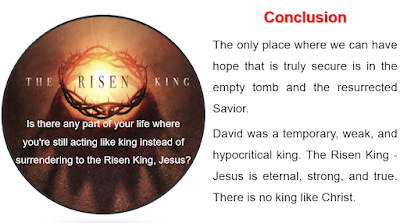
The question for us isn’t whether we admire Jesus as King, but whether we’ve actually submitted our lives to His rule.

END

Teacher's Notes:

When you realize how old you are...


In 1 Kings 2, we see King David at the end of his earthly life, passing the royal mantle of power on to his son Solomon. He explains that men must be strong and careful in their role of leadership.

This reminded me of another father/son passing of power.


Click Play to Watch

Now, I’m not saying that King David and Solomon are like Don Vito and Michael Corleone but there are some similarities here.


There's a question of Personal Vengeance vs. A King’s Responsibility.


As king David nears death, he gives his final instructions, urging Solomon to be strong, to be a man, and to walk faithfully in God’s ways.

But David also calls on Solomon to deal decisively with those threatening the kingdom’s stability.


I want us to talk about these 3 points our lesson makes about David:

  • He was weak, vengeful, and temporary.


1 Kings 2:1-4

David's Instructions to Solomon

When David's time to die drew near, he commanded Solomon his son, saying, “I am about to go the way of all the earth. Be strong, and show yourself a man, and keep the charge of the Lord your God, walking in His ways and keeping His statutes, His commandments, His rules, and His testimonies, as it is written in the Law of Moses, that you may prosper in all that you do and wherever you turn, that the Lord may establish His word that He spoke concerning me, saying, ‘If your sons pay close attention to their way, to walk before Me in faithfulness with all their heart and with all their soul, you shall not lack a man on the throne of Israel.’


No matter how promising or devout a king may begin, death awaits him, sin resides in him, and corruption awaits the human institutions he leads.


1 Kings 2:5-9

“Moreover, you also know what Joab the son of Zeruiah did to me, how he dealt with the two commanders of the armies of Israel, Abner the son of Ner, and Amasa the son of Jether, whom he killed, avenging in time of peace for blood that had been shed in war, and putting the blood of war on the belt around his waist and on the sandals on his feet. Act therefore according to your wisdom, but do not let his gray head go down to Sheol in peace. But deal loyally with the sons of Barzillai the Gileadite, and let them be among those who eat at your table, for with such loyalty they met me when I fled from Absalom your brother. And there is also with you Shimei the son of Gera, the Benjaminite from Bahurim, who cursed me with a grievous curse on the day when I went to Mahanaim. But when he came down to meet me at the Jordan, I swore to him by the Lord, saying, ‘I will not put you to death with the sword.’ Now therefore do not hold him guiltless, for you are a wise man. You will know what you ought to do to him, and you shall bring his gray head down with blood to Sheol.”


There was a country song that addressed this question…


Click Play to Watch

“Let the good Lord do His job and you just pray for them.”

Would you agree with this?


But what if our prayer goes like this…


Click Play to Watch

What do you think?


Was he wrong to do this?


Though some of this was wise, it reveals a heart still wrestling with unfinished justice and unresolved anger.

The man who once wrote, “Create in me a clean heart” ends with, “Do not let his gray head go down to the grave in peace.”


1 Kings 2:10-12

The Death of David

Then David slept with his fathers and was buried in the city of David. And the time that David reigned over Israel was forty years. He reigned seven years in Hebron and thirty-three years in Jerusalem. So, Solomon sat on the throne of David his father, and his kingdom was firmly established.


Where David and Solomon were mortal and flawed, Jesus is eternal and holy. Where earthly kings could establish peace for a season, Jesus established a kingdom of everlasting peace and righteousness.


END