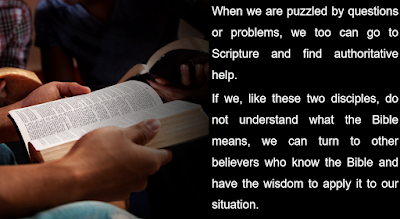
Our Prayer

Our Prayer

Heavenly Father, I know that I have sinned against You and that my sins separate me from You. I am truly sorry. I now want to turn away from my sinful past and turn to You for forgiveness. Please forgive me, and help me avoid sinning again. I believe that Your Son, Jesus Christ, died for my sins, that He was raised from the dead, is alive, and hears my prayer. I invite Jesus to become my Savior and the Lord of my life, to rule and reign in my heart from this day forward. Please send Your Holy Spirit to help me obey You and to convict me when I sin. I pledge to grow in grace and knowledge of You. My greatest purpose in life is to follow Your example and do Your will for the rest of my life. In Jesus' name I pray, Amen.

Tuesday, January 7, 2025

Class Lesson January 12, 2012

New Series - Through the Bible


Welcome to the first Sunday in our year in the Bible. This is a year long reading plan through the Bible as well. I hope you will use the daily reading plan for your devotional time every morning.


Our first weekly study is starting in a place many might find odd: Luke’s account of Jesus' resurrection. In a journey through the Bible, you might have expected that we would start at a more logical place, like the beginning - Genesis 1. Don’t worry; we will get there. We are looking at a text that will help us understand the Bible better as we read it and walk through it together. 

Luke 24 finds two men walking home after a horrible weekend in Jerusalem. These two men were Jesus’s followers, but all their hopes had been dashed over the weekend as they saw Christ arrested, tried, and ultimately crucified on the cross. Jesus was dead. The hope of a better day was dead, too, or so they thought. 

As these men walk home, the resurrected Savior shows up and begins a conversation with them about the events that had unfolded in Jerusalem. These men have no idea who they are talking to and begin to let their despondency show. Their Savior had suffered and died, and now they are sulking. In this conversation, Jesus begins to reveal himself to show the disciples that things aren't quite what they seem. Yes, He suffered. Yes, He died. However, now He is alive, and all that happened to Him was necessary according to the plan of God. 

To explain how His arrest, crucifixion, and resurrection were necessary, Jesus turns to the Old Testament to show how everything previously written pointed to the life, death, and resurrection of Jesus Christ. Jesus's explanation of the Bible in Luke 24 tells us that if we read the Bible correctly, we see that the Bible, every verse, every chapter, and every book is a book about Jesus.


We start our year in the Bible in Luke 24 because the goal is not just to read the Bible this year but to understand the Bible this year. To understand the Bible, you don’t need to start with Genesis 1; you need to start with Jesus. When we start with Jesus, we find the one who was already there in the beginning and created all things. When we start with Jesus, we find the key to understanding the whole Bible.


Read the Bible with Upstate Church this year, but remember, start where we are starting this Sunday, with Jesus.
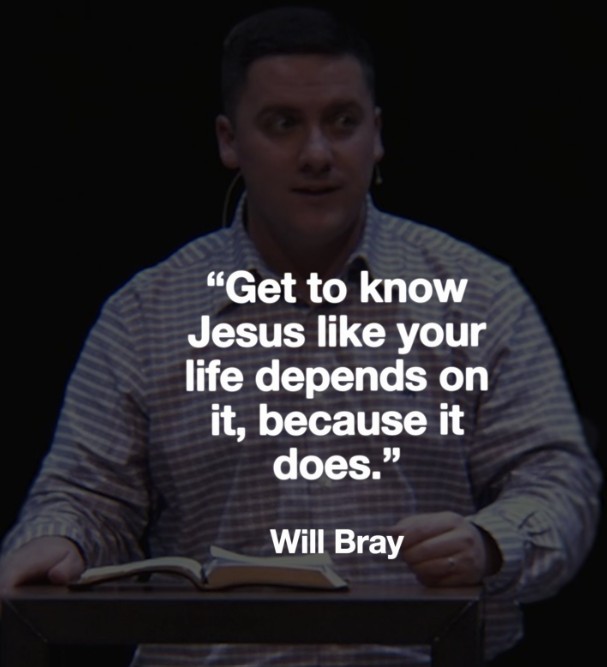


Bottom Line: We read the Bible to encounter Jesus!

Scripture Reveals Who Jesus Is

Scripture Reveals Who We Are

Scripture Reveals Our Need for Community


Sermon Recap

  • Christians do not read the Bible as if it were just another book about just another topic! We read the Bible as God's revelation about His Son, Jesus Christ.
  • The disciples on the road to Emmaus are in crippling despair, but it’s in moments of hopelessness that Jesus works best.
  • In Luke 24, Jesus teaches us how to read the Bible. We are to read every word to see how it points us to Jesus Christ.
  • If the entire Bible is about Jesus, then we know that the Son of God being killed on the cross and rising again on the third day was God’s plan all along!


Luke 24:13-35

13 That very day two of them were going to a village named Emmaus, about seven miles from Jerusalem, 14 and they were talking with each other about all these things that had happened. 15 While they were talking and discussing together, Jesus himself drew near and went with them. 16 But their eyes were kept from recognizing him. 17 And he said to them, “What is this conversation that you are holding with each other as you walk?” And they stood still, looking sad. 18 Then one of them, named Cleopas, answered him, “Are you the only visitor to Jerusalem who does not know the things that have happened there in these days?” 19 And he said to them, “What things?” And they said to him, “Concerning Jesus of Nazareth, a man who was a prophet mighty in deed and word before God and all the people, 20 and how our chief priests and rulers delivered him up to be condemned to death and crucified him. 21 But we had hoped that he was the one to redeem Israel. Yes, and besides all this, it is now the third day since these things happened. 22 Moreover, some women of our company amazed us. They were at the tomb early in the morning, 23 and when they did not find his body, they came back saying that they had even seen a vision of angels, who said that he was alive. 24 Some of those who were with us went to the tomb and found it just as the women had said, but him they did not see.” 25 And he said to them, “O foolish ones, and slow of heart to believe all that the prophets have spoken! 26 Was it not necessary that the Christ should suffer these things and enter into his glory?” 27 And beginning with Moses and all the Prophets, he interpreted to them in all the Scriptures the things concerning himself. 28 So they drew near to the village to which they were going. He acted as if he were going farther, 29 but they urged him strongly, saying, “Stay with us, for it is toward evening and the day is now far spent.” So, he went in to stay with them. 30 When he was at table with them, he took the bread and blessed and broke it and gave it to them. 31 And their eyes were opened, and they recognized him. And he vanished from their sight. 32 They said to each other, “Did not our hearts burn within us while he talked to us on the road, while he opened to us the Scriptures?” 33 And they rose that same hour and returned to Jerusalem. And they found the eleven and those who were with them gathered together, 34 saying, “The Lord has risen indeed, and has appeared to Simon!” 35 Then they told what had happened on the road, and how he was known to them in the breaking of the bread.

The Holy Bible: English Standard Version (Wheaton, IL: Crossway Bibles, 2016), Lk 24:13–35.


Discussion Questions

"What things?" (Luke 24:19)

When Jesus asks the disciples about their conversation, He invites them to express their doubts and struggles. How does Jesus' question encourage authenticity in our own relationship with Him and others? How can we create a space in this group for honest dialogue about our faith and struggles?


"But we had hoped..." (Luke 24:21)

The disciple’s express disappointment and shattered expectations about who they thought Jesus would be. What are some ways we experience unmet expectations in our walk with God? How can we learn to trust God's plan even when it looks different from our own?


"Was it not necessary that the Christ should suffer these things and enter into his glory?" (Luke 24:26)

Jesus reframes their understanding of His suffering by pointing them to Scripture. How does this passage challenge us to view suffering considering God’s greater redemptive plan? How can we rely on God’s Word for clarity when we face confusion or hardship?


"Did not our hearts burn within us while he talked to us on the road?" (Luke 24:32)

The disciples reflect on how their hearts were stirred as Jesus explained the Scriptures. When have you experienced a similar moment where God’s Word brought clarity, conviction, or comfort? How can we cultivate a deeper hunger for the Scriptures in our daily lives?


"Then they told what had happened on the road, and how he was known to them in the breaking of the bread." (Luke 24:35)

The disciples share how Jesus revealed Himself through the Word and a shared meal. How does this encourage us to see Jesus in both the study of Scripture and in fellowship with others? How can we be intentional about sharing how God is working in our lives to encourage others?


After you read Luke 24:13-35, make observations about the text.

What is God teaching us in the passage?

What does this reveal about who God is, what God has done, and how I should respond?

Which part of the text was most meaningful to you and why?

What do you need help understanding about this passage?


END

Teacher Notes:

TO UNDERSTAND the Bible, you don’t need to start with Genesis; you need to start with Jesus. In Jesus, we find the One who was already there in the beginning and created all things. When we start with Jesus, we find the key to understanding the whole Bible.


We are starting in Luke 24 because the goal is not just to read the Bible but to understand the Bible.


Thursday, January 2, 2025

Class Lesson for January 5, 2025

 Stand Alone Lesson 


This lesson explores the Israelites' miraculous crossing of the Jordan River under Joshua's leadership, emphasizing God's faithfulness, His power in overcoming impossible obstacles, and the importance of remembering His works. We’ll see how this passage foreshadows salvation through Christ and invites us to live with faith and worshipful remembrance.


How has your walk with God been this year? 

What needs to change for you in 2025?


The New Year is a time to consider our priorities. Obedience to God should be the priority for every Christian, not only in the new year but throughout life!


Let's read our Scripture for this lesson:


Joshua 3:7-4:24

7 And the Lord said to Joshua, “Today I will begin to exalt you in the eyes of all Israel, so they may know that I am with you as I was with Moses. 8 Tell the priests who carry the ark of the covenant: ‘When you reach the edge of the Jordan’s waters, go and stand in the river.’”

9 Joshua said to the Israelites, “Come here and listen to the words of the Lord your God. 10 This is how you will know that the living God is among you and that he will certainly drive out before you the Canaanites, Hittites, Hivites, Perizzites, Girgashites, Amorites and Jebusites. 11 See, the ark of the covenant of the Lord of all the earth will go into the Jordan ahead of you. 12 Now then, choose twelve men from the tribes of Israel, one from each tribe. 13 And as soon as the priests who carry the ark of the Lord — the Lord of all the earth — set foot in the Jordan, its waters flowing downstream will be cut off and stand up in a heap.”

14 So when the people broke camp to cross the Jordan, the priests carrying the ark of the covenant went ahead of them. 15 Now the Jordan is at flood stage all during harvest. Yet as soon as the priests who carried the ark reached the Jordan and their feet touched the water’s edge, 16 the water from upstream stopped flowing. It piled up in a heap a great distance away, at a town called Adam in the vicinity of Zarethan, while the water flowing down to the Sea of the Arabah (that is, the Dead Sea) was completely cut off. So the people crossed over opposite Jericho. 17 The priests who carried the ark of the covenant of the Lord stopped in the middle of the Jordan and stood on dry ground, while all Israel passed by until the whole nation had completed the crossing on dry ground.


4:1 When the whole nation had finished crossing the Jordan, the Lord said to Joshua, 2 “Choose twelve men from among the people, one from each tribe, 3 and tell them to take up twelve stones from the middle of the Jordan, from right where the priests are standing, and carry them over with you and put them down at the place where you stay tonight.”

4 So Joshua called together the twelve men he had appointed from the Israelites, one from each tribe, 5 and said to them, “Go over before the ark of the Lord your God into the middle of the Jordan. Each of you is to take up a stone on his shoulder, according to the number of the tribes of the Israelites, 6 to serve as a sign among you. In the future, when your children ask you, ‘What do these stones mean?’ 7 tell them that the flow of the Jordan was cut off before the ark of the covenant of the Lord. When it crossed the Jordan, the waters of the Jordan were cut off. These stones are to be a memorial to the people of Israel forever.”

8 So the Israelites did as Joshua commanded them. They took twelve stones from the middle of the Jordan, according to the number of the tribes of the Israelites, as the Lord had told Joshua; and they carried them over with them to their camp, where they put them down. 9 Joshua set up the twelve stones that had been in the middle of the Jordan at the spot where the priests who carried the ark of the covenant had stood. And they are there to this day.

10 Now the priests who carried the ark remained standing in the middle of the Jordan until everything the Lord had commanded Joshua was done by the people, just as Moses had directed Joshua. The people hurried over, 11 and as soon as all of them had crossed, the ark of the Lord and the priests came to the other side while the people watched. 12 The men of Reuben, Gad and the half-tribe of Manasseh crossed over, ready for battle, in front of the Israelites, as Moses had directed them. 13 About forty thousand armed for battle crossed over before the Lord to the plains of Jericho for war.

14 That day the Lord exalted Joshua in the sight of all Israel; and they stood in awe of him all the days of his life, just as they had stood in awe of Moses. 15 Then the Lord said to Joshua, 16 “Command the priests carrying the ark of the covenant law to come up out of the Jordan.” 17 So Joshua commanded the priests, “Come up out of the Jordan.” 18 And the priests came up out of the river carrying the ark of the covenant of the Lord. No sooner had they set their feet on the dry ground than the waters of the Jordan returned to their place and ran at flood stage as before.

19 On the tenth day of the first month the people went up from the Jordan and camped at Gilgal on the eastern border of Jericho. 20 And Joshua set up at Gilgal the twelve stones they had taken out of the Jordan. 21 He said to the Israelites, “In the future when your descendants ask their parents, ‘What do these stones mean?’ 22 tell them, ‘Israel crossed the Jordan on dry ground.’ 23 For the Lord your God dried up the Jordan before you until you had crossed over. The Lord your God did to the Jordan what he had done to the Red Sea when he dried it up before us until we had crossed over. 24 He did this so that all the peoples of the earth might know that the hand of the Lord is powerful and so that you might always fear the Lord your God.”


What was the significance of the Jordan crossing?

The Israelites’ crossing of the Jordan River on dry land was of tremendous significance to the Israelites. Joshua explained the significance of this event before it took place, stating, “This is how you will know that the living God is among you and that he will certainly drive out before you the Canaanites, Hittites, Hivites, Perizzites, Girgashites, Amorites and Jebusites. See, the ark of the covenant of the Lord of all the earth will go into the Jordan ahead of you. Now then, choose twelve men from the tribes of Israel, one from each tribe. And as soon as the priests who carry the ark of the Lord — the Lord of all the earth — set foot in the Jordan, its waters flowing downstream will be cut off and stand up in a heap” (Joshua 3:10–13). Their miraculous crossing affirmed God’s presence with them and His promise to remove their enemies from the land.

Why did the Israelites build a memorial? Joshua said, “When your children ask you, ‘What do these stones mean?’ tell them that the flow of the Jordan was cut off before the ark of the covenant of the Lord. When it crossed the Jordan, the waters of the Jordan were cut off. These stones are to be a memorial to the people of Israel forever” (Joshua 4:6–7). The memorial was to serve as a lasting sign of God’s work among the Israelites.

The conclusion of this event offers an additional insight into its significance and the reason for the memorial. Joshua 4:23–24 says, “The Lord your God dried up the Jordan before you until you had crossed over. The Lord your God did to the Jordan what he had done to the Red Sea when he dried it up before us until we had crossed over. He did this so that all the peoples of the earth might know that the hand of the Lord is powerful and so that you might always fear the Lord your God.” First, a comparison is made with the crossing that took place at the Red Sea under the leadership of Moses. This emphasis on God’s miraculous provision was an ongoing sign to the people of Israel. Second, there was an emphasis on the power of God. The miracle was done “so that all the peoples of the earth might know that the hand of the Lord is powerful.” No other god could compare in power. The gods of Israel’s enemies were created things that had no ability to move water and provide dry passage across a river. Third, the result of the miracle was that the Israelites would fear the Lord forever. The idea was that this miracle would leave the people in such awe that they and their descendants would talk about it and live in the fear of God and worship Him as a result.

God showed His power and presence in the crossing of the Jordan, and the memorial set up by His people served as a reminder of His might and why the Israelites should fear the Lord. Both the act and its memorial worked to point to God’s glory, presence, and strength, which would empower the Israelites as they took possession of their land in the days ahead. Still today, a look at this powerful miracle reveals the greatness of God, and our only appropriate response — to worship and serve Him.


Discussion Questions:

  1. How does this passage demonstrate God’s faithfulness to His promises?                                                                                                                    
  2. What parallels do you see between the crossing of the Jordan and the Red Sea? Why is it significant that God repeats this type of miracle?                                                                                                                           
  3. What does the Ark of the Covenant symbolize in this story? How does it point us to Jesus?                                                                                                           
  4. Why did God instruct Israel to set up a memorial of stones? How can we practically "set up memorials" to remember God’s faithfulness today?                                                                                                                    
  5. How has God led you through a seemingly "impossible" situation in the past? What was your response?


A. Trust God with Your Obstacles

Reflect on a situation in your life that feels impossible. Pray and trust that God’s power can overcome it.


B. Remember and Proclaim God’s Works

Consider how you can "set up a memorial" in your life — journaling answered prayers, sharing testimonies, or creating physical reminders of God’s faithfulness.


C. Live Out Faith in God’s Power

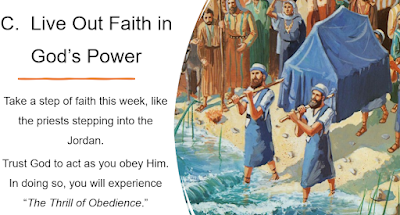
Take a step of faith this week, like the priests stepping into the Jordan. Trust God to act as you obey Him.


Memory Verse: "The hand of the Lord is mighty, that you may fear the Lord your God forever." — Joshua 4:24


As 2024 ends, this is a good opportunity to remember God’s faithfulness to you in the past 12 months and to consider where He is leading you in 2025!


END

Teacher Notes:


Joshua 3:7-4:24


Wednesday, December 25, 2024

Class Lesson December 29, 2024


The Love of Christ


Romans 5:1-11

Therefore, since we have been justified by faith, we have peace with God through our Lord Jesus Christ. 2 Through him we have also obtained access by faith into this grace in which we stand, and we rejoice in hope of the glory of God. 3 Not only that, but we rejoice in our sufferings, knowing that suffering produces endurance, 4 and endurance produces character, and character produces hope, 5 and hope does not put us to shame, because God’s love has been poured into our hearts through the Holy Spirit who has been given to us. 6 For while we were still weak, at the right time Christ died for the ungodly. 7 For one will scarcely die for a righteous person — though perhaps for a good person one would dare even to die — 8 but God shows his love for us in that while we were still sinners, Christ died for us. 9 Since, therefore, we have now been justified by his blood, much more shall we be saved by him from the wrath of God. 10 For if while we were enemies we were reconciled to God by the death of his Son, much more, now that we are reconciled, shall we be saved by his life. 11 More than that, we also rejoice in God through our Lord Jesus Christ, through whom we have now received reconciliation.


Discussion Questions

Romans 5:1 "Therefore, since we have been justified by faith, we have peace with God through our Lord Jesus Christ."

Question: What does it mean to have peace with God? How is this different from feelings of personal peace or calmness?


Romans 5:2 “Through him we have also obtained access by faith into this grace in which we stand, and we rejoice in hope of the glory of God.”

Question: How does “standing in grace” shape our understanding of our relationship with God? How does this impact our hope in daily life?


Romans 5:3-5 “Not only that, but we rejoice in our sufferings, knowing that suffering produces endurance, and endurance produces character, and character produces hope.”

Question: Why does Paul encourage believers to “rejoice in our sufferings”? How have you seen God use trials to strengthen your faith or character?


Romans 5:6-8 "But God shows his love for us in that while we were still sinners, Christ died for us."

Question: What does this verse teach us about the nature of God’s love? Why is it significant that Christ died for us while we were still sinners?


Romans 5:10-11 "For if while we were enemies we were reconciled to God by the death of his Son, much more, now that we are reconciled, shall we be saved by his life."

Question: What does reconciliation mean in this passage? How does being reconciled to God change the way we live and interact with others?


The love of God is something that is poured into every single person who is a Christian. As the love of God pours into our lives it should overflow into the lives of others. How is God calling you to display the love of God to other people this season and going into the New Year?


END

Teacher Notes:


Paul Harvey - Christmas Message


Romans 5:1-11

Therefore, since we have been justified by faith, we have peace with God through our Lord Jesus Christ. 2 Through him we have also obtained access by faith into this grace in which we stand, and we rejoice in hope of the glory of God.

3 Not only that, but we rejoice in our sufferings, knowing that suffering produces endurance, 4 and endurance produces character, and character produces hope, 5 and hope does not put us to shame, because God’s love has been poured into our hearts through the Holy Spirit who has been given to us. 6 For while we were still weak, at the right time Christ died for the ungodly. 7 For one will scarcely die for a righteous person — though perhaps for a good person one would dare even to die — 8 but God shows his love for us in that while we were still sinners, Christ died for us.

9 Since, therefore, we have now been justified by his blood, much more shall we be saved by him from the wrath of God. 10 For if while we were enemies we were reconciled to God by the death of his Son, much more, now that we are reconciled, shall we be saved by his life. 11 More than that, we also rejoice in God through our Lord Jesus Christ, through whom we have now received reconciliation.


Discussion Questions

Romans 5:1 "Therefore, since we have been justified by faith, we have peace with God through our Lord Jesus Christ."

Question: What does it mean to have peace with God?

How is this different from feelings of personal peace or calmness?

Peace with God is not merely a feeling; it’s an objective reality of restored relationship.

We stand in grace — permanently secure and welcomed into God’s favor.

Quote: “The peace we enjoy is not a truce but an abiding peace, resting upon the justice of God and the finished work of Christ.” – Charles Spurgeon

We now have peace with God, which may differ from peaceful feelings such as calmness and tranquility. Peace with God means that we have been reconciled with Him. There is no more hostility between us, no sin blocking our relationship with Him. Peace with God is possible only because Jesus paid the price for our sins through His death on the cross. Vs 1


Romans 5:2 “Through Him we have also obtained access by faith into this grace in which we stand, and we rejoice in hope of the glory of God.”

Question: How does “standing in grace” shape our understanding of our relationship with God?

Paul states that, as believers, we now stand in a place of highest privilege (“this grace in which we now stand”). Not only has God declared us not guilty; He has drawn us close to Himself. Instead of being enemies, we have become His friends – in fact His own children (John 15:15; Galatians 4:5). Vs 2

Romans 5:3-5 “Not only that, but we rejoice in our sufferings, knowing that suffering produces endurance, and endurance produces character, and character produces hope.”

Question: Why does Paul encourage believers to “rejoice in our sufferings”?

How have you seen God use trials to strengthen your faith or character?

God’s love has been “poured into our hearts” through the Holy Spirit. Even in suffering, His love is a firm anchor.

Why do you think Paul links suffering to hope? How have you seen God use trials to grow you?

As Paul clearly states in 1 Corinthians 13:13, faith, hope, and love are at heart of the Christian life. Our relationship with God begins with faith, which helps us realize that we are delivered from our past by Christ’s death. Hope grows as we learn all that God has in mind for us; it gives us the promise of the future. And God’s love fills our lives and gives us the ability to reach out to others. Vs 2-5


Romans 5:6-8 "But God shows his love for us in that while we were still sinners, Christ died for us."

Question: What does this verse teach us about the nature of God’s love?

Why is it significant that Christ died for us while we were still sinners?

All three members of the Trinity are involved in salvation. The Father loved us so much that He sent His Son to bridge the gap between us (John 3:16). The Father and the Son send the Holy Spirit to fill our lives with love and to enable us to live by His power. With all this loving care, how can we do less than serve Him completely! Vs 5-6

How does this truth challenge a performance-based view of God’s love?

We were weak and helpless because we could do nothing on our own to save ourselves. Someone had to come and rescue us. Not only did Christ come at a good time in history; He came at exactly the right time – according to God’s own schedule. God controls all history, and He controlled the timing, methods, and results of Jesus’ death. Vs 6

While we were still sinners – these are amazing words. God sent Jesus Christ to die for us, not because we were good enough, but because He loved us. Whenever you feel uncertain about God’s love for you, remember that He loved you even before you turned to Him. If God loved you when you were a rebel, He can surely strengthen you, now that you love Him in return. Vs 8


Romans 5:10-11 "For if while we were enemies we were reconciled to God by the death of his Son, much more, now that we are reconciled, shall we be saved by his life."

Question: How does being reconciled to God change the way we live and interact with others?

Reconciliation means a restored relationship — believers are no longer enemies but beloved children.

“If Christ saved us while we were enemies, how much more will His risen life sustain us now?”

How does knowing you are reconciled and secure in Christ’s life give you confidence today?


The love that caused Christ to die is the same love that sends the Holy Spirit to live in us and guide us every day. The power that raised Christ from the dead is the same power that saved you and is available to you in your daily life. Be assured that having begun a life with Christ, you have a reserve of power and love to call on each day, for help to meet every challenge or trial. You can pray for God’s power and love as you need it. Vs 9-10
God is holy, and He will not be associated with sin. All people are sinful and so they are separated from God. In addition, all sin deserves punishment, instead of punishing us with the death we deserve, however, Christ took our sins upon himself and took our punishment by dying on the cross. Now we can “rejoice in God.” Through faith in Christ’s work, we become close to God (reconciled) rather than being enemies and outcasts. Vs 11


Closing Video - Can't Post