Our Prayer

Our Prayer

Heavenly Father, I know that I have sinned against You and that my sins separate me from You. I am truly sorry. I now want to turn away from my sinful past and turn to You for forgiveness. Please forgive me, and help me avoid sinning again. I believe that Your Son, Jesus Christ, died for my sins, that He was raised from the dead, is alive, and hears my prayer. I invite Jesus to become my Savior and the Lord of my life, to rule and reign in my heart from this day forward. Please send Your Holy Spirit to help me obey You and to convict me when I sin. I pledge to grow in grace and knowledge of You. My greatest purpose in life is to follow Your example and do Your will for the rest of my life. In Jesus' name I pray, Amen.

Tuesday, March 12, 2019

Class Lesson March 17, 2019

Finding Meaning: Wisdom from Ecclesiastes


In this study we’re going to walk with the richest and smartest person in the world. Solomon built an enormous empire. He established trade with the surrounding nations. He was a living encyclopedia of knowledge. He lived a life of unrivaled luxury and pleasure. Yet with all he had, he shows us that all of it—every single bit of it—is nothing!


Nothing, that is, apart from God.


Click Here to Watch Intro


Lesson #3 The Problem With Wisdom
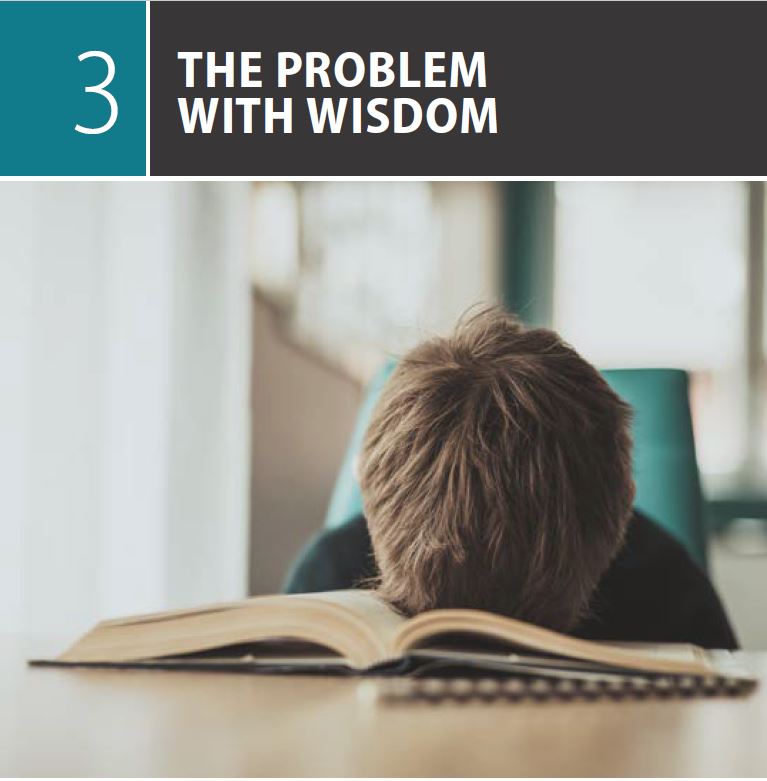


I love this picture, it reminds me of how I use to study as a kid - Osmosis...!!


THE BIBLE MEETS LIFE

Military conflicts. Civil wars. Corrupt governments. Violence. Drug addiction. The news is constantly reminding us our world is falling apart. But what can we do?

“Education is the answer!” We hear this frequently. If we’ll just educate people, they will learn to overcome their prejudices. Education will correct their thinking and take them beyond their ethnic hatred, violent temperaments, and addictions. Education will enable us to get along with each other—and with ourselves. 

If your perspective is that people are basically good, then education may seem to be the logical solution: good people can be taught to choose what is good and right. Unfortunately, that is not the case; it’s certainly not the biblical perspective. The Bible reminds us that our sin and rebellion are at the root of the world’s problems. Education has its benefits to be sure, but it can only do so much. What we need is the wisdom that comes from God.


WHAT DOES THE BIBLE SAY?


Ecclesiastes 2:12-17

12 Then I turned my thoughts to consider wisdom, and also madness and folly. What more can the king’s successor do than what has already been done? 13 I saw that wisdom is better than folly, just as light is better than darkness. 14 The wise have eyes in their heads, while the fool walks in the darkness; but I came to realize that the same fate overtakes them both. 15 Then I said to myself, “The fate of the fool will overtake me also. What then do I gain by being wise?” I said to myself, “This too is meaningless.” 16 For the wise, like the fool, will not be long remembered; the days have already come when both have been forgotten. Like the fool, the wise too must die! 17 So I hated life, because the work that is done under the sun was grievous to me. All of it is meaningless, a chasing after the wind. 

No one in the world was wiser than Solomon. So, in his quest to find meaning in life, it’s not surprising that Solomon would turn “to consider wisdom, and also madness and folly.” 

Verse 12 is hard to interpret. “What more can the king’s successor do than what has already been done?”

We can understand this verse in two ways.

  • No matter what king came after Solomon, he would have to deal with these same issues.                                                                                                                                                                   
  • Since Solomon was the wisest person in the world, no other king after him would be able to do any better.

Both interpretations make sense, and the point stands with either one: Whoever came after Solomon would fare no better in trying to explain the world through human wisdom; he would do well to do as Solomon had done.


But wisdom is right thinking that leads to right living. Wisdom and righteous living are wound tightly together. Conversely, folly results in unrighteous living. Solomon turned to investigate the difference between wisdom and folly and he unearthed three realities:


  1. Even in this life, there is more to gain from wisdom than from folly. Just as light has advantages over darkness, so also “The wise have eyes in their heads”; that is, he is able to see, “while the fool walks in the darkness.” In a world where wisdom abounds, others benefit from the wise person.                                                                                                                            
  2. Whether we live a good life or a wicked life, we all still die and are forgotten. In the end, Solomon said, it doesn’t matter how we live this life on earth because the wise and the foolish, the righteous and the unrighteous, all share the same fate : death! Wisdom may mean a healthier lifestyle, and we might prolong our lives by several years, but still, in the end, we die.                                                                                                                              
  3. Trying to live a righteous life apart from God only leads to frustration and grief. When you consider the fate of humanity, whether you live a good life or not, what’s the point? The pointlessness and futility of it all can make someone like Solomon hate life. From a purely secular viewpoint, it makes no difference how we live this life if we can’t escape death. 


Ecclesiastes 7:23-25

23 All this I tested by wisdom and I said, “I am determined to be wise”—but this was beyond me. 24 Whatever exists is far off and most profound—who can discover it? 25 So I turned my mind to understand, to investigate and to search out wisdom and the scheme of things and to understand the stupidity of wickedness and the madness of folly. 

Even with all its advantages, human wisdom cannot answer life’s ultimate questions. From a secular point of view—a view of life lived only “under the sun”—human wisdom cannot explain: the intelligent design of the universe, order as opposed to chaos, the complex design of the human body, or concepts such as love or joy.


Solomon resolved to test “all this I tested by wisdom.” In other words, he applied human wisdom to what he saw and experienced all around him. Yet, he had to admit, “This was beyond me.” The existence of the world with all its intricacies was “far off and most profound” when he tried to explain it by mere human wisdom.

Notice the language Solomon used in verse 25: he endeavored to “to understand, to investigate and to search.” Solomon took care to try to understand and explain all things by human wisdom. This wasn’t just some casual exercise; he worked at it, but it was beyond him.

It’s not just the good things that the wisdom of this world cannot explain. Human wisdom also has no explanation for “wickedness.” Human wisdom may be sufficient to “understand the stupidity of wickedness and the madness of folly,” but it can’t explain why.

Life “under the sun” (2:17) and wisdom apart from God want to assume all people are good, but the environment, lack of education, or absence of first-world perks ruins them. Even highly educated people living in the ideal first-world environment do evil things, and the world is left wondering why.


Ecclesiastes 7:26-29 

26 I find more bitter than death the woman who is a snare, whose heart is a trap and whose hands are chains. The man who pleases God will escape her, but the sinner she will ensnare. 27 “Look,” says the Teacher, “this is what I have discovered: “Adding one thing to another to discover the scheme of things— 28 while I was still searching but not finding—I found one upright man among a thousand, but not one upright woman among them all. 29 This only have I found: God created mankind upright, but they have gone in search of many schemes.”


Though Solomon’s quest to find meaning by pursuing wisdom proved impossible, his search produced three conclusions:

1. Sin affects our relationships. On the surface, Solomon sounds extremely “anti-woman” in verses 26-28, but from a male perspective, he was addressing the continuing conflict between men and women. Because of sin, the marriage relationship can often be a place of conflict.                                                                                                                                                                             
2. Wisdom is rare in this world. Solomon confessed that he only found “one upright man among a thousand” who was wise, and “not one upright woman among them all.” Again, this sounds biased against women, but remember Solomon didn’t have the best experience with women. Solomon had disobeyed God’s command by marrying hundreds of pagan wives (1 Kings 11:1-6).                                                                                                                                                                         
3. All humanity is sinfully corrupt. Only when we pursue God will we find the wisdom we need to answer life’s questions and to live righteously in this world. Divine wisdom is a gift from God that gives us insight into His character, His will, and His ways. When we embrace His wisdom, it results in righteous living.

This divine wisdom provides the answer to the problem of evil. When God made this good world, Solomon declared, he “created mankind upright.” But instead of living in this upright state and pursuing God, Adam and Eve pursued their own sinful scheme to be like God. And we continue today to foolishly pursue our own schemes.

But that’s not the end of the story! God came to earth to bring us back to Himself. The wisdom we need comes from pursuing God through faith in Jesus, and that wisdom leads to righteous living.


LIVE IT OUT


When we pursue God, He promises to give us the wisdom we need that leads to righteous living. How will you pursue God this week?

Choose one of the following applications:
  
  • Consider God’s good creation. On a clear night this week, go outside and look up at the stars. Read Genesis 1 and Psalm 8, and thank God for His wise and creative work.                                                                                                                                                                     
  • Memorize Scripture. Memorize a passage such as Proverbs 3:5-6. This week, think of ways you can pursue God and trust in His wisdom, rather than relying on yourself.                                                          
  • Have a conversation. Spend time with unbelieving friends, and ask them how they might explain the problems in the world and the nature of sin and evil. As you listen without judging, pray and seek the opportunity to share the gospel and the wisdom of God.

With all the information available to us, it’s easy to lean on our own wisdom. Instead, let’s pursue God and the wisdom He offers. That’s the only wisdom worth possessing.


Hope to see you on Sunday!


In His Love,

David & Susan


Teacher Notes:


Click Here to Watch


THE PROBLEM WITH WISDOM


How to Learn from Solomon, the Wisest Fool in the Bible


Solomon – one of Israel’s kings, whose life is depicted in the Bible’s Old Testament – is known as the wisest man who ever lived, apart from Jesus Christ. Yet despite his incredible God-given wisdom, Solomon still made many foolish decisions. Why? 

Each time, Solomon turned his attention away from God and toward the world’s temptations, such as privilege, power, riches, sex, and the accolades of others. As he did, he fell into sin that led him into destructive situations that ruined his life.

Solomon’s life shows that no one is wise enough to outsmart sin. No matter how smart you are or how much you love God, sin can seduce you if you don’t intentionally guard yourself against it and pursue more of God’s wisdom every day.

From the earliest age, we were taught the value of education – not just “book smarts,” but “street smarts” also. No matter how much we know, the greater value is in knowing how to apply and live out what we know. Solomon certainly was wise, but even he discovered that living by wisdom itself was not enough. The greatest wisdom comes from trusting God. The wisdom God gives passes the test imposed by life’s most critical situations. 

Genesis 3:6 When the woman saw that the fruit of the tree was good for food and pleasing to the eye, and also desirable for gaining wisdom, she took some and ate it. She also gave some to her husband, who was with her, and he ate it. 7 Then the eyes of both of them were opened, and they realized they were naked; so they sewed fig leaves together and made coverings for themselves.


Ecclesiastes 2:12-17

12 Then I turned my thoughts to consider wisdom, and also madness and folly. What more can the king’s successor do than what has already been done? 13 I saw that wisdom is better than folly, just as light is better than darkness. 14 The wise have eyes in their heads, while the fool walks in the darkness; but I came to realize that the same fate overtakes them both. 15 Then I said to myself, “The fate of the fool will overtake me also. What then do I gain by being wise?” I said to myself, “This too is meaningless.” 16 For the wise, like the fool, will not be long remembered; the days have already come when both have been forgotten. Like the fool, the wise too must die! 17 So I hated life, because the work that is done under the sun was grievous to me. All of it is meaningless, a chasing after the wind. 


According to Solomon, how are the wise different from the foolish? How are they similar?

How does trust in God’s wisdom bring value to your life?


I. Wisdom has its advantages, but by itself, it is not enough.

· Living wisely is to be desired over behaving foolishly.

· Death will claim both the wise and the foolish; it is the great equalizer.

· As advantageous as it is to act wisely, even the wisest person cannot know the full meaning of life from God.


2:16 Solomon realized that wisdom alone cannot guarantee eternal life. Wisdom, riches, and personal achievement matter very little after death – and everyone must die. We must not build our lives in perishable pursuits, but on the solid foundation of God. Then even if everything we have is taken away, we still have God, who is all we really need anyway. This is the point of the book of Job. See intro: Trees snap like toothpicks or fly upward, wrenched from the earth. Whole rooftops sail, cars tumble like toys, walls collapse, and a mountain of water jumps the shore and engulfs the land. A hurricane cuts and tears, and only solid foundations can be used for rebuilding after the storm. For any building, the foundation is critical. It must be deep enough and solid enough to withstand the weight of the building and other stresses. Lives are like buildings, and the quality of their foundation will determine the quality of the whole. Too often inferior materials are used, and when tests come, lives crumble. Job was tested. With a life filled with prestige, possessions, and people, he was suddenly assaulted on every side, devastated, stripped down to his foundation. But his life was built on God, and he endured. As you read Job, analyze your life and check your foundation. And may you be able to say that when all is gone but God, He is enough. 


2:16 Is death the ultimate equalizer of all people, no matter what they attain in life? While this appears to be true from an earthly perspective, God makes it clear (as Solomon later points out in 12:14) that what we do here has a great impact upon our eternal reward. (“For God will bring every deed into judgment, including every hidden thing, whether it is good or evil.”) 


Ecclesiastes 7:23-25

23 All this I tested by wisdom and I said, “I am determined to be wise”—but this was beyond me. 24 Whatever exists is far off and most profound—who can discover it? 25 So I turned my mind to understand, to investigate and to search out wisdom and the scheme of things and to understand the stupidity of wickedness and the madness of folly.


What are some things you’ve found human wisdom alone not to be able to answer?

What are some of the best ways a person can gain wisdom in life?


II. Wisdom has its limits in our finite minds.

· Our best efforts at trying to live wisely in our own strength or by our own ability will come up short, for we are flawed beings.

· Absolute wisdom is beyond our ability to comprehend in all its fullness, no matter how hard we try.


7:23-25 Solomon, the wisest man in the world, confessed how difficult it had been to act and think wisely. He emphasized that no matter how much we know, there are always mysteries we will never understand. So, thinking you have enough is a sure sign you don’t.


Ecclesiastes 7:26-29 

26 I find more bitter than death the woman who is a snare, whose heart is a trap and whose hands are chains. The man who pleases God will escape her, but the sinner she will ensnare. 27 “Look,” says the Teacher, “this is what I have discovered: “Adding one thing to another to discover the scheme of things— 28 while I was still searching but not finding—I found one upright man among a thousand, but not one upright woman among them all. 29 This only have I found: God created mankind upright, but they have gone in search of many schemes.”


What is the relationship between human wisdom and human sinfulness?

What strategies have you used to pursue Godly wisdom?


III. The wisdom we need comes from pursuing God and living righteously.

· Our search for wisdom can become railroaded by many distractions, at least one being the way we relate to one another, especially illicit or unhealthy relationships with those of the opposite gender. 

· When we live daily in right relationship with the Lord we can be equipped to escape whatever would deceive, trap, and destroy us. 

· Not that we are seek them out or desire them, but painful experiences can become good teachers that make us wise.

· The wisdom we need to live life and face life issues comes from pursuing God and striving to live righteously. 


7:27-28 Did Solomon think women were not capable of being upright (wise and good)? No, because in the book of Proverbs he personified wisdom as a responsible woman. The point of Solomon’s statement is not that women are unwise, but that hardly anyone, man or woman, is upright before God. In his search, Solomon found that goodness and wisdom were almost as scarce among men as among women, even though men were given a religious education program in his culture and women were not. In effect, the verse is saying, “I have found only one in a thousand people who is wise in God’s eyes. No. I have found even fewer than that!”


7:29 God created human beings to live uprightly and do what is right. Instead, they have left God’s path to follow their own downward road.


LIVE IT OUT

The problem with human wisdom is it doesn’t work. Oh, yes, it has advantages over acting foolishly, but in the long term, our wisdom does not provide the fulfillment we seek. The New Testament gives another perspective. Paul stated it in a portion of his prayer for his Ephesian friends. He prayed for them “to know the love of Christ, which passeth knowledge, that ye might be filled with all the fullness of God” (Eph. 3:19). While God’s love is so great it cannot be completely known in the sense of being understood, it is knowable in the sense that God allows us to draw on His great resource of love, which enables and equips us to know Him better and live life fuller. Resting in His love is the wisest action a person could ever take. 


The apostle Paul was incredibly brilliant, but he said, “For I resolved to know nothing while I was with you except Jesus Christ and him crucified” (1 Cor. 2:2).


In the end that’s the only knowledge that matters.


Go ahead and get an education. Learn—and keep learning. Improve your mind, but in the end, know this: what matters in both this life and for eternity is your personal knowledge and relationship with Jesus Christ. The wisest thing anyone can do has nothing to do with education or books. It has to do with trusting Jesus Christ and living under His lordship. “But grow in the grace and knowledge of our Lord and Savior Jesus Christ. To him be glory both now and forever! Amen” (1 Pet. 3:18).


Can you recall a time when you relied on what you knew in dealing with a life situation only to discover it was not sufficient?

Can you recall an experience when you were sustained in a similar situation by pursuing the things of God and living in right relationship with Him?

How did He make a difference for you?


Added Commentary:

The curse of knowledge refers to the natural psychological tendency to forget what it is like not to know something once we have become expert at it. As a result, it becomes virtually impossible for us to share our knowledge with others since we are incapable of recreating our listeners’ state of mind. Psychologists, therefore, have found that knowing too much or possessing too much expertise in a particular field proves to be a severe drawback when it comes to communicating and sharing knowledge. 


The curse of knowledge also proves disastrous in our pursuit of meaning and satisfaction. Solomon’s experimentation of life’s pursuits transitioned from the pleasure-seeking hedonist to the fact-seeking professor. He moved from delighting his senses to testing his mental capabilities. It’s almost as if he were saying, “I’ve tried stimulating my body, now I’m going to examine my mind.” He considered wisdom, or the pursuit of knowledge, to find fulfillment and satisfaction in life. For him, like pleasure, it became a curse.


Solomon discovered the following in the testing of his knowledge.


1. The Fact (2:13-14a, 7:23-29)

· Wisdom is better than folly in some respects. In living life, wisdom has distinct advantages. It does provide incredible benefits. Interestingly, Solomon wrote extensively about the value of wisdom in Proverbs. And, any sane person would prefer wisdom to folly for it leads to a whole and healthy life. In all probability, wisdom does add value and longevity to life. But, in the long run, neither wisdom or folly provide the key to discovering real meaning in life. If all one does is pursue knowledge, and if they do amass great intellect, emptiness and futility are still possible if the spiritual side of life has been left unattended. It’s interesting that Solomon did not acquire what another intellect, Albert Einstein, learned: “The more I learn, the more I realize I don’t know.”

Solomon should have realized that the source of fulfillment and satisfaction came from a source outside the limits of his understanding.


2. The Fate (2:14b-16)

The fate of both the wise and the folly are the same: they die and are forgotten. Solomon concluded that at the end of life the wise and the fool both die and are no longer remembered. He was right.

· All people die. During World War II, C. S. Lewis pointed out that even war does not increase death: death is total in every generation. George Bernard Shaw wrote, “The statistics on death are quite impressive. One out of one people die.” Later in this journal Solomon wrote, “Death is the destiny of every man” (Ecclesiastes 7:2 NIV). Death is inevitable. The wise remember the brevity of life. Exercise may buy us a few more heartbeats. Medicine may grant us a few more breaths. But in the end, there is an end.


· All people are forgotten. Well, maybe not everyone, but most everyone is forgotten. Outside of the heroic—who accomplish great feats, the philanthropic— who give great gifts, the artistic—who create great masterpieces, and a few other noble and historical figures, most people are forgotten, in time. It's not a crime or a sin, and it's not that people don’t make an impact on their part of the world while they are living, it's just that over time their name, mark, and influence is no longer remembered. People die and are eventually forgotten. It is, in a sense, a curse upon humanity.


3. The Futility (2:17)

The pursuit of knowledge also leads to vanity and meaningless, a grasping for smoke.


And, this futility had a personal curse on Solomon. It led to:

· Depression. Solomon concluded, “I hate life” (v. 17). In spite of his overabundance of possessions and knowledge Solomon didn't enjoy life. He was discouraged, cynical, and in despair. He was like many rich and famous people who keep professional psychologists, psychiatrists, and counselors overworked every year. A proverb states, “You’ll break the bow if you always keep it bent.” It’s as though Solomon kept the bow of his life bent, either through his enterprise, entertainment, or education. And, as a result, his life was at the breaking point. I’m sure he thought, Why go on? What’s the use of living? Let’s end this rat race now. He was a man on a slippery slope, nearing the point of no return. He needed to step back to realize that help and hope would come from outside himself.

· Stress. Solomon wrote, “The work which I have done was grievous to me” (v. 17). Solomon exhibited the outward sign of the knowledge curse by seeking for meaning and satisfaction in the longing for pleasure and the pursuit of knowledge. That sign was stress. His mode of life, the way he threw himself into his search for meaning was the principal cause of his illness. According to the American Academy of Family Physicians, two-thirds of office visits to family doctors are stress-related symptoms. Stress is a significant contributor, either directly or indirectly, to coronary heart disease, cancer, lung ailments, accidental injuries, cirrhosis of the liver, and suicide.

· Emptiness. “I found everything to be futile and a pursuit of the wind” (v. 17) was the refrain for Solomon’s empty life. Pleasure had not filled the void, and now knowledge had not satisfied his yearning for meaning and purpose. He was an unfilled and hollow man.


Conclusion: The curse of knowledge is the root of many people’s problems. We think we know what we need to know to find meaning and purpose. But what we don’t know will destroy us in the end. Or, we have accepted false information—enjoy life, do what feels right, get a good education, establish a career—and you’ll be happy. Ernest Hemingway at age 25, sipped champagne in Paris, and later had well-publicized game hunts in Africa and hunted grizzly bears in America's northwest. At the age of sixty-one, after having it all—wine, women, song, a distinguished literary career, and Sunday afternoon bullfights in Spain—Hemingway chose to end his life, blowing his head off, leaving a note saying, “Life is one damn thing after another.” We need to wake up to the fact, fate, and futility associated with the problem of wisdom before we’re sixty-one-years-old.


The greatest things in life aren’t things.

“A life devoted to things is a dead life, a stump; a God-shaped life is a flourishing tree.”

Proverbs 11:28 MSG


"What is wisdom? What is the difference between wisdom and knowledge?"


Wisdom and knowledge, both recurring themes in the Bible, are related but not synonymous. The dictionary defines wisdom as “the ability to discern or judge what is true, right, or lasting.” Knowledge, on the other hand, is “information gained through experience, reasoning, or acquaintance.” Knowledge can exist without wisdom, but not the other way around. One can be knowledgeable without being wise. Knowledge is knowing how to use a gun; wisdom is knowing when to use it and when to keep it holstered.

God wants us to have knowledge of Him and what He expects of us. In order to obey Him, we have to have knowledge of the commands. But as equally important as having knowledge is having wisdom. Knowing facts about God and the Bible is not all there is to wisdom. Wisdom is a gift from God. James 1:5 states, “If any of you lacks wisdom, you should ask God, who gives generously to all without finding fault, and it will be given to you.” God blesses us with wisdom in order for us to glorify Him and use the knowledge we have of Him.

The book of Proverbs is perhaps the best place in the Bible to learn of biblical wisdom. Proverbs 1:7 speaks of both biblical knowledge and wisdom: “The fear of the LORD is the beginning of knowledge, / but fools despise wisdom and instruction.” To fear the Lord is to start on the path to knowledge, and God can then begin to provide us with wisdom through Christ, who the Bible says is wisdom itself: “It is because of him that you are in Christ Jesus, who has become for us wisdom from God—that is, our righteousness, holiness and redemption” (1 Corinthians 1:30).


Knowledge is what is gathered over time through study of the Scriptures. It can be said that wisdom, in turn, acts properly upon that knowledge. Wisdom is the fitting application of knowledge. Knowledge understands the light has turned red; wisdom applies the brakes. Knowledge sees the quicksand; wisdom walks around it. Knowledge memorizes the Ten Commandments; wisdom obeys them. Knowledge learns of God; wisdom loves Him. 


Tuesday, March 5, 2019

Class Lesson March 10, 2019

Finding Meaning: Wisdom from Ecclesiastes


In this study we’re going to walk with the richest and smartest person in the world. Solomon built an enormous empire. He established trade with the surrounding nations. He was a living encyclopedia of knowledge. He lived a life of unrivaled luxury and pleasure. Yet with all he had, he shows us that all of it—every single bit of it—is nothing!


Nothing, that is, apart from God.


Let’s join Solomon on his exploration of life “under the sun.” We’ll see clues along the way of the purpose and meaning God provides when we live life keeping our perspective “above the sun.” We’ll be both challenged and encouraged to see how wonderful our God is and how much He wants for us to enjoy this brief life He’s given us.


Click Here to Watch Intro


Lesson #2 The Problem With Pleasure


THE BIBLE MEETS LIFE


Roman Catholics and many Protestants observe Lent, a time when they will fast from some desired thing for forty days prior to Easter. Lent begins on Ash Wednesday, but observers use the Tuesday before as their last day to eat fatty foods. That day became known as “Fat Tuesday”—or as we commonly know it: Mardi Gras. 

Somewhere along the way, Mardi Gras changed from a time to indulge in fatty foods to a pursuit of every kind of carnal and sinful pleasure. Many cities and regions celebrate Mardi Gras, but this worldly pursuit is perhaps most closely associated with the French Quarter in New Orleans.

But people don’t have to wait for Mardi Gras to pursue countless worldly pleasures. We live in a day and age where the pursuit of pleasure is available at the click of a mouse or a call on a cell phone. Today’s world lives for pleasure. If you want it, buy it. Don’t hold back from whatever you want to make you happy. 

Worldly pleasures may seem enjoyable, but the enjoyment is brief and temporary. Worldly pleasures will always leave us empty.


WHAT DOES THE BIBLE SAY?


Ecclesiastes 2:1-3 

1 I said to myself, “Come now, I will test you with pleasure to find out what is good.” But that also proved to be meaningless. 2 “Laughter,” I said, “is madness. And what does pleasure accomplish?” 3 I tried cheering myself with wine, and embracing folly—my mind still guiding me with wisdom. I wanted to see what was good for people to do under the heavens during the few days of their lives.


As you read Ecclesiastes, keep in mind the phrase Solomon frequently used: “under the sun” (Ecc. 1:3). “Under the sun” reflects a worldview where nothing exists above the sun: no heavens, nothing supernatural, and no God. So then, to live a life solely “under the sun” is to live a life without God. To view life as only “under the sun” is to have a purely secular worldview. 

If this world is all there is, what’s the point? So why not pursue pleasure? If God doesn’t exist, and if this life is all there is, then perhaps I should derive what meaning I can in my personal happiness and the stuff I accumulate. Isaiah later saw this attitude in the rebellious nation: “Let us eat and drink … for tomorrow we die!” (Isa. 22:13). Solomon tested this idea to see if he could find true joy and fulfillment in pleasure. 

When Solomon said, “I said to myself,” he literally said, “I said in my heart.” This was a serious search. Solomon was putting himself in the secularist’s shoes. Solomon wanted to “test” whether or not pleasure leads to lasting joy. This is an important lesson for all of us. Before we discount those with whom we disagree, it’s important to try to understand where they’re coming from. Of course, that doesn’t mean we have to know everything about others’ beliefs or that we should experience every bit of immorality and debauchery to understand the worldly person. Rather, we should examine the reasons why people are motivated to live their lives the way that they do. 


Solomon mentioned two areas of pleasure he investigated: 

Laughter. Sometimes we try to overcome awkward situations with laughter. We may even hope to overcome grief with laughter, but “even in laughter the heart may ache” (Prov. 14:13). Laughter is no indication of real joy. Solomon discovered that pleasure and laughter fall short. 

Alcohol. Solomon discovered the use of wine did not bring fulfillment. Solomon was not talking about drunkenness. He drank wine but apparently without allowing himself to become intoxicated. He was very careful here. “I tried cheering myself with wine … my mind still guiding me with wisdom.” Solomon wanted to discover if using alcohol was “what was good for people to do under the heavens” during their short lives. 

What Solomon described could be a script for one of many alcohol commercials: a mixture of alcohol and laughter. Everyone has a drink in hand and laughter abounds. Advertisers want to convince us this is the “good life.” But Solomon showed us the sobering reality that these “pleasures” accomplished nothing. “But that also proved to be meaningless.”


Ecclesiastes 2:4-8 

4 I undertook great projects: I built houses for myself and planted vineyards. 5 I made gardens and parks and planted all kinds of fruit trees in them. 6 I made reservoirs to water groves of flourishing trees. 7 I bought male and female slaves and had other slaves who were born in my house. I also owned more herds and flocks than anyone in Jerusalem before me. 8 I amassed silver and gold for myself, and the treasure of kings and provinces. I acquired male and female singers, and a harem as well—the delights of a man’s heart. 


Since seeking pleasure for pleasure’s sake accomplishes nothing, maybe building a personal empire will give our lives the meaning we crave. Notice the self-focus in Solomon’s words: “great projects … houses … for myself.” Solomon probed meaning in four areas:

1. Building projects. Solomon was a master builder. King David had made all the preparations for building the temple, but his son, Solomon, actually built it (1 Kings 5–6), as well as his own palace (7:1-12). 

2. Accumulating wealth. Wealth in the ancient world was also evidenced by how many servants you had, and Solomon had acquired plenty of them. Solomon’s wealth was not “new money”; he had servants long enough that they had children who also served in Solomon’s house. 

3. Patronizing the arts. Solomon not only had an abundance of slaves, he also “acquired male and female singers.” Here was Solomon’s personal choir. He could bring them out if he wanted to be entertained. 

4. Indulging himself sexually. Solomon’s downfall was his sexual indulgences with numerous women. “He had seven hundred wives of royal birth and three hundred concubines, and his wives led him astray” (1 Kings 11:3). 

When we look for meaning by building our personal empires and accumulating possessions, it may appear to the world that we have it all. But “stuff” does not satisfy. It does not fill us with purpose and meaning. Possessions, wealth, and self-focus fills us with everything except what matters.


Ecclesiastes 2:9-11 

9 I became greater by far than anyone in Jerusalem before me. In all this my wisdom stayed with me. 10 I denied myself nothing my eyes desired; I refused my heart no pleasure. My heart took delight in all my labor, and this was the reward for all my toil. 11 Yet when I surveyed all that my hands had done and what I had toiled to achieve, everything was meaningless, a chasing after the wind; nothing was gained under the sun.


Solomon achieved abundant wealth, so that he could easily claim, “I became greater by far than anyone in Jerusalem before me.” That’s not bad, considering that King David was his father. Accounting for inflation, Solomon would still likely be one of the richest persons in today’s world (1 Kings 10:14-29). 

The limitless pursuit of pleasure is no reward. After all his success, Solomon claimed he had earned the right to enjoy every pleasure under the sun. He saw this as his reward to himself for all his struggles. 

In spite of his pursuit of pleasure, Solomon couldn’t escape “toll.” Because we’re sinners in a sinful world, we’ll never escape toil in this present life. Solomon justified his pursuit of pleasure as something he deserved, but this “reward” proved to be no reward at all. 

The self-absorbed focus on our achievements leaves us empty. Solomon came face to face with everything he had accomplished and all that he had labored to achieve. His conclusion in verse 11 is startling: “meaningless, a chasing after the wind; nothing was gained under the sun.” It’s as if Solomon was trying to exhaust all the negative vocabulary he used throughout the book to exclaim, “It all comes to nothing!” 

If this life is all there is, and if we live life like Solomon, thinking that the world owes us, our job owes us, and everybody owes us for all we’ve done; then we, too, will come up empty. Pleasure and possessions may feel like a reward for our work, but it is a reward that doesn’t last. 


LIVE IT OUT


Only God gives us lasting joy. Start cultivating this lasting joy in your life this week. Choose one of the following applications: 

Give God the glory. How can you fight against the empty pursuit of pleasure? Identify something you enjoy—and do it. But do it to honor Christ and give God the glory. 

Memorize Scripture. Memorize a passage such as Philippians 4:4-7 and recall it when you become anxious, discouraged, or the toils of your own struggle tempt you to seek “reward” in the wrong way. 

Acknowledge the achievements of others. Too often, we get caught up in our own achievements. That leads to a false “reward” mentality. Contact others and thank them for their achievements. Encourage them. Consider how to do this in ways that also affirm them in the presence of others. 

God is not against pleasures. Allow Him to be the source of your joy. Your greatest pleasure is God Himself.


Hope to see you on Sunday! 


In His Love,


David & Susan


Solomon Today? - Tom Brady / Warren Buffett / Donald Trump


The Preacher’s search to find meaning for life continued. Surely, life is more than mere existence. Surely, God put us on this earth for a reason. So where would the Preacher turn next in his pursuit to unravel this riddle of life? Having failed to find meaning of life through wisdom, he next looked at other pleasures, specifically those associated with personal accomplishment and accumulation of wealth. With that in mind, the Preacher engaged in an experiment. He devoted himself to doing the kinds of things that he thought would bring him the greatest pleasure. Therein he hoped to find the meaning and purpose of life that had heretofore escaped him.


The greatest things in life aren’t things. 

“A life devoted to things is a dead life, a stump; a God-shaped life is a flourishing tree.” 

Proverbs 11:28 MSG


We too have fallen victim to this experiment in flawed thinking. His mistake becomes our mistake. We convince ourselves that the more we do and the more we possess, the more fulfilled we will be. The Preacher learned his lesson. In the end, those things won’t matter. And they still don’t, but we try them anyway. The treasures of this world will fail; the desires of this world will pass away. 


Only what we do and what we become in Christ will last.


Introduction: A bungee jumper experiences a rush of adrenaline, an emotional high, a thrill of excitement, a controlled near-death experience, but then they are dangling, waiting for the next joy ride. A line in a country song by Jeff Bridges says:


"Funny how falling feels like flying, for a little while.”


In the words of comedian Jerry Seinfeld: “Everybody's looking for good sex, good food, and a good laugh. They're little islands of relief in what's often a painful existence.” People on a pleasure safari soon discover that it takes a bigger thrill and a higher rush to satisfy their senses. In time, their pursuits get them nowhere. Perhaps no one was more qualified to explore the endless pursuit of pleasure than Solomon. If bungee jumping were around in his day, he would have tried it. He did not withhold any pleasure from his heart, because he considered pleasure the fair return for his labor. With all this, he was disgruntled. He had taken the jump, pursued the thrills, and, like the bungee jumper, he was left dangling. 


Ecclesiastes 2:1-3 

I said to myself, “Come now, I will test you with pleasure to find out what is good.” But that also proved to be meaningless. “Laughter,” I said, “is madness. And what does pleasure accomplish?” I tried cheering myself with wine, and embracing folly—my mind still guiding me with wisdom. I wanted to see what was good for people to do under the heavens during the few days of their lives. 


Why are pleasures of this life so attractive to us? 


In spite of all the advertising around us, how can we remind ourselves that life is really about living for God, not ourselves? 


I. Living for pleasure accomplishes nothing. 

· Many a person has sought to find meaning in life in the pleasures of life only to come up short. 

· The search for pleasure itself has led some people to turn to the consumption of alcohol, which soon became a cruel master rather than a purveyor of pleasure. 

· Life is brief and need not be wasted in useless pursuits. 

· We may not be as strong in managing our desires as we convince ourselves we are. 


2:1 Solomon conducted his search for life’s meaning as an experiment. He first tried pursuing pleasure. He undertook great projects, bought slaves and herds and flocks, amassed wealth, acquired singers, added many women to his harem, and became the greatest person in Jerusalem. But none of these gave him satisfaction. Some of the pleasures Solomon sought were wrong and some were worthy, but even the worthy pursuits were futile when he pursued them as an end in themselves. We must look beyond our activities to the reasons we do them and the purpose they fulfill. Is your goal in life to search for meaning or to search for God who gives meaning? 


Solomon mentioned two areas of pleasure he investigated: 


· Laughter. Sometimes we try to overcome awkward situations with laughter. We may even hope to overcome grief with laughter, but “even in laughter the heart may ache” (Prov. 14:13). Laughter is no indication of real joy. Solomon discovered that pleasure and laughter fall short. 


· Alcohol. Solomon discovered the use of wine did not bring fulfillment. Solomon was not talking about drunkenness. He drank wine but apparently without allowing himself to become intoxicated. He was very careful here. “I tried cheering myself with wine … my mind still guiding me with wisdom.” Solomon wanted to discover if using alcohol was “what was good for people to do under the heavens” during their short lives. 


What Solomon described could be a script for one of many alcohol commercials: a mixture of alcohol and laughter. Everyone has a drink in hand and laughter abounds. Advertisers want to convince us this is the “good life.” But Solomon showed us the sobering reality that these “pleasures” accomplished nothing. “But that also proved to be meaningless.” 


Ecclesiastes 2:4-8 

I undertook great projects: I built houses for myself and planted vineyards. I made gardens and parks and planted all kinds of fruit trees in them. I made reservoirs to water groves of flourishing trees. I bought male and female slaves and had other slaves who were born in my house. I also owned more herds and flocks than anyone in Jerusalem before me. I amassed silver and gold for myself, and the treasure of kings and provinces. I acquired male and female singers, and a harem as well—the delights of a man’s heart. 


Many people are driven to accomplish great things and to acquire great things, but in the end, they are still just things! Satisfying only for the moment, temporary achievements and happiness. 


When have you seen an increase in possessions lead to an increase in problems? 


Many people spend their lives trying to create a lasting legacy on earth. They want to be remembered when they’re gone. What ultimately matters most will not be what others say about your life but what God says. 


People fail to realize that all achievements are eventually surpassed, records are broken, reputations fade, and tributes are forgotten. 

In college, James Dobson’s goal was to become the school’s tennis champion. He felt proud when his trophy was prominently placed in the school’s trophy cabinet. Years later, someone mailed him that trophy. They had found it in a trashcan when the school was remodeled. Jim said, “Given enough time, all your trophies will be trashed by someone else!” 


Living to create an earthly legacy is a shortsighted goal. A wiser use of time is to build an eternal legacy. You weren’t put on earth to be remembered. You were put here to prepare for eternity. 


One day you will stand before God, and He will do an audit of your life, a final exam, before you enter eternity. The bible says, “Remember, each of us will stand personally before the judgment seat of God…Yes, each of us will have to give a personal account to God.” 


God wants us to pass this test so He has given us the questions in advance and there are only two: 


1. What did you do with My Son, Jesus Christ? Did you accept what Jesus did for you and did you learn to love and trust Him? 


2. What did you do with what I gave you? What did you do with your life – all the gifts, talents, opportunities, energy, relationships, and resources God gave you? Did you spend them on yourself, or did you use them for the purposes God made you for? 


II. Possessions fill our lives with everything except what matters. 

· Human accomplishments are noteworthy, but if they are undertaken only for selfish purposes, they will fall short of having any long-lasting meaning or effect. 

· Possessions are not evil in themselves, but they will not provide lasting satisfaction. 

· Other people are not to be valued only for what they can do for us, but as individuals who have value and purpose in God’s sight for His holy purposes. 

· In the end, what we have done or what we possess won’t matter if we are without the Lord. 


1. The Characteristics of the Pleasure-Seeking Life 


What are some signs that indicate one is seeking pleasure to find meaning? Solomon’s journal reveals several. 


• A pleasure-seeking life is abnormally busy (vv. 4, 11). Busyness is not wrong in itself, but it causes pleasure-prone people to neglect relationships with spouse, family, friends, and God. Busyness drives these people. Rarely do they think they have accomplished enough. As a result, they strain every minute starting more projects while burning the candle at both ends. They operate on the precept that a reputation for busyness is a sign of success and personal importance. 

• A pleasure-seeking life is gratified only by accomplishment and the symbols of triumph (v. 9). The pleasure-seeking life is often a constant pursuit of gaining more—more attention, more power, more titles, more degrees, more material assets, more, more, more. 

• The pleasure-seeking life is unordered and undisciplined (v. 10). Solomon couldn't say no. He operated according to the maxim, "If it feels good, do it." The pleasure seeker is out of control because they lack discipline. Life contains no order. Whims dictate their actions. They avoid discipline like the plague rather than desire it. 


Since seeking pleasure for pleasure’s sake accomplishes nothing, maybe building a personal empire will give our lives the meaning we crave. Notice the self-focus in Solomon’s words: “great projects … houses … for myself.” When we look for meaning by building our personal empires and accumulating possessions, it may appear to the world that we have it all. But “stuff” does not satisfy. It does not fill us with purpose and meaning. Possessions, wealth, and self-focus fills us with everything except what matters. 


2:4-6 Solomon had built houses, a temple, a kingdom, a family (see 1 Kings 3-11). In the course of history, they all would be ruined. In Psalm 127:1, Solomon wrote, “Unless the Lord builds the house, its builders labor in vain. Unless the Lord watches over the city, the watchmen stand guard in vain.” This book is part of Solomon’s testimony to what happens to a kingdom or family that forgets God. As you examine your projects or goals, what is your starting point, your motivation? Without God as your foundation, all you are living for is meaningless. 


Ecclesiastes 2:9-11 

I became greater by far than anyone in Jerusalem before me. In all this my wisdom stayed with me. I denied myself nothing my eyes desired; I refused my heart no pleasure. My heart took delight in all my labor, and this was the reward for all my toil. Yet when I surveyed all that my hands had done and what I had toiled to achieve, everything was meaningless, a chasing after the wind; nothing was gained under the sun. 


Why is it sometimes good to deny ourselves something we desire? 


III. Pleasure and possessions may feel like a reward for our work, but it is a reward that doesn’t last. 

· We may accomplish our heart’s desire, but those desires are void of meaning if they exclude God. 

· A good effort can produce positive results, but they are not the results that give lasting meaning to life. 


2. The Consequences of Pleasure-Seeking Life (v. 11) 

Solomon examined his situation. He looked at his life, his stuff, his clutter, and observed, “I found everything to be futile and a pursuit of the wind” (v. 11). Revealed in his pitiful summation are the consequences of a pleasure-seeking life. 


• The pleasure-seeking life becomes engulfed by a disease of consumerholism. Their life is the constant pursuit of possessions. They work to buy more stuff. They have homes to have a place to put their junk. They move to bigger houses because they have accumulated more stuff. We couldn't function without some belongings in our life. And nothing is wrong with having possessions. The problem is the excessive desire, the inner compulsion, the undisciplined craving that results in addiction. The demise begins not with having possessions, but when those possessions have us. 

• Consumerholism leads to emptiness (v. 11). When everything is taken away there is nothing. Pleasure has not filled the void. Their lives continue the yearning for meaning and purpose. 


3. The Cause of the Pleasure-Seeking Life 

The heart of the pleasure-seeking person reveals the reason for such futility. The cause may not be apparent at first. But a thorough examination discloses the reason for the redundancy in his vocabulary and reveals the flaw in his thinking. In verses 1-11, 21 times Solomon used the pronoun I and 21 times he employed the words me, mine, or myself. That is 42 references to himself. Ego filled his heart. The big "I," controlled his life. He had pushed God out of his life. 

The pleasure-seeking life leaves no room for God. 

2:11 Solomon summarized all his attempts at finding life’s meaning as “chasing after the wind”. We feel the wind as it passes, but we can’t catch hold of it or keep it. In all our accomplishments, even the big ones, our good feelings are only temporary. Security and self-worth are not found in these accomplishments, but far beyond them in the love of God. Think about what you consider worthwhile in your life – where you place your time, energy, and money. Will you one day look back and decide that these, too, were a “chasing after the wind”? 


Conclusion: Have you smothered God out of your life with your pleasure-seeking activity? Is God just another aspect of your external world? Have you pushed God out of your heart? Man looks at the outward appearance, but the Lord looks at the heart. What does God see in your heart? 


Solomon achieved abundant wealth, so that he could easily claim, “I became greater by far than anyone in Jerusalem before me.” That’s not bad, considering that King David was his father. Accounting for inflation, Solomon would still likely be one of the richest persons in today’s world (1 Kings 10:14-29). 

The limitless pursuit of pleasure is no reward. After all his success, Solomon claimed he had earned the right to enjoy every pleasure under the sun. He saw this as his reward to himself for all his struggles. 

In spite of his pursuit of pleasure, Solomon couldn’t escape “toll.” Because we’re sinners in a sinful world, we’ll never escape toil in this present life. Solomon justified his pursuit of pleasure as something he deserved, but this “reward” proved to be no reward at all. 

The self-absorbed focus on our achievements leaves us empty. Solomon came face to face with everything he had accomplished and all that he had labored to achieve. His conclusion in verse 11 is startling: “meaningless, a chasing after the wind; nothing was gained under the sun.” It’s as if Solomon was trying to exhaust all the negative vocabulary, he used throughout the book to exclaim, “It all comes to nothing!” 

If this life is all there is, and if we live life like Solomon, thinking that the world owes us, our job owes us, and everybody owes us for all we’ve done; then we, too, will come up empty. Pleasure and possessions may feel like a reward for our work, but it is a reward that doesn’t last. 


LIVE IT OUT 

Only God gives us lasting joy. Start cultivating this lasting joy in your life this week. Choose one of the following applications: 


Give God the glory. How can you fight against the empty pursuit of pleasure? Identify something you enjoy—and do it. But do it to honor Christ and give God the glory. 


Memorize Scripture. Memorize a passage such as Philippians 4:4-7 and recall it when you become anxious, discouraged, or the toils of your own struggle tempt you to seek “reward” in the wrong way. 

“4 Rejoice in the Lord always. I will say it again: Rejoice! 5 Let your gentleness be evident to all. The Lord is near. 6 Do not be anxious about anything, but in every situation, by prayer and petition, with thanksgiving, present your requests to God. 7 And the peace of God, which transcends all understanding, will guard your hearts and your minds in Christ Jesus.” 


Acknowledge the achievements of others. Too often, we get caught up in our own achievements. That leads to a false “reward” mentality. Contact others and thank them for their achievements. Encourage them. Consider how to do this in ways that also affirm them in the presence of others. 


The meaning of life is wrapped up in the glory of God. In calling His elect, God says, “Bring all who claim me as their God, for I have made them for my glory. It was I who created them” (Isaiah 43:7, NLT). The reason we were made is for God’s glory. Any time we substitute our own glory for God’s, we miss the meaning of life. “If anyone would come after me, he must deny himself and take up his cross and follow me. For whoever wants to save his life will lose it, but whoever loses his life for me will find it” (Matthew 16:24–25). “Delight yourself in the LORD and He will give you the desires of your heart” (Psalm 37:4). 


God wants us to know the meaning of life. Jesus said, “I have come that they may have life, and have it to the full” (John 10:10). A “full” life is logically one that is meaningful and devoid of aimless wandering. 

God is not against pleasures. Allow Him to be the source of your joy. Your greatest pleasure is God Himself.