
Who are you? Start with Christ.
Most of us struggle with our identity at some point in life. Not knowing who you are can really mess up where you are and what you do.
I know that to be true from personal experience. When I was in my early twenties, I was a passenger in life, traveling through my days without a destination. I had grown up in a great environment, but I had made a total mess of my circumstances.
Jesus changed all that. He changed me, and now my identity is wrapped up in Christ.
In these six sessions, we’ll see what God says about who we are and who we can be in Christ. Our identity in Christ alters our identity at church, in our homes, at our places of work, and everywhere else. We never lose our uniqueness in our various roles, but those roles are transformed by our life of faith—our true, defining identity.
Let this study help you be sure of who you are in Christ and how you can live out that identity.


THE BIBLE MEETS LIFE

Who am I? That’s not always an easy question to answer in one specific way. For example, I’m a husband, a father, and a friend. All of these relationships help to define me. What’s certain is that how I define and see myself—my identity—will affect my thoughts and actions.
The world understands this truth, which is why it tries to shape how we see ourselves. Advertisers want us to see ourselves in a certain way—and then believe their product will enhance that image.
What truly affects our identity is how we see Jesus. In the Gospel of Luke, Jesus asked His disciples, “Who do you say that I am?” How these men saw Jesus changed their lives because it changed how they saw themselves.
The same is true for us. How we see Jesus shapes how we define ourselves. Without correctly understanding who Jesus is, we will never truly understand who we are. Consider, then, life’s most important question: Who is Jesus?

WHAT DOES THE BIBLE SAY?
Luke 9:18-20
18 While he was praying in private and his disciples were with him, he asked them, “Who do the crowds say that I am?” 19 They answered, “John the Baptist; others, Elijah; still others, that one of the ancient prophets has come back.” 20 “But you,” he asked them, “who do you say that I am?” Peter answered, “God’s Messiah.”
During the short period in which the disciples were with Jesus, they saw Him do amazing things—feed the hungry; raise the dead; heal the lame, blind, and diseased; and more. Jesus went from an unknown carpenter in a small town in Galilee to the biggest celebrity in all of Palestine. Many people came to love Him, yet others despised Him. (It seems not much has changed over the last 2,000 years!)
The conversation we’re studying in Luke 9 happened in “the region of Caesarea Philippi” (Matt. 16:13), which had served as a spiritual and cultic center for thousands of years. In that place of spiritual deception and confusion, Jesus asked His disciples, “Who do the crowds say that I am?” They responded with the various opinions people had about Jesus’ identity. Their opinions differed, but they all shared one thing in common: Jesus was somebody of importance.
We hear similar responses today. To your Muslim neighbor, Jesus is a prophet. To your Buddhist friend, He’s an enlightened teacher. Even many atheists regard Jesus as a person of inspiration. All of this is interesting, but the real question—the one Jesus would ask each of us—is the one He asked His disciples: “Who do you say that I am?”
Peter identified Jesus as the long-awaited Christ—a revelation that would transform Peter’s understanding of himself and change his future. Only when Peter rightly understood who Jesus is could he correctly align his own life and identity.


Teacher Notes

The comedian Don Rickles died on April 6 at the age of 90. He was often described as an insult comic. Rickles would always answer the question of who you are with humor allowing you, just for a moment, to laugh at yourself always in fun.
Sometimes when we let others define our identity it can get out of control. There is a Netflicks Series on called “13 Reasons Why” taken from the 2007 young adult novel written by Jay Asher. The show revolves around a student struggling with her identity and she ends up committing suicide because of 13 people in school that labeled her, bullied her and/or did nothing to stop it. It’s a pretty compelling watch – my son/wife believe it should be required viewing among high school. My reaction to this series was, “If a student can just survive high school.”

In our next six lessons, we’ll see what God says about who we are and who we can be … in Christ. This is key – our identity “in Christ” alters our identity in everything else. It all starts with Christ.
So, in Luke 9 - records Jesus’ commissioning of the Twelve disciples (see vv. 1-6). The disciples traveled from village to village ministering in Jesus’ name. Jesus then miraculously fed over 5,000 people with five loaves of bread and two fish (see vv. 12-17). These events brought more and more attention to Jesus as He carried out His public ministry. About midway through His earthly ministry, Jesus gathered His disciples to discuss His identity and its implications for their lives.
Luke 9:18-22
18 While he was praying in private and his disciples were with him, he asked them, “Who do the crowds say that I am?” 19 They answered, “John the Baptist; others, Elijah; still others, that one of the ancient prophets has come back.” 20 “But you,” he asked them, “who do you say that I am?” Peter answered, “God’s Messiah.” 21 But he strictly warned and instructed them to tell this to no one, 22 saying, “It is necessary that the Son of Man suffer many things and be rejected by the elders, chief priests, and scribes, be killed, and be raised the third day.”
What truly affects our identity is how we see Jesus. Jesus asked His disciples, “Who do you say that I am?”
If someone were to ask you who Jesus is, what would you say to them?

Why is Jesus’ true identity so important to us as believers?
How we see Jesus shapes how we define ourselves.

Luke 9:23-26
23 Then he said to them all, “If anyone wants to follow after me, let him deny himself, take up his cross daily, and follow me. 24 For whoever wants to save his life will lose it, but whoever loses his life because of me will save it. 25 For what does it benefit someone if he gains the whole world, and yet loses or forfeits himself? 26 For whoever is ashamed of me and my words, the Son of Man will be ashamed of him when he comes in his glory and that of the Father and the holy angels.
Luke 9:23 is one of the most important verses for any follower of Jesus.

We will never understand who we are until we understand what this verse means for our lives.
So, Jesus says that if we choose to follow Him it will require two radical other choices: deny self and take up your cross.

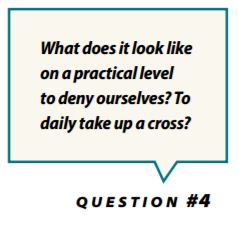
What does it mean to deny ourselves and take up our cross daily?
Why is the new path of discipleship (following Jesus, being a Christian) different? It’s because we have been changed. We now follow Jesus, and the new longings in our heart are to do His will, not our own.
Don’t be frightened. God is not standing there with a scowl on His face, arms folded, with a whole new list of things we can do and things we can’t do. Remember Psalm 16:11 “You make known to me the path of life; in your presence there is fullness of joy; at your right hand are pleasures forevermore”. The path of discipleship is the path of joy, but it is also a path that is different. Because Jesus is different.
Let’s begin with what Jesus didn’t mean. Many people interpret “cross” as some burden they must carry in their lives: a strained relationship, a thankless job, a physical illness. With self-pitying pride, they say, “That’s my cross I have to carry.” Such an interpretation is not what Jesus meant when He said, “Take up your cross and follow Me.”
When Jesus carried His cross up Golgotha to be crucified, no one was thinking of the cross as symbolic of a burden to carry. To a person in the first-century, the cross meant one thing and one thing only: death by the most painful and humiliating means human beings could develop.
Two thousand years later, Christians view the cross as a cherished symbol of atonement, forgiveness, grace, and love. But in Jesus’ day, the cross represented nothing but torturous death. Because the Romans forced convicted criminals to carry their own crosses to the place of crucifixion, bearing a cross meant carrying their own execution device while facing ridicule along the way to death.
Therefore, “Take up your cross and follow Me” means being willing to die in order to follow Jesus. This is called “dying to self.” It’s a call to absolute surrender. After each time Jesus commanded cross bearing, He said, “For whoever wants to save his life will lose it, but whoever loses his life for me will save it. What good is it for a man to gain the whole world, and yet lose or forfeit his very self?” (Luke 9:24-25). Although the call is tough, the reward is matchless.
Wherever Jesus went, He drew crowds. Although these multitudes often followed Him as Messiah, their view of who the Messiah really was—and what He would do—was distorted. They thought the Christ would usher in the restored kingdom. They believed He would free them from the oppressive rule of their Roman occupiers. Even Christ’s own inner circle of disciples thought the kingdom was coming soon (Luke 19:11). When Jesus began teaching that He was going to die at the hands of the Jewish leaders and their Gentile overlords (Luke 9:22), His popularity sank. Many of the shocked followers rejected Him. Truly, they were not able to put to death their own ideas, plans, and desires, and exchange them for His. Following Jesus is easy when life runs smoothly; our true commitment to Him is revealed during trials. Jesus assured us that trials will come to His followers (John 16:33). Discipleship demands sacrifice, and Jesus never hid that cost.
In Luke 9:57-62, three people seemed willing to follow Jesus. When Jesus questioned them further, their commitment was half-hearted at best. They failed to count the cost of following Him. None was willing to take up his cross and crucify upon it his own interests. Therefore, Jesus appeared to dissuade them. How different from the typical Gospel presentation! How many people would respond to an altar call that went, “Come follow Jesus, and you may face the loss of friends, family, reputation, career, and possibly even your life”? The number of false converts would likely decrease! Such a call is what Jesus meant when He said, “Take up your cross and follow Me.” If you wonder if you are ready to take up your cross, consider these questions:
• Are you willing to follow Jesus if it means losing some of your closest friends?
• Are you willing to follow Jesus if it means alienation from your family?
• Are you willing to follow Jesus if it means the loss of your reputation?
• Are you willing to follow Jesus if it means losing your job?
• Are you willing to follow Jesus if it means losing your life?
In some places of the world, these consequences are reality. But notice the questions are phrased, “Are you willing?” Following Jesus doesn’t necessarily mean all these things will happen to you, but are you willing to take up your cross? If there comes a point in your life where you are faced with a choice—Jesus or the comforts of this life—which will you choose?
Commitment to Christ means taking up your cross daily, giving up your hopes, dreams, possessions, even your very life if need be for the cause of Christ. Only if you willingly take up your cross may you be called His disciple (Luke 14:27). The reward is worth the price. Jesus followed His call of death to self (“Take up your cross and follow Me”) with the gift of life in Christ: “For whoever wants to save his life will lose it, but whoever loses his life for me will find it” (Matthew 16:25-26).
Story: When Cortez landed at Vera Cruz in 1519 to begin his dramatic conquest of Mexico with a pocketsize force of 700 men, he purposely set fire to his fleet of eleven ships. His men on the shore watched their only means of retreat sinking to the bottom of the Gulf of Mexico. With no means of retreat, there was only one direction in which to move, forward into the Mexican interior to meet whatever might come their way.
This is what Jesus asks: Move forward committed to Him, no turning back. What old ways of retreat or going back do you need to set fire to?
Who are you? That’s an interesting question. An important question. But you’ll never find the best answer without understanding that your identity is directly tied to Christ…is it?
Hope to see you on Sunday!
In His Love,
David & Susan

Luke 9:21-22
21 But he strictly warned and instructed them to tell this to no one, 22 saying, “It is necessary that the Son of Man suffer many things and be rejected by the elders, chief priests, and scribes, be killed, and be raised the third day.”
Peter correctly identified Jesus. Yet, it is surprising what Jesus told Peter and the other disciples to do with that information. He told them not to tell anyone.

What? Aren’t we called to proclaim Jesus as the Messiah? Yes, and later Jesus gave these same disciples the commission to be His witnesses—to tell anyone and everyone about Jesus (see Acts 1:8). At this particular moment in time, though, Jesus didn’t need the full truth about Himself announced.
Jesus had a precise appointment with death, and He would not die a moment too soon. The word Messiah had become a term that was full of political significance. Many would-be revolutionaries saw themselves as “messiahs.” While many eagerly awaited the Messiah, others saw the “Christ” title as a threat. So, if the disciples went around declaring this new information about Jesus, the political expectations or fears of people would have limited His ability to travel freely and preach the good news of God (see Mark 1:14).
Although it was not yet time to publicly proclaim Jesus as the Christ, it was important for the disciples to know the truth. Since they acknowledged their full awareness of who Jesus was, He told them, “The Son of Man suffer many things and be rejected by the elders, chief priests, and scribes, be killed, and be raised the third day.”
At that point, the disciples probably believed, as most Jews did, that the Messiah would be a political leader who would free them from the oppressive rule of Rome in some type of military victory. The disciples likely were crushed to hear that Jesus would not lead them to military victory, but instead He would suffer and die.


Any political leader might expect opposition and death, but Jesus didn’t expect just to die; He told them He would be raised again. He told them before it happened so they would not be surprised, as if the work and ministry of Jesus had all been a mistake and for nothing. It was all part of God’s plan that Jesus would die—but He would also rise again! (See Acts 2:23-24.)
As hard as this may have been for the disciples to hear, Jesus was about to add a shocking challenge: He was not the only one that must die!
Luke 9:23-26
23 Then he said to them all, “If anyone wants to follow after me, let him deny himself, take up his cross daily, and follow me. 24 For whoever wants to save his life will lose it, but whoever loses his life because of me will save it. 25 For what does it benefit someone if he gains the whole world, and yet loses or forfeits himself? 26 For whoever is ashamed of me and my words, the Son of Man will be ashamed of him when he comes in his glory and that of the Father and the holy angels.
Just as the apostles began to catch their breath after hearing the news of Jesus’ divine appointment with death, Jesus told them of their own. Luke 9:23 is one of the most important verses for any follower of Jesus.
We will never understand who we are until we understand what this verse means for our lives.
If we want to call ourselves followers of Christ, we must say yes to Jesus, which means we must also say no to ourselves. We must pick up our cross and die to self—daily. Every day, we must say no to our desires, our wishes, and our dreams, and we must say yes to Christ’s lordship over our lives.
All of this is extremely difficult in our culture. Why? Because we live in a world that caters to self. By the world’s standard, everybody is in it for themselves—and everyone is drowning!
- Drowning in broken relationships because he demands everything be centered on him.
- Drowning in debt because she has to have it all.
- Drowning in illness and disease because they have to eat or experience it all.
How many times have you seen people work at jobs they hate to buy stuff they don’t need so they can impress people they don’t even like? How many times have you been in that cycle yourself?

Jesus calls us to be different.
Jesus calls us to make a decision about Him. But it can’t be a private decision. Nobody can be a Christian and keep his or her faith completely private. Jesus wants His followers to be loyal to Him, to die to self, and to publicly proclaim their faith in Him: “For whoever is ashamed of me and my words, the Son of Man will be ashamed of him when he comes in his glory and that of the Father and the holy angels.”
We must understand who Jesus is so that we can understand who we are. Our identities are built on the foundation of His identity. Once we’ve made that connection, our decision to follow Jesus— and to follow Him daily—changes everything else.

LIVE IT OUT
Jesus is the Christ, the Son of God. How will you respond to that truth in the days to come? Consider these suggestions.
- Research. Take some time to read through your church’s statement of faith. (You can start with the church website, or with a staff member.) What are some specific truths that statement teaches about Jesus?
- Surrender. Saying yes to Jesus as Lord means saying no to yourself. Do a self-examination and surrender any areas of selfishness to Him.
- Share. We are called to tell everyone who Jesus is. Think of someone you know who needs Jesus. Pray as a group for this person to come to know Jesus, and pray about your part in that process: sharing your testimony, inviting him or her to church, answering questions, and so on.
Who are you? That’s an interesting question. An important question. But you’ll never find the best answer without understanding that your identity is directly tied to Christ.
Teacher Notes

The comedian Don Rickles died on April 6 at the age of 90. He was often described as an insult comic. Rickles would always answer the question of who you are with humor allowing you, just for a moment, to laugh at yourself always in fun.
Video: Don Rickles’ Roast Bob Hope
Click Here to Watch
Sometimes when we let others define our identity it can get out of control. There is a Netflicks Series on called “13 Reasons Why” taken from the 2007 young adult novel written by Jay Asher. The show revolves around a student struggling with her identity and she ends up committing suicide because of 13 people in school that labeled her, bullied her and/or did nothing to stop it. It’s a pretty compelling watch – my son/wife believe it should be required viewing among high school. My reaction to this series was, “If a student can just survive high school.”

We all have our own personal stories of coming to terms with, who we are.
In our next six lessons, we’ll see what God says about who we are and who we can be … in Christ. This is key – our identity “in Christ” alters our identity in everything else. It all starts with Christ.
So, in Luke 9 - records Jesus’ commissioning of the Twelve disciples (see vv. 1-6). The disciples traveled from village to village ministering in Jesus’ name. Jesus then miraculously fed over 5,000 people with five loaves of bread and two fish (see vv. 12-17). These events brought more and more attention to Jesus as He carried out His public ministry. About midway through His earthly ministry, Jesus gathered His disciples to discuss His identity and its implications for their lives.
Luke 9:18-22
18 While he was praying in private and his disciples were with him, he asked them, “Who do the crowds say that I am?” 19 They answered, “John the Baptist; others, Elijah; still others, that one of the ancient prophets has come back.” 20 “But you,” he asked them, “who do you say that I am?” Peter answered, “God’s Messiah.” 21 But he strictly warned and instructed them to tell this to no one, 22 saying, “It is necessary that the Son of Man suffer many things and be rejected by the elders, chief priests, and scribes, be killed, and be raised the third day.”
What truly affects our identity is how we see Jesus. Jesus asked His disciples, “Who do you say that I am?”
If someone were to ask you who Jesus is, what would you say to them?

Savior, God's Son, God in the flesh, Counselor, Friend, Redeemer, Lord
Why is Jesus’ true identity so important to us as believers?
- How these men saw Jesus changed their lives because it changed how they saw themselves.
How we see Jesus shapes how we define ourselves.

Co-worker, grandparent, employer, counselor, teacher
Luke 9:23-26
23 Then he said to them all, “If anyone wants to follow after me, let him deny himself, take up his cross daily, and follow me. 24 For whoever wants to save his life will lose it, but whoever loses his life because of me will save it. 25 For what does it benefit someone if he gains the whole world, and yet loses or forfeits himself? 26 For whoever is ashamed of me and my words, the Son of Man will be ashamed of him when he comes in his glory and that of the Father and the holy angels.
Luke 9:23 is one of the most important verses for any follower of Jesus.
- While watching a football game on television have you ever noticed someone holding a sign that reads “John 3:16”? It’s one of the most memorized verses in the Bible. It communicates a great truth. In that one verse we learn that God loves us, Jesus died for us, and we can have eternal life through Him. I’ve never seen someone holding up a sign that reads “Luke 9:23.” Luke 9:23 also records Jesus’ words. I can understand why no one would paint that verse on a sign and hold it up for all to see. It doesn’t make a very appealing advertisement for Christianity. In fact, it might make it difficult to recruit new Christians. But the truth is that John 3:16 and Luke 9:23 go together in order for there to be an accurate understanding of the gospel’s invitation. John 3:16 emphasizes believing. Luke 9:23 focuses on following. Those two things are necessary and must go together. There is no believing without following.

We will never understand who we are until we understand what this verse means for our lives.
So, Jesus says that if we choose to follow Him it will require two radical other choices: deny self and take up your cross.

What does it mean to deny ourselves and take up our cross daily?
- We must say yes to Jesus, and no to ourselves. We must pick up our cross and die to self—daily. Every day, we must say no to our desires, our wishes, and our dreams, and we must say yes to Christ’s lordship over our lives. Jesus challenged His followers to lives of self-denial in which they laid aside their personal agendas to submit to His agenda.
- A surrendered life. Jesus made it clear that if we are to follow Him, a casual no-strings-attached arrangement isn’t a possibility. You can’t “come with” Jesus without denying yourself. It means to forget that one exists or to cease to consider one’s own interests in the slightest degree. Followers denying themselves say, “I choose Jesus over my family, money, career, freedom, and what people think of me.”
- A committed walk. The cross was an instrument of torture and death. When Jesus said “take up his cross” it would translate in today’s vernacular as “take up his electric chair” or “take up his lethal injection.” He was saying “Come and die.” As Dietrich Bonhoeffer put it, “When Christ calls a man, He bids him come and die.” To carry a cross meant certain death. Jesus took the most despised and rejected symbol of His time and said, “If you want to follow Me, take this up.” He invites us to die.
- What Jesus was telling them is that they needed to put to death their own plans and desires, and then turn their lives over to Him and do His will every day. You see, Jesus doesn’t simply call us to believe that He existed, or even to believe that He can save us. He calls on us to commit our whole lives to Him—to trust Him alone for our salvation, and then to follow Him as His disciples. He said, “Anyone who does not carry his cross and follow me cannot be my disciple” (Luke 14:27).
- If anyone, man or woman, wants to follow Jesus, to be his disciple (be a “Christian” we tend to say), then he must do two things. He must “deny himself” and “take up his cross.” When Luke tells this same story, he clarifies that we are to take up our cross “daily” (Luke 9:23). What does this mean? The answer to this question shows why the path is so different form the world. To “deny” yourself means to say “No” to yourself and “Yes” to God. Paul is not talking about asceticism — forgoing earthly possessions, not eating certain foods, ignoring the world, etc. To say it differently, the process of denial is “to humbly submit my will to God.” It is to go through life repeating the words that Jesus said the night before He died. When He was praying in the garden, He said to God His Father, “Not My will but Yours be done.” It is what millions of Christians have prayed for centuries when they repeat what we call the “Lord’s Prayer.” “Your will be done, on earth as it is in heaven” (Matthew 6:10). What does it look like to live out this prayer? Someone hurts you. Your natural reaction is to lash back, to get angry. But the path of discipleship is “not my will but Yours.” It is humbly submitting my will to God’s will. Instead of getting angry, we realize that God is calling us to forgive even our enemies. When I am hurt, I am called to submit my will to God’s will and follow his example. This is what it means to “deny” yourself.
- What does it mean to “daily take up your cross”? The cross was a horrid symbol of pain, shame, and death. A person hung on it, naked, until his skeletal structure collapsed and he suffocated to death, without air and with his body drowning itself in its own fluids. Every day we are to live in such a way that it is apparent to everyone that we have died to ourselves, to our selfish ways and ambitions, and live for God. Another translation words the verse: “If any of you wants to be My follower, you must turn from your selfish ways, take up your cross, and follow Me” (NLT).
- Something unfair happens and instinctively we want to get even. But we have died to that “right,” we have prayed “not my will but Yours be done.“ Hopefully we humbly submit our will to God’s will, and we respond in kindness and humility. Will you always do this right the first time? Of course not, and that is, in a sense, okay. Life is a journey. God understands that over the years we have created habits of our heart that are not easily broken, and He is patient with us as we learn to walk the new path. Nevertheless, we are called daily to humbly submit our will to His.
Why is the new path of discipleship (following Jesus, being a Christian) different? It’s because we have been changed. We now follow Jesus, and the new longings in our heart are to do His will, not our own.
Don’t be frightened. God is not standing there with a scowl on His face, arms folded, with a whole new list of things we can do and things we can’t do. Remember Psalm 16:11 “You make known to me the path of life; in your presence there is fullness of joy; at your right hand are pleasures forevermore”. The path of discipleship is the path of joy, but it is also a path that is different. Because Jesus is different.
What did Jesus mean when He said, “Take up your cross and follow Me”?
(Matthew 16:24; Mark 8:34; Luke 9:23)
Let’s begin with what Jesus didn’t mean. Many people interpret “cross” as some burden they must carry in their lives: a strained relationship, a thankless job, a physical illness. With self-pitying pride, they say, “That’s my cross I have to carry.” Such an interpretation is not what Jesus meant when He said, “Take up your cross and follow Me.”
When Jesus carried His cross up Golgotha to be crucified, no one was thinking of the cross as symbolic of a burden to carry. To a person in the first-century, the cross meant one thing and one thing only: death by the most painful and humiliating means human beings could develop.
Two thousand years later, Christians view the cross as a cherished symbol of atonement, forgiveness, grace, and love. But in Jesus’ day, the cross represented nothing but torturous death. Because the Romans forced convicted criminals to carry their own crosses to the place of crucifixion, bearing a cross meant carrying their own execution device while facing ridicule along the way to death.
Therefore, “Take up your cross and follow Me” means being willing to die in order to follow Jesus. This is called “dying to self.” It’s a call to absolute surrender. After each time Jesus commanded cross bearing, He said, “For whoever wants to save his life will lose it, but whoever loses his life for me will save it. What good is it for a man to gain the whole world, and yet lose or forfeit his very self?” (Luke 9:24-25). Although the call is tough, the reward is matchless.
Wherever Jesus went, He drew crowds. Although these multitudes often followed Him as Messiah, their view of who the Messiah really was—and what He would do—was distorted. They thought the Christ would usher in the restored kingdom. They believed He would free them from the oppressive rule of their Roman occupiers. Even Christ’s own inner circle of disciples thought the kingdom was coming soon (Luke 19:11). When Jesus began teaching that He was going to die at the hands of the Jewish leaders and their Gentile overlords (Luke 9:22), His popularity sank. Many of the shocked followers rejected Him. Truly, they were not able to put to death their own ideas, plans, and desires, and exchange them for His. Following Jesus is easy when life runs smoothly; our true commitment to Him is revealed during trials. Jesus assured us that trials will come to His followers (John 16:33). Discipleship demands sacrifice, and Jesus never hid that cost.
In Luke 9:57-62, three people seemed willing to follow Jesus. When Jesus questioned them further, their commitment was half-hearted at best. They failed to count the cost of following Him. None was willing to take up his cross and crucify upon it his own interests. Therefore, Jesus appeared to dissuade them. How different from the typical Gospel presentation! How many people would respond to an altar call that went, “Come follow Jesus, and you may face the loss of friends, family, reputation, career, and possibly even your life”? The number of false converts would likely decrease! Such a call is what Jesus meant when He said, “Take up your cross and follow Me.” If you wonder if you are ready to take up your cross, consider these questions:
• Are you willing to follow Jesus if it means losing some of your closest friends?
• Are you willing to follow Jesus if it means alienation from your family?
• Are you willing to follow Jesus if it means the loss of your reputation?
• Are you willing to follow Jesus if it means losing your job?
• Are you willing to follow Jesus if it means losing your life?
In some places of the world, these consequences are reality. But notice the questions are phrased, “Are you willing?” Following Jesus doesn’t necessarily mean all these things will happen to you, but are you willing to take up your cross? If there comes a point in your life where you are faced with a choice—Jesus or the comforts of this life—which will you choose?
Commitment to Christ means taking up your cross daily, giving up your hopes, dreams, possessions, even your very life if need be for the cause of Christ. Only if you willingly take up your cross may you be called His disciple (Luke 14:27). The reward is worth the price. Jesus followed His call of death to self (“Take up your cross and follow Me”) with the gift of life in Christ: “For whoever wants to save his life will lose it, but whoever loses his life for me will find it” (Matthew 16:25-26).
Story: When Cortez landed at Vera Cruz in 1519 to begin his dramatic conquest of Mexico with a pocketsize force of 700 men, he purposely set fire to his fleet of eleven ships. His men on the shore watched their only means of retreat sinking to the bottom of the Gulf of Mexico. With no means of retreat, there was only one direction in which to move, forward into the Mexican interior to meet whatever might come their way.
This is what Jesus asks: Move forward committed to Him, no turning back. What old ways of retreat or going back do you need to set fire to?
Who are you? That’s an interesting question. An important question. But you’ll never find the best answer without understanding that your identity is directly tied to Christ…is it?
Hope to see you on Sunday!
In His Love,
David & Susan


