Our Prayer

Our Prayer

Heavenly Father, I know that I have sinned against You and that my sins separate me from You. I am truly sorry. I now want to turn away from my sinful past and turn to You for forgiveness. Please forgive me, and help me avoid sinning again. I believe that Your Son, Jesus Christ, died for my sins, that He was raised from the dead, is alive, and hears my prayer. I invite Jesus to become my Savior and the Lord of my life, to rule and reign in my heart from this day forward. Please send Your Holy Spirit to help me obey You and to convict me when I sin. I pledge to grow in grace and knowledge of You. My greatest purpose in life is to follow Your example and do Your will for the rest of my life. In Jesus' name I pray, Amen.

Wednesday, May 28, 2025

Class Lesson June 1, 2025

 The Whole Story 


Psalm 23

The Lord Is My Shepherd

A Psalm of David.

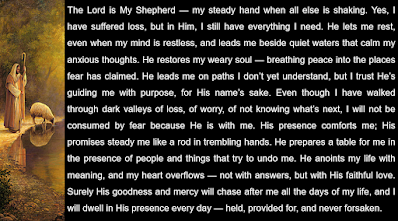
23 The Lord is my shepherd; I shall not want. 2 He makes me lie down in green pastures. He leads me beside still waters. 3 He restores my soul. He leads me in paths of righteousness for his name's sake. 4 Even though I walk through the valley of the shadow of death, I will fear no evil, for you are with me; your rod and your staff, they comfort me. 5 You prepare a table before me in the presence of my enemies; you anoint my head with oil; my cup overflows. 6 Surely goodness and mercy shall follow me all the days of my life, and I shall dwell in the house of the Lord forever.

The Holy Bible, English Standard Version. ESV® Text Edition: 2016. Copyright © 2001 by Crossway Bibles, a publishing ministry of Good News Publishers. Psalm 23


There is no more familiar passage in all scripture than the 23rd Psalm. This passage is a depiction of God’s care, provision, and guidance. As part of the wisdom literature, it reveals how life under God's rule is one of security and peace. This psalm, written by David, presents God as the Shepherd-King who leads His people in righteousness, protects them in danger, and provides for them abundantly. At its heart, Psalm 23 reassures believers that God orders our lives, walking with us through every season and ultimately leading us home to dwell with Him forever.


The psalm opens with a comforting declaration, “The Lord is my shepherd; I shall not want” (v.1). This sets the tone for the entire psalm, illustrating God’s intimate and personal care for His people. Like a shepherd tending his flock, God provides for our every need, ensuring that we lack nothing essential for life and godliness. He leads His people to green pastures and still waters, restoring their souls and guiding them in paths of righteousness (v.2-3). This imagery speaks of both physical provision and the deeper spiritual nourishment found in following God’s ways.

However, life is not without hardship, and Psalm 23 acknowledges this reality. “Even though I walk through the valley of the shadow of death, I will fear no evil, for you are with me” (v.4). This verse highlights the unshakable confidence of those who trust in the Lord. Though trials and suffering come, God’s presence is constant, all the while His rod and staff bring both correction and comfort. His guidance is not just for peaceful pastures but also for dark valleys — He leads through them, not just around them.


The psalm moves from the imagery of a shepherd to that of a gracious host. God prepares a table before His people, even in the presence of their enemies, anointing them with oil and filling their cup to overflowing (v.5). This speaks of divine blessing, honor, and abundance — God does not merely sustain; He lavishes His people with goodness and mercy.

Psalm 23 culminates in the ultimate promise: “I shall dwell in the house of the Lord forever” (v.6). This is the hope of every believer — not just provision for today but an eternal home in the presence of God. Ultimately, Psalm 23 finds its fullest expression in Jesus Christ, the Good Shepherd (John 10:11). He is the one who laid down His life for His sheep, who leads us in righteousness, walks with us through suffering, and secures our eternal dwelling with Him. In Christ, we see the fulfillment of this psalm, as He is both the Shepherd who guides us and the Lamb who was slain for us. Jesus is here, even in Psalm 23.


God is Our Provider / God is Our Shepherd / God is Our Victor


Discussion Questions

What does it mean to you that God is your Shepherd, not just the Shepherd?

In what areas of your life do you need soul restoration right now?

When have you experienced God’s presence in a “valley of the shadow” season?

How does it change your view of suffering to know God prepares a feast in the presence of your enemies?

What do you think it means that God’s goodness and mercy pursue you?


END

Teacher Notes:


Click Play to Watch


Thursday, May 22, 2025

Class Lesson May 25, 2025

 The Whole Story 

Psalm 1

The wisdom literature introduces us to life according to God’s plan. Psalm 1 is the gateway to the book of Psalms, setting the foundation for a life lived under God's rule and blessing. It presents a striking contrast between two ways of life: the way of the righteous, who delight in God’s law, and the way of the wicked, who reject His guidance. This psalm establishes that God orders our lives and reveals how we should walk in His ways, leading to true blessing and stability.

Psalm 1 begins with a portrait of the blessed man — one who avoids the influence of the wicked, sinners, and scoffers but instead one delights in the law of the Lord. This delight is not mere obligation but a deep, meditative engagement with God’s instruction, shaping his heart and mind. The image of a tree planted by streams of water (v.3) illustrates the righteous life: firmly rooted, nourished, and yielding fruit in its season. This reflects the ordered life God desires for His people — one marked by consistency, purpose, and spiritual vitality.

In contrast, the wicked are depicted as chaff (v.4) dry, weightless, and easily scattered by the wind. Unlike the deeply rooted tree, their lives are unstable and fleeting, lacking the firm foundation that comes from obedience to God’s word. Psalm 1 warns that the wicked will not stand in judgment nor belong to the assembly of the righteous (v.5), emphasizing that their path leads to destruction.

At the heart of this psalm is the assurance that God actively watches over and directs the path of the righteous. He does not leave His people to wander aimlessly but orders their steps according to His wisdom. The final verse declares, "For the Lord knows the way of the righteous, but the way of the wicked will perish" (v.6). This highlights God’s intimate involvement in the lives of His people, leading them toward life and security, while allowing those who reject Him to face the consequences of their choices.

Psalm 1 is an invitation to embrace God’s order, to delight in His instruction, and to walk in the way that leads to true flourishing. It calls us to trust that God, in His wisdom, has shown us how to live. In doing so, He establishes our steps and blesses our journey. There is no better example of the blessed man living according to God’s way than Jesus Christ. Psalm 1 ultimately looks forward to Jesus, the way and the life. Jesus is here, even in Psalm 1.


Read Psalm 1 and make observations about the text.


Psalm 1

The Way of the Righteous and the Wicked

1Blessed is the man who walks not in the counsel of the wicked, nor stands in the way of sinners, nor sits in the seat of scoffers; 2 but his delight is in the law of the Lord, and on his law, he meditates day and night. 3 He is like a tree planted by streams of water that yields its fruit in its season, and its leaf does not wither. In all that he does, he prospers. 4 The wicked are not so but are like chaff that the wind drives away. 5 Therefore the wicked will not stand in the judgment, nor sinners in the congregation of the righteous; 6 for the Lord knows the way of the righteous, but the way of the wicked will perish.


The Holy Bible, English Standard Version. ESV® Text Edition: 2016. Copyright © 2001 by Crossway Bibles, a publishing ministry of Good News Publishers. Psalm 1


Discussion Questions:

What does it mean to be “blessed” according to Psalm 1? (v. 1)

In what ways have you experienced the slow drift from walking to sitting with sin? (v. 1)

How would you describe your current relationship with God’s Word — delight, duty, or distant? (v. 2)

What might it look like for your life to be like a tree “planted by streams of water”? (v. 3)

How do verses 4–6 reshape our understanding of success, security, and eternity?


Psalm 1 reminds us that the most important decision we make is not what we do, but where we are planted. One road leads to life and fruitfulness, the other to judgment and emptiness. In Christ, we find the Blessed Man who walked the righteous path perfectly. He invites us to follow Him.


END


Wednesday, May 14, 2025

Class Lesson May 18, 2025

 The Whole Story

Esther brings us to a narrative where God’s name is never explicitly mentioned. However, His sovereign hand is unmistakably present at every turn. This remarkable story unfolds against the backdrop of Persian power, where Jewish people, scattered and vulnerable, face the threat of annihilation. Through the unexpected rise of Esther, an orphaned Jewish girl who becomes queen, and the wise counsel of her cousin Mordecai, God preserves His covenant people. Esther’s courageous decision to risk her life by approaching the king on behalf of her people leads to a dramatic reversal: Haman, the enemy of the Jews, is exposed, and the people who were destined for destruction are rescued instead.

This book shows a God who works subtly, orchestrating events and personalities to fulfill His purposes. He uses unlikely individuals and hidden circumstances to bring about deliverance, showing that no edict from a human throne can thwart His redemptive plan. Esther’s bravery and Mordecai’s faithfulness are models of trust in the unseen God, who remains faithful to His promises, even in a foreign land far removed from the Temple and its sacrifices.

This narrative points us forward to the far greater deliverance accomplished by Jesus Christ. Just as Esther’s courageous intervention saved her people from destruction, Jesus interceded for us at the cost of His own life — rescuing us not merely from earthly threats but from sin and eternal judgment. Where the kingdom of Persia offered temporal decrees that rose and fell with each passing king, Christ’s kingdom is everlasting. The salvation accomplished through Esther invites us to see a grander story in which the unexpected Lamb of God triumphs over sin and death. From Esther to Jesus, we see a pattern: God’s sovereign, sometimes hidden hand directing the affairs of human history to bring about the ultimate rescue of His people, shining the light of eternal hope into the darkest circumstances. Jesus is here, even in a book that never mentions His name.


Now, the book of Esther is a short read so I would encourage you to read the entire book.

These two verses are our focal thoughts:


Esther 4:13-14

13 Then Mordecai told them to reply to Esther, “Do not think to yourself that in the king's palace you will escape any more than all the other Jews. 14 For if you keep silent at this time, relief and deliverance will rise for the Jews from another place, but you and your father's house will perish. And who knows whether you have not come to the kingdom for such a time as this?”

The Holy Bible, English Standard Version. ESV® Text Edition: 2016. Copyright © 2001 by Crossway Bibles, a publishing ministry of Good News Publishers.


Discussion Questions

What stands out to you about Mordecai’s challenge in verses 13–14? How might this apply to your own life and calling?

Have you ever felt God was placing you in a position “for such a time as this”? What made it hard to step up?

Esther called for fasting before acting (v. 16). How do you seek God’s direction before big decisions?


Esther’s willingness to risk her life points us to Jesus. How does Jesus’ greater sacrifice give you courage today?

What might obedience to God look like in your current season — especially if it feels risky or costly?


END


Thursday, May 8, 2025

Class Lesson May 11, 2025

The Whole Story

2 Chronicles 36

2 Chronicles brings us to a sobering conclusion to the era of the Davidic kings. Chapter 36 shows Judah’s final slide into rebellion as one king after another turns away from the Lord’s covenant. Despite generations of warnings through the prophets, the people harden their hearts and refuse to repent. The result is catastrophic: the armies of Babylon tear down Jerusalem’s walls, destroy the Temple, and carry the people into exile. All the promises and hopes that were once bound-up in the Davidic throne now appear lost, scattered in the dust of a ruined city.


These dark pages may tempt us to believe that God has abandoned his people. Yet, the Lord’s steadfast commitment to His covenant people shines through. After seventy years of exile, He moves the heart of a foreign king — Cyrus of Persia — to issue a decree allowing the exiles to return home and rebuild God’s house.

We see God’s plan unfolding through unexpected means within these bleak events. The sin of Judah’s kings and the brokenness of God’s people only heighten our longing for the true and perfect King, who will never fail. 


2 Chronicles 36:14-21

14 All the officers of the priests and the people likewise were exceedingly unfaithful, following all the abominations of the nations. And they polluted the house of the Lord that He had made holy in Jerusalem. 15 The Lord, the God of their fathers, sent persistently to them by His messengers, because He had compassion on His people and on His dwelling place. 16 But they kept mocking the messengers of God, despising His words and scoffing at His prophets, until the wrath of the Lord rose against His people, until there was no remedy. 17 Therefore, He brought up against them the king of the Chaldeans, who killed their young men with the sword in the house of their sanctuary and had no compassion on young man or virgin, old man or aged. He gave them all into his hand. 18 And all the vessels of the house of God, great and small, and the treasures of the house of the Lord, and the treasures of the king and of his princes, all these he brought to Babylon. 19 And they burned the house of God and broke down the wall of Jerusalem and burned all its palaces with fire and destroyed all its precious vessels. 20 He took into exile in Babylon those who had escaped from the sword, and they became servants to him and to his sons until the establishment of the kingdom of Persia, 21 to fulfill the word of the Lord by the mouth of Jeremiah, until the land had enjoyed its Sabbaths. All the days that it lay desolate it kept Sabbath, to fulfill seventy years.

The Holy Bible, English Standard Version. ESV® Text Edition: 2016. Copyright © 2001 by Crossway Bibles, a publishing ministry of Good News Publishers. 2 Chronicles’ 36:14-21


Here, we are reminded that earthly kings and kingdoms, even those begun by God’s hand, can never fully achieve what only the divine Son of David can accomplish. The tragedy of 2 Chronicles 36 points to the day God Himself would come in the flesh. The covenant is upheld and fulfilled in Jesus Christ, the perfect King of kings. Where the sons of David fell short, Christ remains faithful. Where human power crumbles into captivity, Christ rises in glorious freedom through His death and resurrection. In the gloom of exile and judgment, God sets the stage for a future far greater than any earthly throne could offer. In Christ alone, the true Temple is raised, a kingdom without end is established, and the hope of a restored creation finds its final answer. Jesus is here, even as the people are led away into captivity.


Discussion Questions

Why do you think Zedekiah refused to humble himself before Jeremiah, even after multiple warnings? 

How have you seen the danger of hearing God's Word without responding to it in your own life or in others? 

What does it mean to “pollute the house of the Lord” today? How does our sin impact the church community? 

What stood out to you about the phrase, “there was no remedy”? How does this shape how we think about grace and repentance?

Where in your life is God showing patience right now — and how can you respond to His Word before correction becomes necessary?


END

Teacher Notes:


Click Play to Watch


2 Chronicles 36:11-13

Zedekiah was twenty-one years old when he began to reign, and he reigned eleven years in Jerusalem. He did what was evil in the sight of the Lord his God. He did not humble himself before Jeremiah the prophet, who spoke from the mouth of the Lord. He also rebelled against King Nebuchadnezzar, who had made him swear by God. He stiffened his neck and hardened his heart against turning to the Lord, the God of Israel.


2 Chronicles 36:14-16

All the officers of the priests and the people likewise were exceedingly unfaithful, following all the abominations of the nations. And they polluted the house of the Lord that He had made holy in Jerusalem.  The Lord, the God of their fathers, sent persistently to them by His messengers, because He had compassion on His people and on His dwelling place. But they kept mocking the messengers of God, despising His words and scoffing at His prophets, until the wrath of the Lord rose against His people, until there was no remedy. 


2 Chronicles 36:14

they polluted the house of the Lord that He had made holy in Jerusalem. 


2 Chronicles 36:17-20

Therefore, He brought up against them the king of the Chaldeans, who killed their young men with the sword in the house of their sanctuary and had no compassion on young man or virgin, old man or aged. He gave them all into his hand. And all the vessels of the house of God, great and small, and the treasures of the house of the Lord, and the treasures of the king and of his princes, all these he brought to Babylon. And they burned the house of God and broke down the wall of Jerusalem and burned all its palaces with fire and destroyed all its precious vessels. He took into exile in Babylon those who had escaped from the sword, and they became servants to him and to his sons until the establishment of the kingdom of Persia,