Our Prayer

Our Prayer

Heavenly Father, I know that I have sinned against You and that my sins separate me from You. I am truly sorry. I now want to turn away from my sinful past and turn to You for forgiveness. Please forgive me, and help me avoid sinning again. I believe that Your Son, Jesus Christ, died for my sins, that He was raised from the dead, is alive, and hears my prayer. I invite Jesus to become my Savior and the Lord of my life, to rule and reign in my heart from this day forward. Please send Your Holy Spirit to help me obey You and to convict me when I sin. I pledge to grow in grace and knowledge of You. My greatest purpose in life is to follow Your example and do Your will for the rest of my life. In Jesus' name I pray, Amen.

Wednesday, March 21, 2018

Class Lesson March 25, 2018


THE BIBLE MEETS LIFE 


The United States flag represents a lot of things to its citizens: freedom, democracy, justice, and home. Seeing the flag unfurled inspires a feeling of patriotism in many of us. For so many who served in the military or who lost a family member in war, the flag reminds them of courage and sacrifice. 

For American citizens abroad needing assistance, the American flag also represents protection. When an American citizen steps onto the grounds of the U.S. embassy, the stars and stripes remind them they are now under the protection of the United States. 

We face times when life throws us such a curve that we can feel alone and exposed—even when we’re surrounded by others. In those moments, we feel vulnerable and under attack. In one moment of Israel’s history, they too were vulnerable and under attack. But God Himself showed that He was on their side; He was their Banner, standing over them with His sovereign protection. We are not alone. We stand under another flag, a banner of protection: God Himself. He stands over every issue we face. God covers us with His protection.


WHAT DOES THE BIBLE SAY? 


Exodus 17:8-10 

8 At Rephidim, Amalek came and fought against Israel. 9 Moses said to Joshua, “Select some men for us and go fight against Amalek. Tomorrow I will stand on the hilltop with God’s staff in my hand.” 10 Joshua did as Moses had told him, and fought against Amalek, while Moses, Aaron, and Hur went up to the top of the hill. 

The Israelites were now camped at Rephidim, and again the people had no water to drink. (See Ex. 17:1.) Unfortunately, the people responded in their usual way: they grumbled. Although they were testing God, the Lord provided water by instructing Moses to strike the rock with his staff. As when the people had complained about an earlier water problem (see Ex. 15:22-27), God miraculously provided this time too. 

The Israelites were about to face a new—and perhaps greater—challenge to their faith. Thirst was the least of their worries because the Amalekites confronted them at Rephidim. The Israelites and the Amalekites had been enemies for generations. The Amalekites were the descendants of Amalek, a grandson of Esau. (See Gen. 36:12.) Even though they were direct descendants of Isaac, they became enemies of Israel, a constant threat to their spiritual and national life. Forty years after the events in Exodus 17, Moses still described the Amalekites as people who “did not fear God” (Deut. 25:18). 

It was obvious how the Amalekites’ viewed God because they attacked His people all along the way after they left Egypt. Clearly, however, God was with the Israelites. He had performed miracle after miracle in His work of delivering the people from slavery. God’s hand was on the Israelites, but the Amalekites didn’t care. They still attacked. 

Thankfully, we are not left on our own in our struggles and battles. As we will see in the next few verses, the Israelites were not alone—and neither are we.


What daily challenges can make us feel 
like we’re in a battle?


Exodus 17:11-13 

11 While Moses held up his hand, Israel prevailed, but whenever he put his hand down, Amalek prevailed. 12 When Moses’s hands grew heavy, they took a stone and put it under him, and he sat down on it. Then Aaron and Hur supported his hands, one on one side and one on the other so that his hands remained steady until the sun went down. 13 So Joshua defeated Amalek and his army with the sword. 

The battle plan to defeat the Amalekites may seem a bit unorthodox but it was certainly effective. Moses commissioned Joshua to select men to join him in battle as they confronted the enemy. While Joshua was leading the troops, Moses, Aaron, and Hur stood on the top of a nearby hill. Moses had God’s staff in his hand. 

Nothing indicates any fear or confusion, which might have been expected, among the Israelites as they faced Amalek. These were wandering people, ill-equipped for battle, yet as long as Moses held up the staff Israel prevailed. But when his arms grew tired and he let his hand down, Amalek had the upper hand. Ultimately, Aaron and Hur supported Moses’ hands “so that his hands remained steady until the sun went down.” As a result, “Joshua defeated Amalek and his army with the sword.” 

What made the difference? It was not simply Moses’ visible presence and dramatic posture on the hilltop with his hand in the air that inspired confidence in his troops; it was that he was holding up God’s staff. Though this staff was likely nothing more than a shepherd’s staff, God used it as an object lesson to show all Israel His power to accomplish His work. 

This staff became a visible sign that God was with Moses. This simple staff became the staff of God that Moses used to bring various plagues, part the Red Sea (see 14:15-16), and strike the rock to provide water for the thirsty Israelites. (See 17:5-6.) 


How can we maintain our reliance 
on 
God’s power when the battle is long?


The staff in Moses’ hand was an ordinary implement any shepherd would carry. It had nothing magical about it and no inherent power in it. It was simply a sign of God’s presence and power to accomplish His work among His people. Israel prevailed in battle when Moses’ hand lifted up the presence of God for all to see. We also prevail in our spiritual battles when God’s presence and power are in our lives. It is critical to note that, before we put on the spiritual armor (see Eph. 6:10-18), we are given clear instruction about the source of our strength. “Finally, be strengthened by the Lord and by His vast strength” (v. 10). 

We must never underestimate the craft and cunning of our spiritual adversary nor overestimate our own strength. We cannot win spiritual battles in our own strength. We can walk in victory over sin only when we stand under God’s banner of protection and put on the spiritual armor He has provided.


Exodus 17:14-16 

14 The Lord then said to Moses, “Write this down on a scroll as a reminder and recite it to Joshua: I will completely blot out the memory of Amalek under heaven.” 15 And Moses built an altar and named it, “The Lord Is My Banner.” 16 He said, “Indeed, my hand is lifted up toward the Lord’s throne. The Lord will be at war with Amalek from generation to generation.”


What does God’s banner of protection 
look like in your life?


After the victory, God’s first command was for Moses to write and recite to Joshua His declaration: “I will completely blot out the memory of Amalek under heaven.” The Israelites would have other encounters with the Amalekites, whose atrocities were such that God later commanded King Saul to completely annihilate them. Unfortunately, Saul was disobedient. (See 1 Sam. 15:2-9.) The Amalekites were not completely defeated until the eighth century BC, in the days of Hezekiah. (See 1 Chron. 4:41-43.) 

In response to God’s work, Moses built an altar and called it “The LORD Is My Banner.” God had shown Israel yet another aspect of His character. Israel had already discovered that God was their healer (Jehovah Rapha). Now they understood He was also their banner of protection—their Jehovah Nissi. 

The staff or banner in Moses’ hand was a visible image of the protection and the power of God, who provided the victory over Amalek. The Israelites were to understand that their victory was because God was a banner over them. He was their protection. 

One of the most famous banners in the Old Testament also appeared while the Israelites were in the wilderness. Once again, the people grumbled about the lack of bread and water. “Then the LORD sent poisonous snakes among the people, and they bit” many of them so that they died (Num. 21:5-6). They confessed to Moses their sin against the Lord, and he interceded for them before God. 

“Then the LORD said to Moses, ‘Make a snake image and mount it on a pole. When anyone who is bitten looks at it, he will recover.’ So Moses made a bronze snake and mounted it on a pole” (Num. 21:8-9). 

Jesus referred to the banner in His conversation with Nicodemus about the need to be born again to enter the Kingdom of God. Jesus told him, “Just as Moses lifted up the snake in the wilderness, so the Son of Man must be lifted up, so that everyone who believes in him may have eternal life” (John 3:14-15). 

Jesus is “Our Banner” who provides forgiveness of sin and eternal life. He “covers” us with His protection and victory.


How can our actions and attitudes 
demonstrate 
that we serve the God who protects? 


LIVE IT OUT


How will the truth that Jesus is “Our Banner” make a difference in your life? Consider these suggestions: 

  • Trust. Have you accepted Jesus as your banner of forgiveness? If not, commit your life to Him and trust Him for salvation. 
  • Pray. Specifically pray for individuals this week to experience the presence and protection of Christ in their lives. Pray also that these people would be keenly aware Christ is the One who goes with them. 
  • Be bold. If you’re facing a difficult relationship or assignment from God, step out in trust because Christ goes with you. Rest confidently in His presence and protection. 

As awesome as it is to look up to the flag of the great country in which you live, there is something even better when you trust in Christ. You can live a victorious Christian life as you stand under Jehovah Nissi, God Our Banner. 

__________________________________

__________________________________

__________________________________


Teacher's Notes


Click Here to Watch


Video: The Star Spangled Banner

The Israelites had been given their freedom, but they soon learned that living in freedom has its challenges. Their faith had been tested as they sought sources of food and water for themselves and their livestock. Repeatedly, the journey was filled with miraculous provision of water (Ex. 15:22-27), quail (16:1-20), manna (16:21-36), and more water (17:1-7). God provided all of this despite their complaining. Sadly, the Israelites were slow learners, for the pattern would continue often: a need would surface; the people would complain; and God met the need. However, the challenge described in these verses broke the pattern. There was a threat to their safety and well-being. Men, who weeks earlier had been slaves, were now warriors fighting for their lives. But they too, had a flag—a banner—they rallied around. 

Let’s read Exodus 17:8-13

“At Rephidim, Amalek came and fought against Israel. 9 Moses said to Joshua, “Select some men for us and go fight against Amalek. Tomorrow I will stand on the hilltop with God’s staff in my hand. So, Joshua fought the Amalekites as Moses had ordered, and Moses, Aaron and Hur went to the top of the hill. As long as Moses held up his hands, the Israelites were winning, but whenever he lowered his hands, the Amalekites were winning. When Moses’ hands grew tired, they took a stone and put it under him and he sat on it. Aaron and Hur held his hands up—one on one side, one on the other—so that his hands remained steady till sunset. So, Joshua overcame the Amalekite army with the sword.” 


So, what was their flag? 

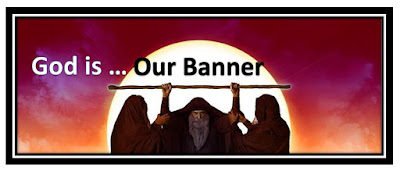
It was the staff Moses held up for all to see. The staff was a symbol of God’s presence with Moses—and thus with the people. Moses held up this “banner” to rally the Israelites and remind them that God was with them.


How does life make us feel like we’re in a battle?

We face times when life throws us such a curve that we can feel alone and exposed—even when we’re surrounded by others. In those moments, we feel vulnerable and under attack. In one moment of Israel’s history, they too were vulnerable and under attack. 


The first message to us this morning is that…


I. We Can Stand Against Those Who Seek to Harm Us
Our lesson points out that even those who are faithful to the Lord and follow His way can expect to encounter opposition. It goes on to say that God expects His people to stand against evil and those who would hinder the people of God. God uses different people with different skills to make different contributions to His work. He can use the most ordinary people or simple objects for His purpose. While God expects His people to engage in the fight against evil, He promises to be present with them and to empower them. God showed that He was on their side; He was their Banner, standing over them with His sovereign protection. We are not alone. We stand under another flag, a banner of protection: God Himself. He stands over every issue we face. God covers us with His protection.


How do you maintain a reliance on God’s power when the struggle of life is long?

Billy Graham recently went home to heaven at the age of 99. Considered by many to be the most influential religious figure of the 20th century, Graham advised twelve sitting presidents, preached in person to more than 100 million people, and almost 3 million people responded to his message to accept Jesus. Below are some of Billy Graham’s memorable words. 
  • “My home is in Heaven. I’m just traveling through this world.”
  • “Being a Christian is more than just an instantaneous conversion – it is a daily process whereby you grow to be more and more like Christ.”
  • “I’ve read the last page of the bible. It’s all going to turn out alright.”

II. We Prevail in Spiritual Battle Because of God’s Presence and Power in Our Lives
Our lesson says this morning, that God will help His people in dire situations when they rely on Him. We can count on God to be present to help us in situations so dire that seemingly they cannot be overcome. Our well-being and success depends entirely on God, but He does work through His chosen instruments. God’s people will prevail and His enemies will be overcome and overwhelmed by His judgment.


Someone read Exodus 17:14-16 

14 The Lord then said to Moses, “Write this down on a scroll as a reminder and recite it to Joshua: I will completely blot out the memory of Amalek under heaven.” 15 And Moses built an altar and named it, “The Lord Is My Banner.” 16 He said, “Indeed, my hand is lifted up toward the Lord’s throne. The Lord will be at war with Amalek from generation to generation.”


Why was it important for Israel to remember what God had done on their behalf?

In our modern culture, we probably don’t think of a banner as something that protects us from harm. What does God’s banner of protection look like in your life? Is there an object you rely on to protect you that could symbolize how God is your protection?


III. God Is Forever Over Us as Our Banner of Protection
Our lesson this morning wants us to remember all that God has done on our behalf and to worship Him as the mighty God that He is. When the Israelites fought in their first battle as a nation – against the Amalekites – they discovered a new kind of banner: The Lord Himself. As long as He was with them, they were guaranteed victory over their enemies. That’s a flag worth rallying around. In those moments when our circumstances try to drag us down … when we feel attacked …. when we tire of the onslaught of life, remember this flag: the gracious, loving powerful presence of God. “But those who hope in the Lord will renew their strength. They will soar on wings like eagles; they will run and not grow weary, they will walk and not be faint” (Isa. 40:31).


LIVE IT OUT: Just as Moses erected an altar and named it Jehovah Nissi, so we must establish such an altar of worship in our hearts. By so doing, we are declaring to spiritual enemies that the assurance of victory is firmly rooted in the One who is our banner.


Click Here to Watch


As awesome as it is to look up to the flag of the great country in which you live, there is something even better when you trust in Christ. You can live a victorious Christian life as you stand under Jehovah Nissi, God Our Banner. 


"Alright, saddle up and get back in the war."


What is the meaning of Jehovah-Nissi?

Jehovah-Nissi (more properly Yahweh-Nissi) means “the Lord is our banner” in Hebrew. The name Jehovah-Nissi appears only once in the Bible, in Exodus 17:15. Moses, after the children of Israel defeated the Amalekites, built an altar and named it Jehovah-Nissi. The background of the name Jehovah-Nissi involves the Israelites’ wandering in the desert after leaving their bondage in Egypt. Along the way, they were attacked by the Amalekites, a powerful and warlike group of nomads. As the battle commenced, Moses stood on the top of a hill where he could see the armies below him. He held in his hand the “rod of God”—the same rod with which he had struck a rock to bring forth water for the people in the desert (Exodus 17:5–6).

The battle was an unusual one: “As long as Moses held up his hands, the Israelites were winning, but whenever he lowered his hands, the Amalekites were winning” (Exodus 17:11). As Moses’ arms grew weary, they had to be supported by his brother, Aaron, and a man named Hur. At sunset, Israel defeated the Amalekites (verses 12–13). After the battle, Moses built an altar and named it Jehovah-Nissi, “the Lord is my banner.”

The strange way in which the battle was won left no doubt as to who was responsible for the victory. Only as the rod of God was held aloft did the Israelites prevail. The battle was not won by military might or superior battle plans; it was won by the power of God. “The battle is the Lord’s” (1 Samuel 17:47).

The hands and rod of Moses were held up in the same way that soldiers hold up their flags in the time of battle. As these flags bear the insignia of their country, the soldiers are said to fight under that banner. The Israelites fought under the direction of God, Jehovah-Nissi. It was under the Lord’s banner and with His aid they fought, and in His name and strength they conquered.

It is safe to assume that, as Moses held up the rod of God, he was praying for the success of the Israelite troops below him. Moses’ lifting up of the rod can thus be seen as a picture of intercessory prayer. “The prayer of a righteous person is powerful and effective” (James 5:16). Moses’ weariness, evidenced by the lowering of his hands, illustrates the truth that “the spirit is willing, but the flesh is weak” (Mark 14:38). The naming of the altar Jehovah-Nissi is a reminder to believers of every era that we can only be victorious as we honor the name of the Lord and rally to Him as our Banner.


Hope to see you on Sunday! 

In His Love, 

David & Susan 


Wednesday, March 14, 2018

Class Lesson March 18, 2018


THE BIBLE MEETS LIFE 

Works of art like Leonardo da Vinci’s Mona Lisa and The Last Supper are universally recognized as great masterpieces, but most people don’t realize the images we admire are quite different from what da Vinci first painted. Mona Lisa has darkened over time because of the varnishes used on it. Original fine details are now obscured. The Last Supper has deteriorated due to mildew. Early on, well meaning painters attempted to clean it and repaint sections. In the process, they covered up da Vinci’s actual work. Restoration is needed when we want to return to the artist’s original design. 

When left to themselves, objects like art, houses, and old cars lose their luster and even fall apart. And so do we. When left to ourselves, we drift from God’s original plan and design for our lives. We take our eyes off Him. We often complain about Him while forgetting all He has done for us. 

In short, we need restoration and healing. 

In the Book of Exodus, the Israelites lost their focus, yet God showed Himself to be the God who restores. He is the Lord, our Healer.


WHAT DOES THE BIBLE SAY? 


Exodus 14:29-31 

29 But the Israelites had walked through the sea on dry ground, with the waters like a wall to them on their right and their left. 30 That day the Lord saved Israel from the power of the Egyptians, and Israel saw the Egyptians dead on the seashore. 31 When Israel saw the great power that the Lord used against the Egyptians, the people feared the Lord and believed in him and in his servant Moses. 

The parting of the Red Sea was an incredible miracle that sealed God’s rescue of His people from their slavery in Egypt. Not surprisingly, that event holds a prime position as a symbol of God’s salvation in the Old Testament. Isaiah later wrote: “Wasn’t it you who dried up the sea, the waters of the great deep, who made the sea-bed into a road for the redeemed to pass over? And the redeemed of the LORD will return and come to Zion with singing, crowned with unending joy. Joy and gladness will overtake them, and sorrow and sighing will flee” (Isa. 51:10-11). 

The Israelites had seen a clear demonstration of God’s great power. As a result, “the people feared the LORD and believed in him and in his servant Moses.” When they reached the other shore, the Israelites sang a song of celebration praising God for His deliverance. (See Ex. 15:1-18.) The song not only celebrated their present victory over Pharaoh; it also looked forward to their victorious conquest and settlement of the promised land. As we’ll see, however, those songs didn’t last very long. In fact, the Israelites’ rejoicing turned quickly to grumbling when they were confronted with the reality of their freedom from Egypt. 

What was true of the Israelites is often true of us today. Indeed, we often find that a testing of our faith will follow moments of spiritual victory. The question is whether we can still sing of God’s glorious holiness even when we face moments of spiritual drought. 


What have you learned about God 
from firsthand experience?


Exodus 15:22-24 

22 Then Moses led Israel on from the Red Sea, and they went out to the Wilderness of Shur. They journeyed for three days in the wilderness without finding water. 23 They came to Marah, but they could not drink the water at Marah because it was bitter—that is why it was named Marah. 24 The people grumbled to Moses, “What are we going to drink?” 

Only a few days into the journey, the people of Israel began to grumble and complain, frustrated by the lack of water. When the Israelites saw Marah in the distance, they thought it was an oasis and likely believed their problems were solved. But their hope was dashed to pieces when they discovered the wells contained “bitter” (non-potable) water. Many artesian wells are bitter and unpleasant because of mineral salts. This one was not simply unpleasant; it may have been dangerous to their health. 

The Israelites responded the way we typically do when things don’t go our way: they complained. They demanded of Moses, “What are we going to drink?” How quickly a hero can become a scapegoat! 

While their grumbling was aimed explicitly at Moses, it was implicitly directed at God, who had appointed Moses as their leader. Moses made this connection clear when Israel grumbled later about the lack of food: “He has heard the complaints that you are raising against him. Who are we? Your complaints are not against us but against the LORD” (Ex. 16:8). Sadly, God’s people are described as complaining over twelve times during their wilderness wanderings. 

The apostle Paul used the grumbling nature of the Israelites to warn believers in Corinth about such behavior, along with craving evil things, idolatry, immorality, and more. (See 1 Cor. 10:6-11.) We tend to treat grumbling, griping, and complaining as minor issues, hardly worthy of mention since “everyone does it.” Yet Paul treated grumbling as a major offense and insisted it must be avoided. 


How does complaining 
impact our connection with God?


The Israelites’ thirst caused them to forget the deliverance they had recently enjoyed by the power of God. The contrast is striking between the faith they expressed in praise after crossing the Red Sea and the lack of faith when they encountered a challenge just three days into their journey. The matter was one of perspective. Could Israel trust God to work in every circumstance based on His character? 

It’s possible to grumble inwardly without verbalizing it. When we allow struggles and doubts to cause us to blame God for our circumstances, we’re falling into the same pattern of behavior as the Israelites did in the wilderness. When we allow anxiety to rule our lives, we’re focusing on circumstances rather than God’s provision.


Exodus 15:25-27 

25 So he cried out to the Lord, and the Lord showed him a tree. When he threw it into the water, the water became drinkable. The Lord made a statute and ordinance for them at Marah, and he tested them there. 26 He said, “If you will carefully obey the Lord your God, do what is right in his sight, pay attention to his commands, and keep all his statutes, I will not inflict any illnesses on you that I inflicted on the Egyptians. For I am the Lord who heals you.” 27 Then they came to Elim, where there were twelve springs and seventy date palms, and they camped there by the water. 

God once again provided for the Israelites in a miraculous way, showing that He’s not only powerful to deliver His people, but can and will sustain them. In addition, God made “a statute and ordinance for them.” This statute contained a condition, “If you will carefully obey,” which was followed by a promise: “I will not inflict….” The Old Testament contains numerous examples of “if/then” covenants. They demonstrate that God’s blessings flow through the obedience of His children. 


What are some different ways 
God heals and restores His people?


In this case, God’s promise was related specifically to the illnesses that had been “inflicted on the Egyptians.” Surely the Israelites would have connected God’s turning of the Nile to blood (see Ex. 7:14-25) with the undrinkable water at Marah. If Israel would carefully obey the Lord, they would not find the water God provided to be bitter because He is “the LORD who heals you.” This is the name Jehovah Rapha. 

The word Rapha occurs about sixty times in the Old Testament; it always refers to restoring, healing, or curing. It’s frequently used in relation to physical healing, but it also can relate to moral and spiritual healing. At Marah, Jehovah revealed Himself to be the only source of true wholeness. He alone has the power to change the bitter experiences of life into something sweet. 

God mercifully sustained the people at Marah, but there’s more to the story. God led them from Marah “to Elim, where there were twelve springs and seventy date palms, and they camped there by the water.” The numbers seven and twelve (and multiples of those numbers) appear throughout Scripture representing completeness. Elim was a place of completeness—a refuge that pointed to the abundant and healing provision of Jehovah Rapha. 

We should never overlook the most important way Jehovah Rapha heals: through Jesus Christ. “He himself bore our sins in his body on the tree; so that, having died to sins, we might live for righteousness. By his wounds you have been healed” (1 Pet. 2:24). God promises healing for your deepest pains, your disappointments, your past, and your sins. He can turn your bitterness into sweet refreshment. If you’ve been sidetracked at Marah, bitter in soul and spirit, the only way to travel from Marah to Elim is to turn to Jehovah Rapha. Jesus is our Jehovah Rapha—our God who heals! 


How can our actions and attitudes 
demonstrate that we follow the God 
who heals and restores?


LIVE IT OUT


How should we respond when we find ourselves drinking from the bitter wells of Marah? Consider taking one of these steps this week: 

  • Listen. Listen earnestly to the voice of God. What is He trying to teach you in your present circumstances? What have you learned about God from these events? Change your perspective by seeing what God is doing on your behalf. 

  • Obey. Look to see if there are areas of disobedience in your life. Repent and turn from any disobedient actions or attitudes. Turn to the One who desires to heal you. Obedience flows from an accurate understanding of God’s character. 

  • Encourage. Encourage someone you know who is drinking from bitter waters. Point them to Christ who offers healing, hope, and abundance. 

You may not feel like a work of art right now, but the Bible assures each and every one of us that we’ve been created in God’s image. If you want to move away from a place of bitterness, turn to Jehovah Rapha, the God Who Heals.

__________________________________

__________________________________

__________________________________


Teacher's Notes


Ever wondered what the world’s nastiest drink is? 

Click Here to See


If you have the opportunity to go to Atlanta, Georgia, take time to visit The World of Coca-Cola. It’s a well-done interactive museum. The last stop is the “Taste It” exhibit where you can sample the gazillion flavors the company bottles all over the world. Some are quite tasty, some are unusual, and some are … well, there’s Beverly


In the Book of Exodus, the Israelites lost their focus, yet God showed Himself to be the God who restores. He is the Lord, our Healer.


I. When We Complain, We Are Focusing on the Problem and Not on God 

Exodus 15:22-24 

Then Moses led Israel on from the Red Sea, and they went out to the Wilderness of Shur. They journeyed for three days in the wilderness without finding water. They came to Marah, but they could not drink the water at Marah because it was bitter—that is why it was named Marah. The people grumbled to Moses, “What are we going to drink?” 


What are our Marah’s or Beverly’s in life?


But sometimes life hands me bitter things to drink anyway. It happens to all of us.
  • A relationship gone south
  • An ER visit turns into far more than an ER visit
  • A job we don’t like
  • Someone turns on us
  • Loss of income
  • Uncertainty. What’s going to happen now?

In those moments, we can do one of two things:

1. Complain to God.

2. Trust God.

The first one’s easy—and it comes so naturally.


What makes their complaint so surprising?

In Exodus 15, the Israelites were thirsty, but water was in sight. The water, however, was bitter. Who knows, maybe it was a Middle Eastern form of Beverly. In that moment, they chose to complain. What is sadly funny to me in this account is that, just three days earlier, God had miraculously parted the Red Sea and rescued them from the Egyptians. Three days! One of God’s most spectacular miracles and rescues, and they forgot it in less time than it takes for me to get around to taking the trash out.


God Has Worked Powerfully on Our Behalf 

Exodus 14:29-31 

But the Israelites had walked through the sea on dry ground, with the waters like a wall to them on their right and their left. That day the Lord saved Israel from the power of the Egyptians, and Israel saw the Egyptians dead on the seashore. When Israel saw the great power that the Lord used against the Egyptians, the people feared the Lord and believed in him and in his servant Moses. 


God had just brought the Israelites across the Red Sea. The crossing of the Red Sea was an undeniable miracle. The people crossed through the sea, not on mud, but on dry land. Skeptics say such a thing is scientifically impossible. They are correct, and that’s why we call it a miracle! The Israelites saw the dead Egyptians, whose bodies had evidently washed up on the shore. The Egyptians were the most powerful army in the known world, but they were no match for God. They were reminded that God can deliver His people, regardless of the circumstances. The incident renewed people’s faith in God. They “feared the Lord”. The word “fear” carries more the idea of reverence or awe rather than fright. They knew God was capable of keeping His promises. They also believed “His servant Moses”. Moses had proven he was a servant of the true God. The people had complained about him before (Exodus 14:11-12), but now he had their attention – at least for a while.


Why do you think it is so easy to forget God’s blessings?

What was true of the Israelites is often true of us today. Indeed, we often find that a testing of our faith will follow moments of spiritual victory. The question is whether we can still sing of God’s glorious holiness even when we face moments of spiritual drought. The people of Israel were focusing on their circumstances, and as a result they had taken their eyes off God.


What does complaining reveal about our hearts?

Even the redeemed still face times of trial and struggle. During times of trial, we can grumble and complain or we can decide to trust and obey. Our propensity to complain during difficult times reveals something about the condition of our hearts. 


Is complaining a sin?

The apostle Paul used the grumbling nature of the Israelites to warn believers in Corinth about such behavior, along with craving evil things, idolatry, immorality, and more. (See 1 Cor. 10:6-11.) We tend to treat grumbling, griping, and complaining as minor issues, hardly worthy of mention since “everyone does it.” Yet Paul treated grumbling as a major offense and insisted it must be avoided. 

One of the things we learn from Israel’s wilderness wanderings is that complaining is incompatible with our salvation. They were saved from slavery in Egypt and God deemed it unreasonable for them to complain after such a large display of grace. However, we have received much more grace. We have been delivered from slavery to sin, the world, and the devil. We have been given eternal life and the status of children of God. How much more is our complaining a sin in the sight of God? Therefore, God calls us to work out the completion of our salvation without complaining and arguing.

We must understand that complaining is not a little sin; it is a big sin. The writer of Hebrews said this about bitterness, which again was possibly an allusion to the wilderness wanderings of Israel: “See to it that no one misses the grace of God and that no bitter root grows up to cause trouble and defile many” (Hebrews 12:15). Bitterness and complaining is contagious. Not only does it blind us to all the ways God has graced us, but it also spreads to others. It spreads throughout a family, an organization, and a church—limiting and sometimes destroying spiritual growth.

Let us remember the time Israel was at the border of the promised land, and how they sent ten spies to survey the land. Two of them came back with a positive report of God’s faithfulness and how good the land was; while eight of them complained about the giants and the impossibility of taking the land. They then complained about God and Moses and convinced the Israelites not to go into the land (Numbers 13-14). “This task is too great!” they said. This root of bitterness coming from only eight Israelites defiled the whole nation and led to God’s judgment. The Israelites were judged by God and called to wander in the wilderness for forty years while everybody over twenty died for their rebellion.

Many people in the church are in a wandering experience in their spiritual life. They are not progressing; they are not going anywhere. And the reason is because there is a bitter root destroying their harvest and inviting the chastisement of God on their lives. It also might be bringing God’s chastisement on others’ lives as well. Maybe this bitterness is an anger against somebody that harmed them. Maybe it’s simply discontentment with their circumstances or lack of trust in God’s goodness. Whatever it may be, it must be known that this complaining spirit is a very dangerous sin that brings God’s discipline.


We are introduced to Jehovah-Rapha … the Lord who heals.


II. God Responds and Restores When We Call to Him 

Exodus 15:25-27 

So he cried out to the Lord, and the Lord showed him a tree. When he threw it into the water, the water became drinkable. The Lord made a statute and ordinance for them at Marah, and he tested them there. He said, “If you will carefully obey the Lord your God, do what is right in his sight, pay attention to his commands, and keep all his statutes, I will not inflict any illnesses on you that I inflicted on the Egyptians. For I am the Lord who heals you.” Then they came to Elim, where there were twelve springs and seventy date palms, and they camped there by the water. 


How did God heal and restore the water and what should this mean to us?

“Then Moses cried out to the Lord, and the Lord showed him a piece of wood. He threw it into the water, and the water became fit to drink” (Ex. 15:25). That’s it? No spectacular waving of the staff? No miraculous stirring of the water? Just a chunk of wood? There was nothing special about that wood. In fact, it may have been the complete ordinariness of it that made this so miraculous. A piece of wood was God’s way of reminding the people that the power lies with Him. He was with them. He had always been with them. He was with them when the water was bitter. And He was with them now. God then declared, “I am the Lord, who heals you” (v. 26). Healing carries the idea of restoration. Just as God healed—restored—the water, He restored His people. He spared them from all the bitterness the Egyptians faced: He was with them, and He would continue to restore them.


God still works this way. He used another piece of wood to heal and restore us: the cross of Christ.

  • When we’ve made life bitter through our own waywardness and sin, the cross of Christ heals and restores us.
  • When life becomes bitter through no fault of our own, it is still the cross that heals and restores us. We come to the cross with trust in Him. He is with us, He walks with us through the bitterness, and He will restore us.

“’He himself bore our sins’ in his body on the cross, so that we might die to sins and live for righteousness; ‘by his wounds you have been healed'” (1 Pet. 2:24).


Does this promise still apply to us today? We are under a different covenant (Jeremiah 31:31-34). Be that as it may, God still blesses obedience.


We can call on the Lord in difficult situations. By His grace and through His power, the Lord can turn the bitter moments of life into something sweet. The Lord has expectations of His people that prove the validity of our trust in Him. The Lord is our Healer, the only one who can make us whole.


What does it mean that God is Jehovah-Rapha?


Jehovah-Rapha (more properly Yahweh-Rapha) means “The Lord Who Heals” in Hebrew. Jehovah-Rapha is one of the many different names of God found in the Old Testament.

The name Jehovah-Rapha appears in Exodus 15:26. God says to the people of Israel, “If you listen carefully to the Lord your God and do what is right in His eyes, if you pay attention to His commands and keep all His decrees, I will not bring on you any of the diseases I brought on the Egyptians, for I am the Lord, who heals you.”

The context of God’s revelation of His name Jehovah-Rapha is an incident that took place early on in the wilderness wanderings of the Israelites. They had just left Egypt and crossed the Red Sea. Moses took them into the Desert of Shur, where “for three days they traveled in the desert without finding water” (Exodus 15:22). The Lord was testing them and their faith.

The Israelites’ test in the desert was soon amplified. They came across a body of water, but, to their great discontent, they could not drink from it. They called the water Marah, which means “bitter.” Their souls began to turn bitter, as well, and they “grumbled against Moses, saying, ‘What are we to drink?’” (Exodus 15:24). Moses did exactly what he should have done: he prayed to the Lord, and “the Lord showed him a piece of wood” (verse 25). Following God’s instructions, Moses threw the wood into the water, and the water miraculously became fit to drink.

Immediately after the Lord “healed” the waters of Marah, He identified Himself to them as Jehovah-Rapha: “I am the Lord, who heals you” (Exodus 15:26). He doesn’t just heal water; He heals people. The healing of the waters was a demonstration of God’s power to overcome any impurity, contamination, or corruption. This power was going to work on behalf of the Israelites, God’s chosen people, as the Lord brought them to the Promised Land.

Along with giving His name Jehovah-Rapha, God gives the Israelites a promise: “I will not bring on you any of the diseases I brought on the Egyptians” (Exodus 15:26). This is a reference to the ten plagues that God had recently sent upon the Egyptians—plagues including boils, the death of livestock, devastating hail, etc. Like many Old Testament promises to Israel, this one was conditional; God’s people were required to “diligently listen to the voice of the LORD your God, and do that which is right in his eyes, and give ear to his commandments and keep all his statutes” (verse 26, ESV; cf. Deuteronomy 30).

Jehovah-Rapha has the power to heal physically (2 Kings 5:10), emotionally (Psalm 34:18), mentally (Daniel 4:34), and spiritually (Psalm 103:2–3). Neither impurity of body nor impurity of soul can withstand the purifying, healing power of Jehovah-Rapha.

Jesus Christ showed that He was the Great Physician who heals the sick. In Galilee, Jesus went from town to town, “healing every disease and sickness among the people” (Matthew 4:23). In Judea “large crowds followed him, and he healed them there” (Matthew 19:2). In fact, “wherever he went—into villages, towns or countryside—they placed the sick in the marketplaces. They begged him to let them touch even the edge of his cloak, and all who touched it were healed” (Mark 6:56). Not only did Jesus heal people physically, He also healed them spiritually by forgiving their sins (Luke 5:20). Every day, in every way, Jesus proved Himself to be Jehovah-Rapha in the flesh.


Hope to see you on Sunday! 

In His Love, 

David & Susan 


Friday, March 9, 2018

NEW SERIES BEGINS MARCH 11, 2018


"God" is not His only name. 

You are probably known by different names. Those names reflect both your character and your relationships with those around you. For example, people who know me professionally call me Dr. Hemphill, yet others who know me personally call me Ken. My children call me Daddy and my grandkids call me Papa. 

Not surprisingly, God has also been known by many names throughout the centuries. 

The many names of God revealed in Scripture tell us much about His character. Those names invite us to know Him in a growing, intimate relationship. Knowing these names is important for three reasons: 
  • God’s name is inherently great. “LORD, our Lord, how magnificent is your name throughout the earth!” (Ps. 8:1). Understanding the names of God will enable us to praise and worship Him more effectively.                                                                                                          
  • God’s name protects and benefits us. “The name of the LORD is a strong tower” (Prov. 18:10). God’s various names can be a tremendous aid to effective and specific prayer.                                                                                                                                                                                                       
  • We represent God’s name and must bring honor to it. God gave Ten Commandments, and one of those Commandments has to do with His name: “Do not misuse the name of the LORD your God” (Ex. 20: 7). This command means far more than avoiding its use in vulgar or slang expressions. It means the people of God must reflect His name or character in their lives. 

The names of God are a love gift to us. God reveals Himself fully so that we might experience His fullness. As we look at six of those names, we’ll discover truths about the lovely character of our God.


THE BIBLE MEETS LIFE 

We’ve all made decisions to take on a daunting task, but it can be especially difficult when someone else makes that decision for you. The soldier who is “volunteered” for an assignment. The employee who is transferred to a new task or city. The student who is called on by the instructor to show the rest of the class how to solve “x.” In those moments, our minds can be dominated by a single thought: How am I going to do this?

A few years ago, my wife, Paula, and I chose to move closer to our extended families. That might not seem like a hard decision, but things didn’t fall together the way we expected. To make it even more challenging, my wife was diagnosed with cancer in the midst of the transition. We moved ahead, though, choosing to trust God and not our circumstances. We trusted and God provided.


When we look back, we can see God’s hand at work. Our home has given us a quiet retreat—a wonderful healing place for Paula. God provides what we need, when we need it. Abraham knew this too. God truly is our Provider, and Abraham saw God’s provision as he trusted Him during a great test of his faith.


WHAT DOES THE BIBLE SAY? 

Genesis 22:1-2 

1 After these things God tested Abraham and said to him, “Abraham!” “Here I am,” he answered. 2 “Take your son,” he said, “your only son Isaac, whom you love, go to the land of Moriah, and offer him there as a burnt offering on one of the mountains I will tell you about.” 

Abraham is commonly seen as a great example of someone who exercised strong faith. (See Heb. 11:8.) But Abraham’s journey wasn’t always easy. In fact, there were moments when he faltered:

In his fear, Abraham claimed Sarah was not his wife—twice! (See Gen. 12:12-13; 20:1-3.)

In his doubt, Abraham attempted to “help” fulfill God’s promise through having a son by Sarah’s slave Hagar. (See 18:1-3.)

In Genesis 22, Abraham faced his greatest test of faith. Verse 1 begins with an interesting phrase that is easy to overlook: “After these things.” Moses, the writer of Genesis, wanted us to think back over Abraham’s long journey that had led him from Ur of the Chaldeans to this very conversation with God.

God called to Abram when he was 75 years old (see Gen. 12:4), instructing him to leave his land, his relatives, and his father’s house—everything that was familiar and comfortable. In return, God promised to bless Abram by making him into a great nation that would bless all the nations of the earth. (See v. 2.) This was problematic because Abraham had no children and his wife, Sarah, was barren. Even so, “Abram believed the LORD, and he credited it to him as righteousness ” (15:6).

Abraham eventually did have a son, Isaac, although it took 25 years for God’s promise to be fulfilled. (See 21:1-7.) Genesis 22 took place several years after Isaac’s birth.


What’s your initial reaction to these verses?


Given Abraham’s story, God’s command in verse 2 is difficult to understand: “Take your son … your only son Isaac, whom you love, go to the land of Moriah, and offer him there as a burnt offering on one of the mountains I will tell you about.”

Notice God’s detailed description of Isaac: “your son … your only son Isaac, whom you love.” This wasn’t simply “a son” God required of Abraham. It was his only son. It was Isaac, the son whom you love. This son was not only dear to Abraham, he was essential to God’s promises concerning the blessing of the nations—yet he was about to be offered as a sacrifice.


Genesis 22:3-10 

3 So Abraham got up early in the morning, saddled his donkey, and took with him two of his young men and his son Isaac. He split wood for a burnt offering and set out to go to the place God had told him about. 4 On the third day Abraham looked up and saw the place in the distance. 5 Then Abraham said to his young men, “Stay here with the donkey. The boy and I will go over there to worship; then we’ll come back to you.” 6 Abraham took the wood for the burnt offering and laid it on his son Isaac. In his hand he took the fire and the knife, and the two of them walked on together. 7 Then Isaac spoke to his father Abraham and said, “My father.” And he replied, “Here I am, my son.” Isaac said, “The fire and the wood are here, but where is the lamb for the burnt offering?” 8 Abraham answered, “God himself will provide the lamb for the burnt offering, my son.” Then the two of them walked on together. 9 When they arrived at the place that God had told him about, Abraham built the altar there and arranged the wood. He bound his son Isaac and placed him on the altar on top of the wood. 10 Then Abraham reached out and took the knife to slaughter his son. 


How do Abraham’s actions in these verses demonstrate faith?


We can hear Abraham’s faith in his instructions to the young men: “Stay here with the donkey. The boy and I will go over there to worship; then we’ll come back to you” (emphasis added). How could he be so confident? The writer of Hebrews gave us insight into Abraham’s thoughts as he took his son to Mount Moriah: “He considered God to be able even to raise someone from the dead; therefore, he received him back, figuratively speaking” (Heb. 11:19). Abraham was convinced that God, who had already performed one miracle by putting life into a barren womb, could raise Isaac from the dead. In short, Abraham had arrived at a point in his faith journey where he was confident he could trust God with his most valued possession: his only son.

The text gives us no clue as to how much time passed between verses 8 and 9. Having arrived at the place God designated, Abraham built the altar and arranged the wood in preparation for the sacrifice. This work might have taken considerable time, and I’ve often wondered if any additional dialogue passed between Abraham and Isaac. The text is silent. We are only told with utter simplicity that Abraham “bound his son Isaac and placed him on the altar on top of the wood,” and then raised his knife to kill his beloved son.

Just reading the account leaves us nearly breathless. There’s no doubt Abraham was committed to obey the command of God. Yet we should understand that Abraham’s actions were based on his understanding of God’s character. Our circumstances never test the faithfulness of God; they only test our understanding of His character and purpose.


When have you experienced a time of testing?


Genesis 22:11-14 

11 But the angel of the Lord called to him from heaven and said, “Abraham, Abraham!” He replied, “Here I am.” 12 Then he said, “Do not lay a hand on the boy or do anything to him. For now I know that you fear God, since you have not withheld your only son from me.” 13 Abraham looked up and saw a ram caught in the thicket by its horns. So Abraham went and took the ram and offered it as a burnt offering in place of his son. 14 And Abraham named that place The Lord Will Provide, so today it is said: “It will be provided on the Lord’s mountain.” 

This place of divine encounter became sacred for Abraham, and so he called it “The LORD Will Provide.” This is the literal translation of the name Jehovah Jireh. The Hebrew word jireh can be translated “to see.” We may wonder what the connection is between “seeing” and “providing.” We can make the connection with the English noun “provision,” a compound made up of two Latin words which when taken together mean “to see beforehand.” God’s pre-vision leads to His provision. God knew before Abraham ever reached Moriah that he would need a sacrifice; therefore, God personally provided the ram.

This is an amazing picture of salvation. Before the foundation of the world, God had prior vision of man’s sin and rebellion. Seeing our need, He made provision for our redemption by providing a lamb of sacrifice—Jesus, “his one and only Son” (John 3:16).

Notice that it was Abraham’s obedience that unleashed God’s blessings in his life. (See Gen. 22:16-18.) For us as well, obedience is the key to growing faith. James spoke to this issue with great clarity when he compared those who hear God’s Word and refuse to act with those who hear and do act. The latter will be blessed in what they do. (See Jas. 1:23-25.)

If you desire to unleash God’s blessing in your life—if you want to discover that God is your Provider— then obey His Word. Obey immediately and without reservation, and see all that God will provide.

How can our actions and attitudes demonstrate that we serve the God who provides? 


LIVE IT OUT

God will use challenging circumstances to lead us to a deeper understanding of His ability to provide for our needs. How will you apply these truths this week? Consider these suggestions:

  • Identify your Isaac. What circumstance, person, or thing are you having the most difficulty placing in God’s care? Pray this week for the faith necessary to let go.                                                                   
  • Place your Isaac on the altar. Abraham had to first gather the resources necessary to make a sacrifice before he could find God’s provision. Identify concrete steps you can take to place your “Isaac” in God’s care.                                                                                                                                  
  • Look for God’s provision. Write down the ways God provides for you this week. Make known to others the good things God is providing in your life. 


You can experience a breakthrough in your faith walk when you are willing to trust God with those things you hold most precious. Make that decision today and trust Jehovah Jireh, the God Who Provides.

___________________________________

___________________________________

___________________________________


Teacher's Notes


"God" is not His only name. 

You are probably known by different names. Those names reflect both your character and your relationships with those around you. For example, people who know me professionally call me Mr. Ballinger, yet others who know me personally call me David or Dave. My children call me Dad and my grandchild now, will call me Papa. 


God has also been known by many names throughout the centuries.


Jehovah Jireh – The Lord Will Provide / Jehovah Rapha – The Lord Who Heals

Jehovah Nissi – The Lord Is My Banner / Jehovah Shalom – The Lord Is Peace

Jehovah Rohi – The Lord Is My Shepherd / Jehovah Tsidkenu – The Lord Is Our Righteousness


Video: Abraham & Isaac

Our tendency is to live by what we can see. We believe what we can touch. We’re confident when what we need is right in front of us. But life does not always hand us easy answers and quick solutions. A life in Christ is a life of trust – trusting Him to provide what we need even when we don’t readily see the answer. Abraham showed us that God truly is our Provider.


Genesis 22:1-2

1 After these things God tested Abraham and said to him, “Abraham!” “Here I am,” he answered. 2 “Take your son,” he said, “your only son Isaac, whom you love, go to the land of Moriah, and offer him there as a burnt offering on one of the mountains I will tell you about.”


In Genesis 22, Abraham faced his greatest test of faith. Verse 1 begins with an interesting phrase that is easy to overlook: “After these things.” Moses, the writer of Genesis, wanted us to think back over Abraham’s long journey that had led him from Ur of the Chaldeans to this very conversation with God.

  • In his fear, Abraham claimed Sarah was not his wife—twice! (See Gen. 12:12-13; 20:1-3.)
  • In his doubt, Abraham attempted to “help” fulfill God’s promise through having a son by Sarah’s slave Hagar. (See 18:1-3.)

What’s your initial reaction to these verses?

Since God knows what we will do in advance, why did He test Abraham in this way?

When have you been tested to trust that God would provide what you needed when the provision wasn’t apparent?


Why did God command Abraham to sacrifice Isaac?

  • God was testing the level of Abraham’s faith. Genuine faith is connected with obedience (James 2:21-24). Abraham did what God told him to do. 1. “On the third day” – Evidently it was a long journey to the place where God commanded Abraham to make the sacrifice. Abraham told his servants, “We will…come again to you.” He knew God could bring Isaac back from the dead if He so chose (Hebrews 11:17-19). One thing is certain: Abraham knew God was in control.


How did Abraham respond to God’s command to sacrifice Isaac? 

  • With immediate obedience.
  • Obedience led to provision -- the provision of Jehovah Jireh. God did not provide the lamb until Abraham had shown His willingness to be obedient to God regardless of the cost to himself.

Some years ago, James Dobson wrote a book titled When God Doesn’t Make Sense. He talked about things in life that put our faith in God to the test. If your faith has never been tested, chances are you haven’t been a Christian for very long. We still live in a fallen world, and as believers we’re not immune to its unfairness. When tragedy strikes – such as the death of a loved one, or a financial setback, or some other type of injustice – we’re often tempted to ask God, “Why?” If God truly loves us, why does He allow us to experience such heartache? 


We can only imagine what went through Abraham’s mind when God commanded him to offer Isaac as a sacrifice. Hadn’t God promised to bless Isaac’s descendants? How could God bless his descendants if Isaac was going to die so young? This command did not make a bit of sense, but Abraham obeyed it anyway. This episode gives us some important lessons about trusting God in all circumstances.


I. Our Faith Will Often be Tested

God tested Abraham, not to trip him and watch him fall, but to deepen his capacity to obey God and develop his character. Just as fire refines ore to extract precious metals, God refines us through difficult circumstances. Over the years Abraham had learned many tough lessons about the importance of obeying God. Obeying God is often a struggle because it may mean giving up something we truly want. We should not expect our obedience to God to be easy or to come naturally. We may have life experiences that God either orchestrates or allows to test the depth of our faith. Our commitment to God is to exceed anybody or anything that we consider most precious to us.


Identify your Isaac. What circumstance, person, or thing are you having the most difficulty placing in God’s care? Pray this week for the faith necessary to let go.


Genesis 22:3-10

3 So Abraham got up early in the morning, saddled his donkey, and took with him two of his young men and his son Isaac. He split wood for a burnt offering and set out to go to the place God had told him about. 4 On the third day Abraham looked up and saw the place in the distance. 5 Then Abraham said to his young men, “Stay here with the donkey. The boy and I will go over there to worship; then we’ll come back to you.” 6 Abraham took the wood for the burnt offering and laid it on his son Isaac. In his hand he took the fire and the knife, and the two of them walked on together. 7 Then Isaac spoke to his father Abraham and said, “My father.” And he replied, “Here I am, my son.” Isaac said, “The fire and the wood are here, but where is the lamb for the burnt offering?” 8 Abraham answered, “God himself will provide the lamb for the burnt offering, my son.” Then the two of them walked on together. 9 When they arrived at the place that God had told him about, Abraham built the altar there and arranged the wood. He bound his son Isaac and placed him on the altar on top of the wood. 10 Then Abraham reached out and took the knife to slaughter his son.


How do Abraham’s actions in these verses demonstrate faith?


  • We can hear Abraham’s faith in his instructions to the young men: “Stay here with the donkey. The boy and I will go over there to worship; then we’ll come back to you”. How could he be so confident? The writer of Hebrews gave us insight into Abraham’s thoughts as he took his son to Mount Moriah: “He considered God to be able even to raise someone from the dead; therefore, he received him back, figuratively speaking” (Heb. 11:19). Abraham was convinced that God, who had already performed one miracle by putting life into a barren womb, could raise Isaac from the dead. In short, Abraham had arrived at a point in his faith journey where he was confident he could trust God with his most valued possession: his only son.
  • The text gives us no clue as to how much time passed between verses 8 and 9. Having arrived at the place God designated, Abraham built the altar and arranged the wood in preparation for the sacrifice. This work might have taken considerable time, and I’ve often wondered if any additional dialogue passed between Abraham and Isaac. The text is silent. We are only told with utter simplicity that Abraham “bound his son Isaac and placed him on the altar on top of the wood,” and then raised his knife to kill his beloved son.


When have you experienced a time of testing?

An uneasy conversation. As they made their way up the mountain, they had what must have been a very awkward conversation. Isaac asked why they didn’t have a lamb for the sacrifice. Abraham did not give a direct answer but assured his son that God would provide the lamb. Evidently Isaac was satisfied with this reply. It is noteworthy that Isaac carried the firewood, not Abraham. Abraham was an old man when Isaac was born, and Isaac was probably in his teens by this time. Since Abraham could not have put Isaac on the altar by force, Isaac must have really trusted him. Do you trust God in all circumstances? Do your children know that you trust God in all things? During times of financial stress. When tragedy strikes the family. Pastors, do your church members know that you trust God? When things aren’t going well in your ministry. When your church lacks resources. During times of spiritual warfare. 


Why does God test us?

When we ask why God tests us or allows us to be tested, we are admitting that testing does indeed come from Him. When God tests His children, He does a valuable thing. David sought God’s testing, asking Him to examine his heart and mind and see that they were true to Him (Psalm 26:2; 139:23). When Abram was tested by God in the matter of sacrificing Isaac, Abram obeyed (Hebrews 11:17–19) and showed to all the world that he is the father of faith (Romans 4:16). In both the Old and New Testaments, the words translated “test” mean “to prove by trial.” Therefore, when God tests His children, His purpose is to prove that our faith is real. Not that God needs to prove it to Himself since He knows all things, but He is proving to us that our faith is real, that we are truly His children, and that no trial will overcome our faith. The testing or trials we undergo come in various ways. Becoming a Christian will often require us to move out of our comfort zones and into the unknown. Perseverance in testing results in spiritual maturity and completeness. This is why James wrote, “Consider it pure joy, my brothers, whenever you face trials of many kinds” (James 1:2). The testing of faith can come in small ways and daily irritations; they may also be severe afflictions (Isaiah 48:10) and attacks from Satan (Job 2:7). Whatever the source of the testing, it is to our benefit to undergo the trials that God allows.

The account of Job is a perfect example of God’s allowing one of His saints to be tested by the devil. Job bore all his trials patiently and “did not sin by charging God with wrongdoing” (Job 1:22). However, the account of Job’s testing is proof that Satan’s ability to try us is limited by God’s sovereign control. No demon can test or afflict us with beyond what God has ordained. All our trials work toward God’s perfect purpose and our benefit.

There are many examples of the positive results of being tested. The psalmist likens our testing to being refined like silver (Psalm 66:10). Peter speaks of our faith as “of greater worth than gold,” and that’s why we “suffer grief in all kinds of trials” (1 Peter 1:6–7). In testing our faith, God causes us to grow into strong disciples who truly live by faith and not by what we see (2 Corinthians 5:7).

When we experience the storms of life, we should be like the tree that digs its roots ever more deeply for a greater grip in the earth. We must “dig our roots” more deeply into God’s Word and cling to His promises so we can weather whatever storms come against us. Most comforting of all, we know that God will never allow us to be tested beyond what we are able to handle by His power. His grace is sufficient for us, and His power is made perfect in our weakness (2 Corinthians 12:9). “That is why,” Paul said, “for Christ’s sake, I delight in weaknesses, in insults, in hardships, in persecutions, in difficulties. For when I am weak, then I am strong.”


II. Trust God to Provide What We Need

Place your Isaac on the altar. God did not want Isaac to die, but He wanted Abraham to sacrifice Isaac in his heart so it would be clear that Abraham loved God more than he loved his promised and long-awaited son. God was testing Abraham. The purpose of the testing is to strengthen our character and deepen our commitment to God and His perfect timing. Through his obedience, Abraham learned about God’s ability to provide.


Faith in God is to be seen as a serious matter, not an easy path. 

Faith is the readiness to answer God even when we do not completely understand.


Genesis 22:11-14

11 But the angel of the Lord called to him from heaven and said, “Abraham, Abraham!” He replied, “Here I am.” 12 Then he said, “Do not lay a hand on the boy or do anything to him. For now I know that you fear God, since you have not withheld your only son from me.” 13 Abraham looked up and saw a ram caught in the thicket by its horns. So Abraham went and took the ram and offered it as a burnt offering in place of his son. 14 And Abraham named that place The Lord Will Provide, so today it is said: “It will be provided on the Lord’s mountain.”


This place of divine encounter became sacred for Abraham, and so he called it “The LORD Will Provide.” This is the literal translation of the name Jehovah Jireh.

An unexpected conclusion. Abraham was about to go through with it, but God stopped him. God explained that the sacrifice was only a test. His willingness to sacrifice Isaac proved that he wanted to honor God above all things – even his own son. God renewed His promise to Abraham. Abraham saw a ram caught in a nearby thicket. God had provided a lamb for the sacrifice, just as Abraham had said He would. Abraham offered the ram in Isaac’s place. Many people see this sacrifice as a “type” of Jesus. While we must be careful not to read things into Scripture that aren’t there, we can definitely see some parallels! Abraham named the place “Jehovah-jireh”, which means, “the Lord will provide”. Do you trust God to provide for all your needs? This does not mean Christians shouldn’t work to provide for their families (2 Thessalonians 3:10; 1 Timothy 5:8). When we seek God first, we can trust Him to take care of all our other needs (Matthew 6:25-34). He also provides emotional strength to face life’s trials. Do you trust Him enough to obey Him in all things, even when you don’t understand? 


What was the connection between Abraham’s obedience and God’s provision?

  • Notice that it was Abraham’s obedience that unleashed God’s blessings in his life. (See Gen. 22:16-18.) For us as well, obedience is the key to growing faith. James spoke to this issue with great clarity when he compared those who hear God’s Word and refuse to act with those who hear and do act. The latter will be blessed in what they do. (See Jas. 1:23-25.) If you desire to unleash God’s blessing in your life—if you want to discover that God is your Provider— then obey His Word. Obey immediately and without reservation, and see all that God will provide.


How is Jesus the ultimate demonstration of God’s provision for us?


What breakthrough are you trusting God for this week?


III. God Provides


Look for God’s provision. Write down the ways God provides for you this week. Make known to others the good things God is providing in your life. It is difficult to let go of what we deeply love. What could be more proper than to love your only child? Yet when we do give to God what He asks, He returns to us far more than we could dream. 


The God who sometimes tests us always provides for us. 

God meets the needs of everyone who trusts Him.


What does it mean that God is Jehovah-Jireh?


“Jehovah-Jireh” is one of the many different names of God found in the Old Testament. “Jehovah-Jireh” is the KJV’s translation of YHWH-Yireh and means “The LORD Will Provide” (Genesis 22:14). It is the name memorialized by Abraham when God provided the ram to be sacrificed in place of Isaac.

The story begins with a strange command from God to Abraham, instructing him to offer his “son of promise,” Isaac, as a burnt offering. Early the next morning, Abraham packs wood and a knife, and he and Isaac travel to Moriah, the place God had specified. As they near the site, Isaac questions Abraham concerning the intended offering: “Where is the lamb?” With great faith and foresight, Abraham responds, “God himself will provide the lamb for the burnt offering, my son” (Genesis 22:1-8). The New Testament tells us that Abraham believed God would raise Isaac from the dead (Hebrews 11:19). Upon reaching the place God had chosen, Abraham demonstrates his faith and obedience by building an altar, binding Isaac, and placing him on the wood. Before Abraham can finish the offering, the Angel of the Lord calls to him from heaven, and Isaac’s life is spared. Then, “Abraham looked up and there in a thicket he saw a ram caught by its horns. He went over and took the ram and sacrificed it as a burnt offering instead of his son” (Genesis 22:13). Abraham names the place “Jehovah-Jireh” because of God’s gracious provision of a substitute for Isaac. Immediately afterwards, God reconfirms His covenant with Abraham (v 17-18). Centuries later, King Solomon would build the temple in the same location (2 Chronicles 3:1).

The account of Abraham on Mt. Moriah thus becomes more than a dramatic illustration of faith and obedience. It is a presentation of the Lord’s eternal grace, continual provision, and all-encompassing wisdom. Jehovah-Jireh is not “The LORD Did Provide,” but “The LORD Will Provide.” In other words, the name does not simply memorialize a past event; it anticipates a future action.

Likewise, the statement “on the mountain of the LORD it will be provided” (verse 14) refers to more than Mt. Moriah—it also refers to a hill called Calvary, where God “did not spare his own Son, but gave him up for us all” (Romans 8:32). Abraham’s faith-filled statement that “God himself will provide the lamb” is a companion to John the Baptist’s exclamation, “Look, the Lamb of God, who takes away the sin of the world!” (John 1:29). 


Jehovah-Jireh provided a sacrifice to save Isaac, and that action was a foreshadowing of the provision of His Son for the salvation of the world.


Join us this Sunday as we begin this new series, GOD IS ...


Hope to see you!

In His Love,

David & Susan